


Water Hammer. Part 2
Description
This section is from the book "Principles And Practice Of Plumbing", by John Joseph Cosgrove. Also available from Amazon: Principles and Practice of Plumbing.
Water Hammer. Part 2
When an air chamber of 320 cubic inches capacity was used, and with a velocity of 8 feet per second, the maximum pressure produced was less than that produced with a velocity of 3.5 feet per second when no air chamber was used.
It will be observed, however, that the experiment conducted with the 1/2-inch self-closing basin cock more nearly approaches the condition found in practice. In those experiments the ultimate pressure was equal to about three times the initial pressure, while in a water supply system provided with adequate air chambers at suitable points, and fitted with slow-closing faucets, the maximum pressure due to water hammer should never exceed double the static pressure.
No satisfactory formula has yet been advanced for calculating the force of impact due to water hammer. The following example, however, will serve to illustrate arithmetically the severe strain that a water pipe is sometimes subjected to when a bibb is closed.
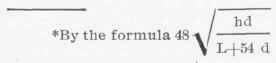
If a 2-inch pipe 100 feet long, and subject to the pressure due to a head of 100 feet, has a 24-inch bibb open at its extreme end, the velocity* of the spouting water will be 65.28 feet per second; as the area of the 2-inch pipe is 7.12 times the area of a 3/4 bibb, the velocity of water in the 2-inch pipe will be 65.28=9.16 feet per second. The
7.12 weight of the column of water in motion, from which is
. . length of pipe X area of pipe derived the force of impact, is 1 cubic foot
1,200 inchesX3.14 square inches
1,728 cubic inches = 2.18 cubic feet, which, multi ' plied by 62.5, the weight of one cubic foot of water, gives 136.25 pounds, the weight of the moving column.
The (velocity2/ 2) X (weight/ gravity)
= (9.162/ 2) X (136.25/ 32.16) =177.45 foot pounds, the force with which the moving column of water would strike the bibb, if water were incompressible. As a matter of fact, however, water is slightly compressible, therefore the actual force of impact would be slightly less than this value.
The force of impact to a great extent is dependent upon the time consumed in closing the bibb. Thus, if the force of impact due to closing the bibb in one second= 174.45 pounds, the force due to closing it in 1/2 second would equal 354.9 pounds, and to closing it in 1/4 second, 532.35 pounds.
Air Chambers
An air chamber is a tank, vessel or chamber so attached to a pipe that the confined air cannot escape, and so located that it will receive the initial impact and thus absorb the momentum of a column of water when it is suddenly brought to rest. When properly designed and located for the purpose, air chambers also provide expansion space for water in exposed pipes; the water expands upon freezing and might burst the pipes if provision were not made for its expansion.
The value of air chambers for water supply systems has never been fully appreciated, nor the sizes required under varying conditions fully understood; hence, in the exceptional cases where air chambers are installed, they are usually so small as to be of no practical value.
To wholly absorb the momentum of a moving column of water, an air chamber should be proportioned to the quantity of water in motion and the static pressure due to the head. For instance, it would require a larger air chamber for a 4-inch pipe 100 feet long than for either a 4-inch pipe 50 feet long or for a 1-inch pipe 100 feet long, the pressure in all cases being the same; and it would require a larger air chamber for a 4-inch pipe 100 feet long under 100 pounds pressure than for the same size and length of pipe under 50 pounds pressure. This is due to the compressibility of air, which when the temperature remains unchanged varies inversely as the absolute pressure.* That is to say, if the pressure on air in a vessel be increased to twice the atmospheric pressure the air will be compressed to 1/2 its original volume. If the pressure be increased to 3 atmospheres, reckoning from absolute, the air will be compressed to 1/3 its original volume. If the pressure be increased to 4, 5, 6, 8 or 10 atmospheres, the air will be compressed respectively to 1/4, 1/5, 1/6, 1/8 or 1/10 its original volume. Hence, if an air chamber containing 25 cubic feet were used in connection with a water supply system subject to a pressure of 11 atmospheres absolute or 147 pounds gauge pressure, the air in the chamber would be compressed to 1/10 its original bulk or to 2.5 cubic feet. The size of air chamber required when the diameter and length of pipe and the static pressure are known, can be approximately determined by the following empirical rule:
Rule
Multiply the quantity of moving water in cubic feet by the coefficient of pressure in Table XXX. The product will be the contents in cubic feet of the air chamber.
Example
What size air chamber will be required for a pipe 4 inches diameter and 100 feet long under a static gauge pressure of 58 pounds per square inch.
Solution
1200X12.57=8.7X1.18=10.26 cubic feet. Answer.
*Absolute pressure equals gauge pressure plus atmospheric pressure which at sea level is taken as 14.7 pounds.
Table XXX - Coefficients Of Pressure
Absolute Pressure | Gauge Pressure | No. of Atmospheres | Coefficient of Pressure | Portion of original bulk to which air will be compressed | |
29.4 | 14.7 | Abso. 2 | Gauge 1 | .28 | 1/2 |
44.1 | 29.4 | 3 | 2 | .59 | 1/3 |
58.8 | 44.1 | 4 | 3 | .88 | 1/4 |
73.5 | 58.8 | 5 | 4 | 1.18 | 1/5 |
88.2 | 73.5 | 6 | 5 | 1.41 | 1/6 |
102.9 | 88.2 | 7 | 6 | 1.76 | 1/7 |
117.6 | 102.9 | 8 | 7 | 2.05 | 1/8 |
132.3 | 117.6 | 9 | 8 | 2.35 | 1/9 |
147. | 132.3 | 10 | 9 | 2.65 | 1/10 |
161.7 | 147. | 11 | 10 | 2.94 | 1/11 |
176.4 | 161.7 | 12 | 11 | 3.24 | 1/12 |
The coefficients of pressure in the foregoing table are arbitrarily obtained by allowing .2 for each 10-pound gauge pressure in the water mains. Therefore, the rule to determine the size of air chambers can be expressed as a formula, thus: s=qc In which s=size of air chamber in cubic feet q=quantity of moving water in cubic feet c=coefficient of friction which is .2 for each 10-pounds gauge pressure Example - What size air chamber will be required for a pipe 2 inches diameter and 50 feet long under a static gauge pressure of 100 pounds per square inch?
Solution
Area of 2-inch pipe=3.36 inches. Coefficient of pressure equals .2X10=2.0; then 600X3.36 X 2=2.33 cubic feet. Answer.
Continue to:


My Books

