


Volume Meters
Description
This section is from the book "Principles And Practice Of Plumbing", by John Joseph Cosgrove. Also available from Amazon: Principles and Practice of Plumbing.
Volume Meters
The Hersey Disk Meter, Fig. 70, discharges a known quantity of water at each gyration of the disk a, and is therefore a positive or volume meter. The principle of its operation is as follows: Water entering the meter passes through a perforated metal screen b to remove all coarse particles of matter that might interfere with the operation of the meter. The water enters the disk chamber on top of the disk a and exerts a pressure there at the same time that the pressure is released in the discharge chamber. This uneven pressure causes the disk to gyrate, rising on the inlet side and lowering on the discharge side, so that water now enters and presses on the under side of the disk which again gyrates and brings the pressure to the upper side of the disk. The disk is thus alternately raised and lowered at the inlet and outlet ports at each gyration of the disk as long as water is flowing through the pipe.
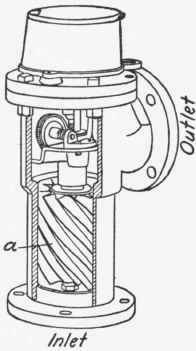
Fig. 69
At each gyration of the disk an amount of water equal to the entire contents of the disk cylinder is discharged and each gyration indicates on the index dial the amount of water that passes through the meter.
Continue to:


My Books

