


Compressed-Air Ejectors
Description
This section is from the book "Principles And Practice Of Plumbing", by John Joseph Cosgrove. Also available from Amazon: Principles and Practice of Plumbing.
Compressed-Air Ejectors
Air ejectors are now more generally used for sewage ejectment than any other type of apparatus. They are automatic and almost noiseless in operation, are perfectly odorless, and have but few working parts that can get out of order. A type of compressed air ejector known as the Shone, is illustrated in Fig. 50. Sewage flows into the chamber a through the house drain b. As the chamber fills with sewage it raises the bucket c until it reaches a certain level, when by means of the rod d it opens valve e, thus admitting compressed air to chamber a. The pressure of air closes the check valve f through which sewage entered the chamber and opens check valve g through which it forces the contents of the sump into the street sewer. As the sewage level in the sump falls, the bucket float, which remains full of sewage, lowers with the contents until it reaches a point near the bottom of the chamber when it closes the air valve, thus shutting off the supply of compressed air, and at the same time opening a vent through which the confined air can escape to a vent stack. Valves h and i are placed respectively in the house drain pipe to and the discharge pipe from the tank, so that the ejector may be cut out of service at any time
Sewage ejectment apparatus should always be installed in duplicate so that either apparatus may be cut out for cleaning or repairs without interrupting the drainage service. The manner of installing a duplicate compressed air apparatus is shown in Fig. 51.
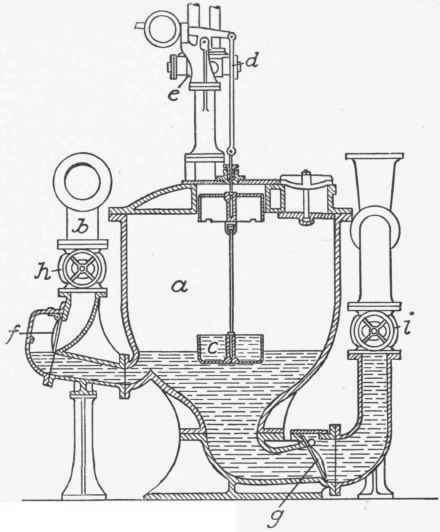
Pig. 50
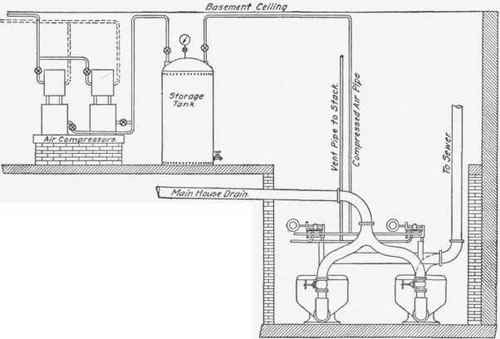
Fig. 51
The size of sump tanks for sewage ejectment depends upon the frequency with which they are to be emptied and the probable amount of sewage to be taken care of. When operated automatically they need only be large enough to hold an hour's storage of sewage, during the hour of maximum flow. The process of emptying occupies only a few minutes when the tank is ready for service again. If the apparatus is not to be operated automatically, storage capacity for twenty-four hours should be provided. In estimating the quantity of sewage from basement floors of different classes of buildings, greater per capita allowance should be made for the basement and sub-basement floors of hotels and like institutions than from other classes of buildings.
Storage tanks for compressed air are usually made of galvanized sheet iron similar to those used for the storage of hot water. They should be equal in size to the cubical capacity of the sumps they are to discharge. When made of such a size, at least two pounds pressure of air should be maintained as working pressure for each foot in height the sewage must be raised; with greater pressure a more speedy ejectment is obtained. To operate satisfactorily with lifts of less than 7 feet, at least 15 pounds pressure of air should be maintained; 30 to 40 pounds is the pressure the average sewage ejectment plant operates under.
Sub=soil Drainage Where Required - In localities where the ground water is high or where an impervious strata of clay or rock causes seepage to dampen the foundation walls or wet the cellar floor, sub-soil drains are resorted to. The manner of laying a sub-soil drain is shown in Fig. 52. A line of field tile is laid around the outside of the foundation wall below the level of the foundation footings. The pipes are laid with open joints which are covered with tile collars, pieces of tar paper, excelsior, bagging, or some other coarse material that will keep out dirt until the earth settles and packs into shape. The drain should be covered for a depth of 12 to 18 inches with crushed stone and the trench then filled to within a foot of the top with loose porous materials through which water will easily percolate to the drain. The top dressing for the trench may be any kind of good loamy soil suitable for a lawn.
Continue to:


My Books

