


Plumbing Of Hotels. Plumbing In The Waldorf Hotel. Part I.- Arrangement Of Main Drains In The Basement
Description
This section is from the book "American Plumbing Practice", by The Engineering Record. Also available from Amazon: Plumbing: A working manual of American plumbing practice.
Plumbing Of Hotels. Plumbing In The Waldorf Hotel. Part I.- Arrangement Of Main Drains In The Basement
(Published In 1893.)
Prominent among the hotels which have lately been erected in that region of New York City extending from Twenty-third Street to the Central Park is the Waldorf Hotel, now approaching completion. This structure, which is a 14-story building of iron, stone, and brick, occupies a corner of Fifth Avenue and Thirty-third Street. Its general drainage scheme is indicated on the accompanying plan, Fig. 1, which shows the run of the horizontal pipes and the location of risers. About two-thirds of the area of the plan shown has a subbasement beneath it, and in this part of the building all the pipes are suspended from the subbasement ceiling, and are of screwed wrought iron. Where there is no subbasement the sewer pipes are of cast-iron and are bedded in trenches in the earth. With the exception of one piece of leader drain on the wall this is the only cast pipe used in the plumbing of the building. All the hot and cold water supply lines are so connected that every branch and fixture may be removed without interfering with the others on the same line.
The floor drains are connected to special wastes which are trapped into the sewer and are flushed at daily intervals by special automatic flush tanks. All drainage below the level of the basement floor is received in a cesspool and automatically pumped out. In the general toilet-rooms there are three cisterns, each automatically flushing the urinals, and so connected that each cistern flushes all the urinal traps at each discharge.
The trap vent risers are of large diameter, most of them being 4 inches or 5 inches at the foot and larger at the roof. In some instances, where practicable, several of them are connected at the foot by an open horizontal pipe intended to maintain an equilibrium between them, and to afford an air supply to each cluster of fixtures from each of the connected risers.
The lines of sewer, soil, waste, and vent pipes have been tested in sections from time to time as the work progressed, so as to give frequent checks on the quality of the work and prevent the possibility of serious defects being developed by the ultimate test. The final test was made upon every cluster of fixtures served by each set of risers, and so arranged as to be connected in one circuit and to receive air pressure from a single point. The pipes tested were from 1½ to 8 inches in diameter, and aggregated over 15 miles in length. They satisfactorily sustained an air pressure of about 20 pounds per square inch, which was maintained for half an hour.
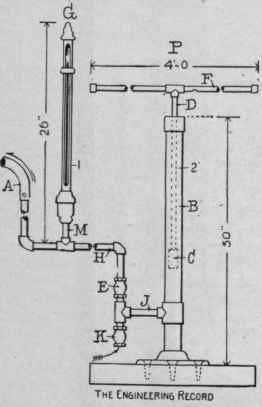
Fig.3.
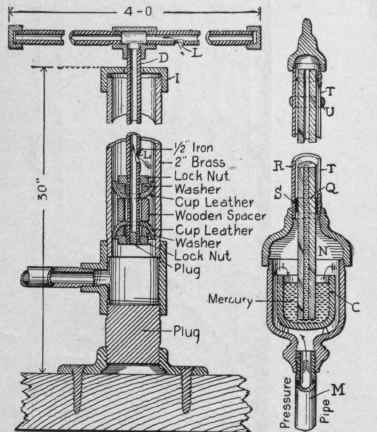
Fig.4.
Fig. 5.
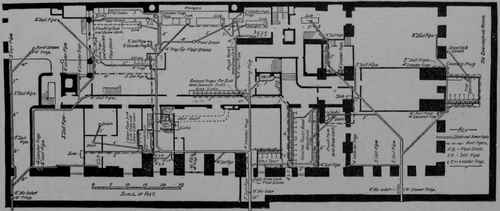
Fig. I.
The difficulties of designing and arranging the drainage system were much increased by the impossibility of carrying any part of it through large areas of the lower floors which were required to be unobstructed for corridors, rotunda, halls, etc. Especial care was necessary in proportioning the lowest branches of the soil-pipe risers which served many clusters of fixtures and were obliquely carried for long horizontal distances. Their flow was carefully computed and then the pitch was made excessive enough to provide for the delivery of much more than the total volume of water that could come from the simultaneous discharge of all the fixtures, so as to prevent all possibility of backing up at the lowest connections. Their capacities were demonstrated by connecting three leaders to one of the waste pipes designed to serve only one, which freely discharged their combined flow without backing up at all.
The estimated cost of the plumbing and gasfitting was about $200,000, and the contracts for it were executed by Messrs. Byrne & Tucker, of New York, in accordance with the plans of H. J. Hardenberg.
Continue to:


My Books

