


Plumbing In John D. Rockefeller's House At Tarrytown. N. Y
Description
This section is from the book "American Plumbing Practice", by The Engineering Record. Also available from Amazon: Plumbing: A working manual of American plumbing practice.
Plumbing In John D. Rockefeller's House At Tarrytown. N. Y
(Published In 1891.)
The systems of hot and cold-water supply, drainage and trap ventilation in this house and its stables, etc., illustrate the design and execution of extensive work for a large and costly establishment, having nearly all the requirements of a city house in addition to some others belonging to a country place, and under the conditions imposed by its isolated location.
Water is brought from the Pocantico water supply, of Tarrytown, in a special 4-inch main, about 4 miles long, which supplies it at a pressure of about 140 pounds per square inch to a reducing valve. This maintains a constant delivery at about 40 pounds, which is sufficient to raise it to the storage tanks in the attic.
All water pipes throughout are of galvanized iron. The branches to all fixtures are ¾-inch AAA lead pipe; all boiler connections are brass. Two toilet-rooms on the first floor have exposed silver-plated pipes; elsewhere the washstands, etc. have the space underneath occupied with drawers. Lead safes are everywhere placed under the pipes and fixtures. All soil pipes are perfectly vertical from sewer to above roof; most of them are built in recesses left in the walls and subsequently bricked and plastered up. All are 4 inches except one line 5 inches in diameter. All water supplies rise in elevator shafts to attic or fourth floor, where they are distributed in lead-lined troughs, see Fig. 1, between floor and joist, and have vertical branches with stop cocks to all fixtures on second and third floors.
For the basement and first floor all branches for water supply rise vertically from distribution pipes, suspended below the basement ceiling.
All the drainage pipes are suspended below the basement floor, overhead in cellar.
In the main part of the house there are, on the third floor, six toilet-rooms, each containing a water-closet, a bathtub and a washbasin; another toilet-room with water-closet, bathtub and two basins, and a chambermaid's slopsink. On the fourth floor is a photographers's sink. On the second floor is a toilet-room containing a water-closet, two washbasins, a long bathtub and a hip bathtub; another toilet-room with the same fixtures except the hip bath; three toilet-rooms with one basin, a bathtub and a water-closet in each, and one with a basin and water-closet only. On the first floor is one toilet-room with water-closet, washbasin, and urinal, another with a washbasin and urinal only. There are also two butlers* pantry sinks, one servants' hall sink, one kitchen sink, one scullery sink, and one slopsink. In the basement there are two servants' water-closets, one engineroom sink, seven laundry tubs (in two sets), and one laundry sink.
Besides the above, there is, in a portion of the house designed for the servants' hall, a water-closet and bathroom on the third floor; water-closet, bath, and slopsink on the second floor; and in the kitchen a house boiler, laundry boiler, and a water heater.
The two stables have accommodations for the superintendent and coachman and their families, and bachelors' apartments for the stable hands. The superintendent has a bathroom, water-closet, kitchen boiler, sink, and two laundry tubs. The coachman has a water-closet and ordinary kitchen fixtures. The bachelors' apartments are furnished with a bathtub, water-closet, and a sink.
In the stables there are 26 box stalls and 16 open stalls. The latter drain into gutters at the rear with bell-trap waste pipes for every two stalls. Each box stall has separate waste and trap. There are two horse troughs, one harness-room, sink, one washbasin, and two water-closets in the stable. Outside, under a roof, is a concrete platform, 30x60 feet, pitched to two wastes, with bell-trapped strainers and hose cocks for washing carriages. In the adjacent engine and dynamo house there is one water-closet and one sink. There are about 25 fire hydrants distributed through the grounds, and 15 street washers for sprinkling lawn.
All the sewage is discharged through an 8-inch main iron pipe into the river between high and low water. All the soil pipe was tested by water pressure up to the roof after the connections were made ready for the fixtures.
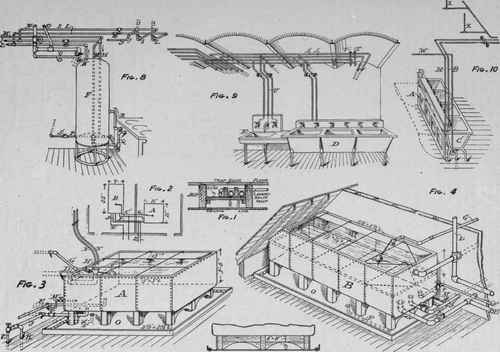
Figure 2 shows the location of the house tanks A and B in the attic, and Figs. 3 and 4 are separate views of A and B respectively. Each tank is filled through a ball cock from the 2-inch pump pipe G, and overflows through funnel heads H on the branches of a 4-inch pipe D open above the roof and discharging into the engine-room sink. F is a 2-inch equalizing pipe which connects the two tanks, and through which they may be emptied directly into the sewer. J is the 2½-inch house-supply pipe, and E is a 4-inch supply to the elevator tank. K, Fig. 3, is a special 2-inch branch to the kitchen boiler, and L is the 1½-inch supply for the distributing pipes throughout the house. M is a 1 inch supply for the photographer's room on the attic floor. N N are ¾-inch safety pipes from the kitchen and laundry boilers. O is an iron safe, and P is its waste pipe.
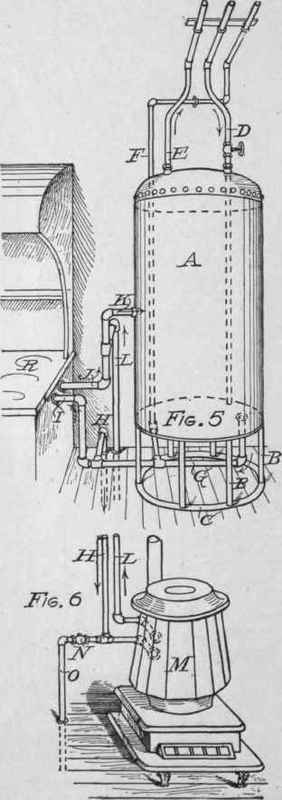
Figure 5 shows the 250-gallon boiler A in the kitchen. It is about 40x70 inches and has a domed top, flat-bottomed, and is supported by a frame of brass pipes B, screwed into a floorplate C. The cold supply is through D, and the hot delivery through E, both 1½-inch pipes. Circulation is through the 1-inch pipe F, which runs from the third-floor pipes to the 1½-inch circulation pipe G. The branch I connects with the water-back in the kitchen range R, which returns the heated water through the 1½-inch branch J of the upper circulation pipe K. All these pipes are of polished brass.
Figure 6 shows the heater M (Bramhall, Deane & Co.'s No. 2), which is placed in the basement underneath boiler A, to help heat its water when the demand overtaxes the range water-back. The 1½ inch brass pipes L and H are connected to the water jacket and above, as shown in Fig. 5, with the circulation pipes G and K, in which part of the water flows through branch I to kitchen range and returns through branch J. The remainder flows through branch H to the heater and returns through branch L. N is a key valve through which, and the pipe O, the hot-water system may be emptied into the sewer. Figure 8 is a diagram of the overhead arrangement of the hot and cold water pipes in the basement.
PLUMBING IN MR. JOHN D ROCKEFELLER's HOUSE AND STABLE, TARRYTOWN, N. Y.
A A are the laundry rooms. B is a closet, C and D are sets of enameled tubs, E is a sink, F is the 100-gallon laundry boiler, G is a steam pipe.
Figure 7 shows the connections to laundry boiler F, Fig. 7. Cold water is supplied to it through the 1 inch branch H from the tank pipe I, and as the main part of the house may be closed and the tanks emptied in the winter, it has also a special branch J, through which it may be supplied direct from the 4-inch main. Hot water is delivered to the tubs through 1¼ inch pipe K, which has also a branch L, connecting with the bathtub and washbasin supply, so that boiler F may assist the kitchen boiler to operate the house system if necessary, or the kitchen boiler can be connected with the laundry tubs. M is the return circulation pipe, and P is the sediment pipe to the sewer, with a key valve S; Q and R are the circulation pipes to the water-back.
Figure 9 is a perspective from Z, Fig. 7, and shows the exposed arrangement, under the fireproof floor, of the distribution pipes to the tubs D, sink E, and risers T T, which are like the numerous other lines, taken from the basement ceiling vertically to the first floor and servants' fixtures, or lines of fixtures they supply. S S are steam heating pipes, and U is the refrigerator waste which terminates above the sink in a flap valve V.
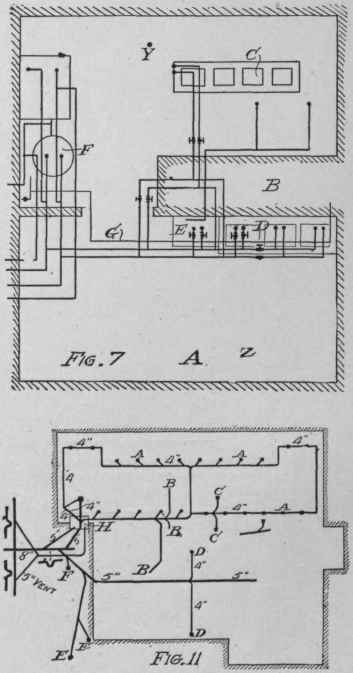
Figure 10 is a view from Y, Fig. 7, of the detached tubs C, which were especially designed by Mrs. Rockefeller to stand in the middle of the room and be provided with an adjustable table A, that, when not in use, should hang down as shown, to form a side panel, and may be raised to the position shown by broken lines. The hot and cold pipes H and B are protected by a case D, and are carried on the ceiling as shown in Fig. 9. XX are refrigerator drip pipe, and W is a trap vent.
Figure 11 is a diagram showing the sizes and arrangement of the soil and waste pipes and leaders under the stable floor. The stable is in the second Story of the building, and all the pipes are suspended from its floor joists in the upper part of the basement. A A, etc. are the branches to the open and box stall; B B, etc. are branches to rainwater leaders; C C are wastes from hose troughs; D D are drains from the carriage-washing platform; E E are soil pipes from the employees' rooms; F is a drain pipe from the exercising room; and H is the elevator shaft through which the trap ventilation pipe passes to above the roof.
E. M. Roberts was the architect. The plumbing and gasfitting was executed by John Toumey & Son, of New York.
Continue to:


My Books

