


The Boiler. Part 8
Description
This section is from the "The Construction Of The Modern Locomotive" book, by George Hughes. Also see Amazon: The Construction Of The Modern Locomotive.
The Boiler. Part 8
The wash-out door is a well annealed steel casting, riveted to the under side of the boiler in front of the fire-box, the cover being made with a cone joint. Brass taper mud plugs are placed at the front and back of the fire-box, and in the smoke-box tube plate. The boiler is now-ready for the mountings, the caulkers having done their work at the proper period, following upon the riveters.

Fig. 48.
Fig. 49.
Fig. 50..
The copper piping for the ejector and injectors, etc, is first put in, drifted and ferruled; then a specially designed surfacing machine is cramped to the fire-hole, and the surfaces got up for the regulator gland, injectors, ejector, jet, water gauges, etc, and these bedded to the machined surface. The fire-hole door, Fig. 51 (Webb's), and hand-rail studs are fitted into their places, working to the centre lines of the boiler. The regulator steam pipe elbow is levelled in the dome, and the copper pipe with the cone on it is bolted up to it, then a coppersmith fixes the flange for the tube plate joint ready for brazing. The tubes, if copper, must be solid drawn and seamless, perfectly sound and well finished, free from surface defects, and also capable of withstanding expanding and bending, without showing the least sign of splitting or cold shortness whatever.
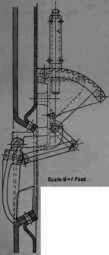
Fig. 51. Webb's Fire-Hole And Door.
The ends should not be annealed, but left "hard" or "half hard" throughout, because, if the ends are annealed, the junction of the hard and soft metal becomes a plane of weakness, and the tube invariably collapses there.
The thickness must be 10 I.W.G-. for 12 inches from the fire-box end, and then taper from 10-12 I.W.G. in a length of 18 inches, the remainder parallel, and 12 I.W.G. thick; to be swelled 1/16 inch at the smoke-box end for 3 inches, to facilitate withdrawal.
Slight deviations may occur, e.g. cambered tubes may be required, which should be specified when ordering.
The weight per lineal foot is as follows: -
1⅝ in. outside diameter, | 1.98 lb. | A maximum of 10 per cent, above each, and a minimum of 5 per cent, under will be allowed. |
1¾ " " | 2.15 „ | |
1 ⅞ " " | 2.31 „ | |
2 „ „ | 2.47 „ | |
2⅛ " " | 2. 63 „ |
They must be free from dirt, inside and out; each tube must be branded, and also capable of sustaining an internal pressure of 800 lb. per square inch and an external of 250 lb. per square inch. They are put in, expanded at each end, and ferfuled in the fire-box. The longitudinal stays are bolted up, using copper washers between the nuts and the plates. The dome and safety-valve seatings have a finishing cut in their places, a small machine being designed for the purpose, this having been found necessary because the surface obtained from the lathe was irregular owing to vibration. The whistle-stand joint is made by screwing a piece of piping through it and the «-inch plate, steam-tight, as Fig. 52. The fusible plugs and brick arch studs are put in, and all joints made with a fine seam of thin red lead. Water is then put in and warmed, afterwards pumped up to 200 lb. per square inch, then drawn off until the gauge glass is left just full, and the boiler fired up for five hours, steam blowing off at 160 lb. per square inch.

Fig. 52.
Continue to:


My Books

