


III. On The Influence Of Saline Mineral Waters On The Metabolism Of Proteids
Description
This section is from the book "Part 5. Saline Therapy. Clinical Treatises On the Pathology and Therapy of Disorders of Metabolism and Nutrition", by Prof. Carl von Noorden. Also available from Amazon: Clinical Treatises On the Pathology and Therapy of Disorders of Metabolism and Nutrition, Part 5
III. On The Influence Of Saline Mineral Waters On The Metabolism Of Proteids
The well-known experiments of C. von Voit snowed that the use of sodium chloride increased the excretion of urea. Dehn performed similar experiments in healthy human subjects with potassium chloride, and obtained the same results. Voit conceded that the increased excretion of urea was in part due to flushing of the tissues as the result of the increased ingestion of water. In addition, however, he postulated from his experiments that the administration of sodium chloride also produced "a slight increase in the metabolism of albumin." He based his conclusion on the observation that in the course of the forty-nine days during which the animal was under observation, 105 grams of urea more were excreted than were taken in with the food. (Handbook, p. 159.) Weiske performed similar experiments in sheep, and also arrived at the same conclusion. Dubelir, under Voit's direction, performed still other experiments, and arrived at a different conclusion, namely, that the excretion of nitrogen (in dogs) was reduced if sodium chloride was added to the diet.
In addition to these animal experiments, a number of investigations in human subjects have been performed, and the results obtained from these investigations must be compared with the animal experiments. J. von Mering found that the excretion of urea was increased slightly after the ingestion of Friedrichshall Bitter water. Mosler performed some investigations with the same water, and obtained less marked results, and B. Markwald investigated the same question with the same water, and found that the excretion of urea was slightly reduced. Although all these older experiments yielded contradictory results, as far as the investigations in human subjects were concerned (Mosler, von Mering, Markwald), and were far from convincing, the old idea of von Voit still predominates in the minds of most writers, and is incorporated in all text-books and in all the pamphlets that are published in the different watering places; for in all of them one can read that saline waters increase the metabolism of albumin. One should never forget, however, that this is merely a broad deduction from the isolated fact originally announced by von Voit, that in dogs the excretion of urea is slightly increased under sodium chloride. This conclusion in regard to the metabolism of albumin was only very conservatively pronounced by von Voit himself. In fact, there can be no doubt that this statement needs corroboration before it can be accepted. Nevertheless, the doctrine was soon accepted by a large circle of physicians, and was ultimately amplified to read, "that saline waters accelerate metabolism." Here the two ideas of an increase in the metabolism of albumin and an acceleration of metabolism in general were used synonymously without justification, and this error has crept into our modern literature, showing in many instances that the authors of the articles in which this egregious error is committed are unfamiliar with the fundamental rudiments of our knowledge of metabolism.
If we do not attach too much importance to these more or less random statements, then the old doctrine that sodium chloride and saline mineral waters increase proteid metabolism still remains to be critically investigated. It is necessary, of course, to consider experiments performed in human beings alone, and to subject each one of these investigations to the most rigid criticism. Only the experiments of J. Katz stand the light of critical illumination; all the other experiments that were published before our own do not come up to this standard. Katz, during the period of investigation, lived on a diet of absolutely uniform composition and of known constitution (17.14 grams of N., 125.43 grams of fat, and 310.85 grams of carbohydrate), and assimilated, i. e., retained, 1.589 gram of N., during the fore-period; 1.356 gram during the saline water period; 1.593 gram during the after-period. The differences observed are within the boundaries of error, so that one can say positively that the metabolism of albumin was not increased.
This experiment performed on a healthy subject is not sufficiently conclusive for our purposes. What we need are experiments in sick people. We will have occasion to speak later of the necessity of such experiments.
First Experiment. Miss F., suffering from gastrectasis, hypersecretion, and hyperacidity of the gastric juice. (See above.) The diet during the whole experiment consisted of 2 liters of milk, 80 grams of zwieback, 40 grams of butter, 80 grams of meat a day. The diet was most carefully analyzed in this experiment, for this is absolutely necessary whenever the attempt is made to gain information in regard to the metabolism of the proteids.
During the fore-period (seven days) the diet on an average contained 14.8 grams of N.; the urine and faeces together, 3.1 grams of N. a day.
During the water period (200 c. c. of Rakoczy and 200 c. c. of Kissingen bitter water) the diet during the period of five days contained 15.4 grams of nitrogen; the faeces and urine together 12.8 grams of nitrogen a day.
No increase in the assimilation and disassimilation of albumin could be determined with certainty, nor could the reverse be discovered, for the figures fluctuated within normal boundaries.
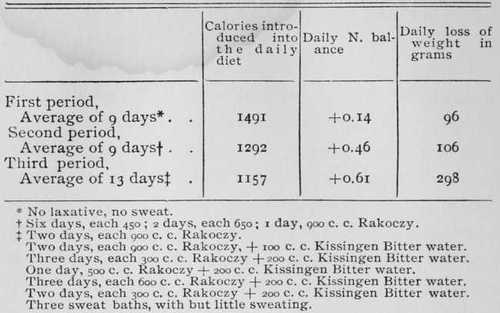
Second Experiment. Mrs. Kl. (See above.) Obesity. The following table shows the nitrogen metabolism during a reduction cure, that this patient underwent :
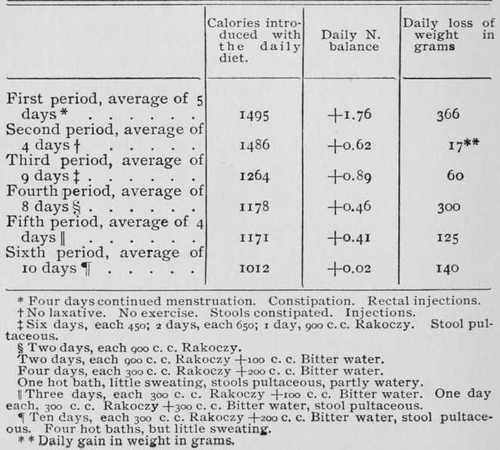
Third Experiment. Mrs. St. (See above.) Obesity. The following table shows the nitrogen metabolism during a reduction period.
Continue to:


My Books

