


III. On The Influence Of Saline Mineral Waters On The Metabolism Of Proteids. Continued
Description
This section is from the book "Part 5. Saline Therapy. Clinical Treatises On the Pathology and Therapy of Disorders of Metabolism and Nutrition", by Prof. Carl von Noorden. Also available from Amazon: Clinical Treatises On the Pathology and Therapy of Disorders of Metabolism and Nutrition, Part 5
III. On The Influence Of Saline Mineral Waters On The Metabolism Of Proteids. Continued
From both of these experiments the conclusion can be drawn that the ingestion of considerable quantities of this mineral water exercises no effect on proteid metabolism. These investigations in patients undergoing a reduction cure are particularly important, because we know that in reduction cures the proteid content of the body is always in danger. If the waters exercised any influence whatever on the proteid metabolism, then this effect should certainly become apparent in these experiments, for in such cases it is always difficult to maintain nitrogen equilibrium.
We call attention to three other metabolic experiments that were performed in a healthy subject, in a subject undergoing a reduction cure, and in a patient with diabetes mellitus. It would be too tedious to report the details of these investigations in this place. We will simply state that the administration even of considerable quantities of Kissingen Rakoczy water (500 to 700 c. c.), exercised no influence on the metabolism of the proteids.
In the meantime, a number of other similar experiments have been performed. H. Leber, who also carried on his investigations in von Noorden's laboratory, found that the administration of Homburg Elizabeth water (750 c. c.), if anything, reduced the metabolism of proteids as compared to the fore-period. Brandenburg, as already mentioned, administered artificial Carlsbad Muhlbrunnen. Jacoby used Apenta water. Allard, Mergentheim Carlsbrunnen water. In none of these cases was an increase in the nitrogen output discovered. Jacoby and Allard called particular attention to the fact that they were able, just as we were, to carry on energetic reduction cures with the aid of these mineral waters without at the same time increasing the nitrogen metabolism, and in this way depriving the organism of albumin.
We will not enter into a discussion of some of the more recent animal experiments, and of some other experiments in healthy adults, in which the effects of large quantities of sodium chloride on proteid metabolism were studied. These investigations are theoretically of some interest, but permit of no conclusions in regard to the clinical and balneological features of the question. All that we are trying to discover is what effect the common balneologic measures that are universally adopted and practiced exercise on metabolism. Whether the salts contained in these different waters, when given in abnormally large quantities, exercise an influence on proteid metabolism or not, is of subordinate practical importance, but is, of course, of considerable toxicologic interest.
On the other hand, it seemed very desirable to determine by convenient, and at the same time, reliable methods, in a considerable number of cases, whether or not the saline waters, as ordinarily administered, cause a loss of body nitrogen. For this purpose we selected a number of patients undergoing a reduction cure, chiefly because in such cases a loss of nitrogen was particularly to be dreaded, and because it is a matter of great practical importance to prevent such a loss.
We adopted the following method, that one of us (Dapper) employed in a large number of patients in his Kissingen sanitarium. The patients received daily a diet of known quality and quantity. From time to time (according to the requirements of the individual case) they received for two or three days in succession a diet that contained the same amount of proteid, fat, and carbohydrate as the diet taken before this period, but this was composed in such a way that its proteid content and its caloric value could be calculated very easily and at the same time very accurately; namely, a weighed quantity of meat containing little fat, broiled; a weighed quantity of bread, eggs, butter, pastry, and fruit of known composition, black coffee, bouillon from which the fat had been removed, Moselle wine, mineral water, etc. It was unnecessary to perform careful analyses of the diet in the cases that were fed in this way. After these patients had lived on the same diet for one or two days, the twenty-four hours' quantity of urine was carefully collected and its nitrogen determined. The nitrogen of the faeces was valued in all cases at 1.5 gram (that is really too little for a diet constituted as above). From the intake and output the nitrogen balance could readily be calculated, and one could determine whether the regimen, that is, the diet, exercise, bathing, and the drinking of the saline water, together, produced a considerable loss of nitrogen or not. Dapper reported his results in twenty-eight cases that were examined in this way some years ago. Below will be found a table giving the results obtained in twenty-one other cases.
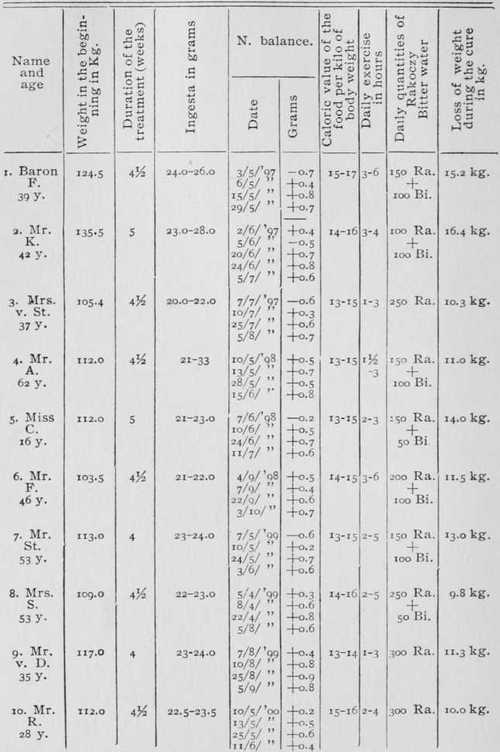
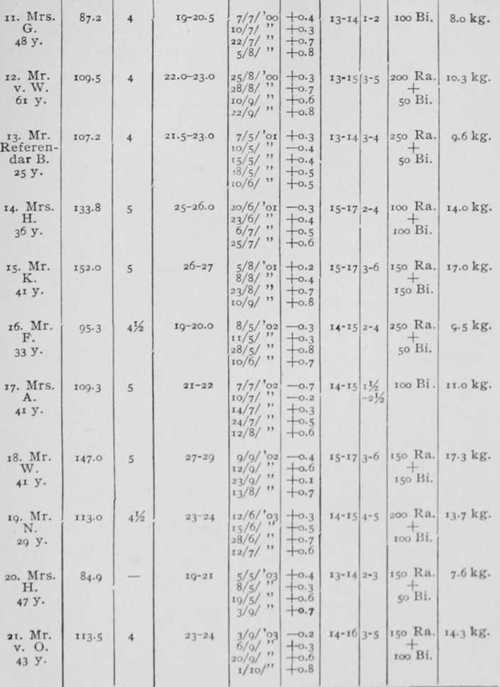
The significance of this table can readily be understood; and one can see that, with very slight exceptions, the reduction cure could be arranged in such a way at any time, even while Kissingen Rakoczy and Kissingen Bitter water were taken, that the nitrogen equilibrium was maintained at a favorable level, even though the loss of body weight was considerable and rapid.
We may say, therefore, that the acceleration of the proteid metabolism which is so much dwelt upon in the literature of watering places does not occur when saline mineral waters are used. The question arises whether or not this detracts in any way from the therapeutic value of saline mineral water. In the eyes of those clinicians who babble the metabolic jargon of past ages without understanding what they are talking about, this conclusion may possibly be interpreted to signify that the therapeutic value of these waters is depreciated - as a matter of fact, however, this is not at all the case. If it were true that sodium chloride per se increased proteid metabolism, that is, increased the combustion of albumin within the cells, then this should become manifest in metabolic investigations by an increase in the nitrogen output. In other words, more nitrogen should be excreted in the faeces and the urine than is administered by mouth. Such a perversion of the nitrogen economy is only seen in processes that are accompanied by a destruction of protoplasm, - in the most classical form, in fevers, and in phosphorus poisoning. Whoever, therefore, claims that saline waters increase the metabolism of proteids independently of the character and the quantity of the diet, must postulate that sodium chloride in some way attacks the cells themselves; in other words, that it is a protoplasmic poison; or otherwise he must wish to give a new significance to the conception " ncrease of proteid metabolism." If proteid metabolism were really increased, then it would be our duty to warn our patients against all drinking cures, for the latter are, as a rule, intended to strengthen the patients and to build them up. We have seen that no such thing as a loss of proteid really occurs, and we do not refrain, therefore, from instituting an energetic reduction cure, together with a drinking cure, in many patients who are suffering, for instance, from heart disease; for we are certain that the metabolism of proteids remains at a favorable level, and that no serious nutritive disturbances are produced by this treatment. The truth of this idea has been borne out by our practical experience, for in none of the cases that we have treated in this way have we ever noticed any detriment to the general well-being of the patients, either during the reduction cure or afterwards. On the contrary, the patients without exception grew stronger under this treatment and more capable of performing their labors.
Continue to:


My Books

