


The Feeding Of Farm Animals
Description
This section is from the book "Vitamines - Essential Food Factors", by Benjamin Harrow. Also available from Amazon: Vitamines, Essential Food Factors.
The Feeding Of Farm Animals
Of equal and perhaps even more immediate consequence are these studies to animal production in agriculture. Let me quote Drs. Osborne and Mendel: "Corn forms the cheapest basis for the feeding of farm animals in food production. Inasmuch as the rate of growth is limited by hereditary rather than nutritive conditions, it is futile to furnish more energy, and particularly more protein, than is essential for normal development. An inadequate but cheap protein can be supplemented advantageously by one which supplies the needed factors, that is, amino-acids. The relative economy of these additions of supplementary proteins to an efficient but inexpensive ration depends not only on their quantity but likewise on their amino-acid make-up. A very small addition of a protein like lactalbumin may be far more advantageous, when the cost per unit of gain is considered, than larger amounts of cheaper proteins which supplement less perfectly the amino-acid deficiency of the standard diet. It is perhaps not too Utopian to expect that the day may come when amino-acid concentrates may serve to render perfect the mixtures of proteins in a fodder like maize or its commercial by-products."
Figure 5. - Amino-Acids and Growth
When 18 per cent of casein (as the sole protein) is present in the diet, satisfactory growth is obtained. With 9 per cent of casein much less rapid growth ensues. That the insufficiency of the smaller amounts of casein is essentially due to its relative deficiency in cystine-yielding groups is shown by the marked accelerating influence on growth brought about by the addition of cystine to the food containing 9 per cent casein.
Osborne and Mendel: J. A. M. A., 1915.
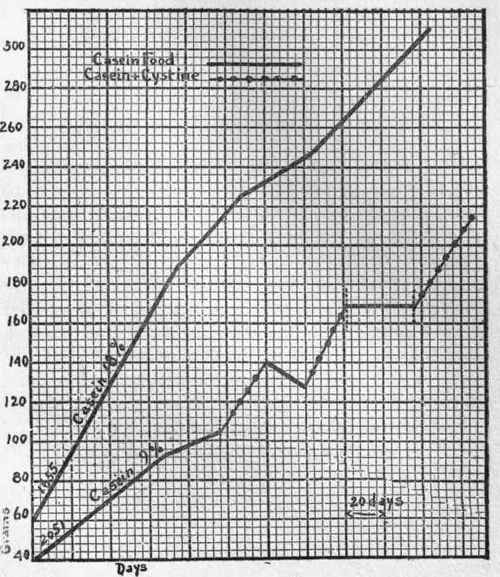
Figure 6. - Amino-Acids and Growth
The curve shows the satisfactory growth obtained when 18 per cent of edestin was present in the diet as the sole protein. With a smaller amount of edestin - 9 per cent - much less rapid growth ensued. That the insufficiency of the smaller amount of edestin is essentially due to its relative deficiency in lysine-yielding groups is suggested by the marked accelerating influence on growth brought about by the addition of the amino-acid lysin to the food containing 9 per cent of edestin and the less rapid growth when the additional lysine was withdrawn from the diet.
Osborne and Mendel: J. A. M. A., 1915.

Continue to:


My Books

