


Fat-Soluble A And Water-Soluble B
Description
This section is from the book "Vitamines - Essential Food Factors", by Benjamin Harrow. Also available from Amazon: Vitamines, Essential Food Factors.
Fat-Soluble A And Water-Soluble B
Later on Dr. McCollum and others showed that wheat, and particularly yeast, was very rich in this second vitamine, which we shall call water-soluble B, in distinction to the first vitamine, which we shall call fat-soluble A. The naming of these two vitamines is due to McCollum.
To illustrate still further this water-soluble B factor, I shall describe a short experiment taken from Professor Hawk's book.* Two white rats from one to two months old and weighing from thirty to sixty grams (one to two ounces) are fed on an adequate synthetic diet consisting of casein 20 per cent, butter fat 15 per cent, starch 56 per cent, salt mixture (mineral salts) 4 per cent and yeast 5 per cent. The butter fat supplies fat-soluble A, and the yeast, water-soluble B. You will remember that in McCollum's early synthetic diet the water-soluble B was obtained from the milk sugar. In about two weeks the rats double their weight. Now the yeast (containing the water-soluble B) is eliminated. The food still contains sufficient energy-yielding material, sufficient protein rich in amino-acids, etc. You may, if you like, add even more casein or butter fat to the diet. The result is all the same: the rats lose weight. They lose weight so rapidly that in two weeks they drop from 80 to 60 grams.
By retaining the yeast in the diet, but substituting lard for butter fat, the influence of fat-soluble A can be illustrated.
For convenience we can summarize our results as follows:
Vitamines | |||
A | B | Growth | |
Purified protein+starch+inorganicsalt-f-vegetable fat | - | - | - |
butter fat | + | - | - |
.. vegetable fat and yeast | -* | + | - |
„ „ " " butter fat and yeast | + | + | + |
*P. B. Hawk: Practical Physiological Chemistry (P. Blakis-ton's Son & Co., 1918), page 585.
Figure 8. - A Satisfactory Synthetic Diet
Illustrations Of The Influence Of Fat-Soluble A And Water-Soluble B On The Growth And Nutrition Of Rats
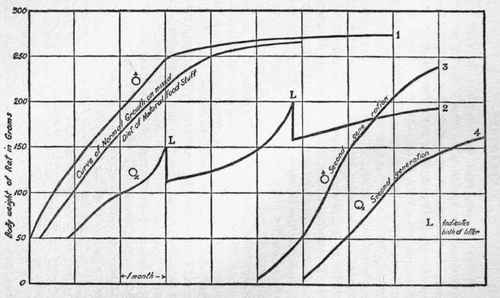
Here are given a number of curves illustrating the changes in body weight of rats which were fed from an early age upon an artificial ration of purified protein, carbohydrate, fat and inorganic salts, supplemented with adequate amounts of the factors "A" and "B." *
The actual dietary employed was constituted as follows: Purified casein, 20 parts; Purified starch, 55 parts; Mixture of crystalline inorganic salts, 5 parts; Butter fat (as source both of fat and the factor "A"), 15 parts; Yeast extract (as a source of factor "B"), 5 parts.
Chart shows normal growth of rats over 4-5 months with production, and satisfactory growth, of young on above dietary.
Curve 1 represents the growth of a male rat, and Curve 2 the growth of a female rat. At the points marked on the second curve litters of young were born. Average curves for the growth of the second generation reared on this diet are given in Curve 3 (males) and Curve 4 (females). In one experiment four generations were reared upon this dietary as a sole source of food, and in every case the animals were well up to, and in some cases were considerably superior to, the normal standard.
Report Of The British Medical Research Committee, 1919
* The curves illustrating this section are taken from records obtained during experiments carried out by Drummond. They confirm those previously obtained by McCollum and his co-workers.
Notice, please, that we have not isolated our vitamines. We have not the least idea of what they look like and little idea of what they are. All that we can say is that certain foods contain them and others do not. Still better, that certain foods contain one or more factors essential to life and others do not. We are made aware of their presence by a process of elimination. If a diet is adequate when butter fat is included, and not adequate when butter fat gives place to lard, we look to the butter fat for the missing factor. If after having examined the butter, our chemistry still affords us no help in isolating the effective substance, if after having accounted for every known constituent in butter fat without being able to trace the effective substance to any one of the constituents, then we are led to the conclusion (from our feeding experiments) that something is there which chemical analysis has so far failed to detect. We cannot see it but its effects are obvious. The effects come within the range of our senses. We cannot see micro-organisms with the naked eye; we detect their presence by the use of the microscope. We cannot see atoms and the still smaller electrons; yet science has found a way of measuring them. And so we have not so far been able to isolate a vitamine; we have not as yet been able to look at one; but our science teaches us how to know when it is present or absent by its effects on the living organism.
Continue to:


My Books

