


177. Most Foods Are Too Poor In The Element Calcium
Description
This section is from the book "The Newer Knowledge Of Nutrition", by Elmer Verner McCollum. Also available from Amazon: The Newer Knowledge of Nutrition: The Use of Food for the Preservation of Vitality and Health.
177. Most Foods Are Too Poor In The Element Calcium
The cereals, tubers and roots must be used in combination with calcium-rich foods such as milk, or leaves, and the addition of meats or eggs cannot take their place. The best type of diet is one which, in addition to moderate amounts of cereals, tubers, legume seeds, root vegetables, and small amounts of meats and eggs, contains liberal quantities of milk, and the leafy vegetables.
Milk supplements any diet to which it is added, in respect to the quality of its proteins, its inorganic content, and its content of the three demonstrated dietary essentials A, B, and C, whose natures are not understood. When it has been heated it lacks the factor C, which is protective against scurvy. Milk is deficient only in iron.
Leafy vegetables possess essentially the same supplementary relations to other foods as does milk. When eaten raw, they are excellent preventives of scurvy, but when cooked they lose most of this property. They are rich in iron.
Eggs have much the same supplementary relations to other foods as has milk, except that they are deficient in calcium, and do not contain carbohydrate, so their tendency is to favor putrefactive decompositions in the intestine rather than to encourage fermentative organisms to develop.

Fig. 3. - This cow was the same age as that shown in Figure 1. She derived her ration entirely from the wheat plant during the last two-thirds of her growing period. This ration, when submitted to chemical analysis, showed almost exactly the same composition as that fed to the cow in Figure 1. Note the poor nutritive condition of the wheat-fed cow. It has not been possible to prepare a ration solely from wheat products, which will induce good nutrition in animals. Figure 4 shows the typical appearance of the calves produced by cows fed upon a ration properly "balanced," but derived entirely from the wheat plant, and containing the seed, stem and leaf.
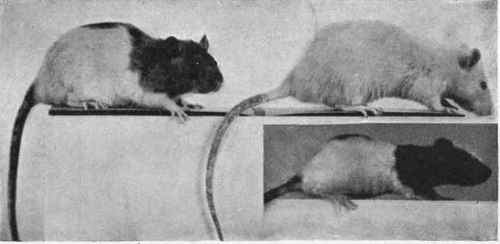
Fig. 8. - This photograph shows the degree of success which has been attained in securing growth, reproduction and rearing of young in an omnivorous animal, the rat, with a diet of strictly vegetable origin. The diet is described on page 161. The data available seem to demonstrate that successful diets of plant origin can be secured only when the leaf of the plant is a prominent constituent of the diet. Those parts of the plant whose functions are those of storage organs (seeds, tubers and roots), do not serve as adequate diets, even when there is a wide variety in the food supply. The leafy structures are so constituted as to correct the deficiencies of mixtures of seeds, tubers and roots.
The albino and her daughter are shown above, and her granddaughter below. Young in the fourth generation were successfully reared, with no apparent diminution in vitality.
Continue to:


My Books

