


Meat Cutting. General Cuts
Description
This section is from the book "Food - What It Is And Does", by Edith Greer. Also available from Amazon: Food: What it is and Does.
Meat Cutting. General Cuts
In general, the animal is cut both lengthwise and crosswise, therefore into four quarters, two fore and two hind. The fore and hind quarters differ in some respects in very marked ways. Inspection of the diagrams (p. 90) and of meat itself shows this. The fact that the form of the skeleton of the animal distributes the bones differently through the different parts of the animal, and the further fact that the muscles of the animal are so differently used in different parts, make the existing differences in the cuts and in their quality a natural consequence of these facts. Purchase and preparation of meat are both controlled by these differences in the cuts.
Difference in cuts of meat and its significance should be understood. Such knowledge guides buying and directs cooking of meat. The flesh of animals above and toward the back is finer and firmer than that below and toward the front.

Ham.

Pork.
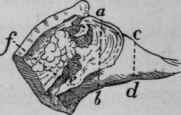
Leg of lamb (see p. 99).
Fore quarters (weigh in beef about 310 lb.) are cut into:
Ribs, chuck, neck, shoulder, shank, brisket, plate, navel. (See p. 91).
Coarse, inferior, less desirable. Ribs are the best fore-quarter cuts.
In general, fore quarters, except the ribs, are used in the main for stews and soups, canning and corning, chopped or mince meat. Hind quarters (weigh in beef about 268 lb.) are cut into : Loin, rump, round, flank, shank. (See p. 91).
Fine, firm, and with the ribs of the fore quarters are the best cuts of meat. In general, hind quarters are less fat and used as steaks, roasts, stews, soups. Fore quarters cost from 5 to 25+ cents a pound. Hind, from 12 to 40. (The quantity of each as well as the quality affects this range in price.) The chuck, plate, brisket, flank, keep less well than do other cuts.
Continue to:


My Books

