


Of The Mechanical Division Of Bodies. Part 9
Description
This section is from the book "The London Dispensatory", by Anthony Todd Thomson. Also available from Amazon: PDR: Physicians Desk Reference.
Of The Mechanical Division Of Bodies. Part 9
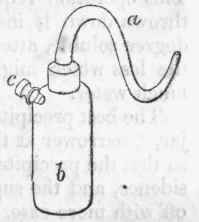
Dissolution is the appellation given to cases of solution accompanied with decomposition, or some alteration in the nature of the dissolved body. In general, the dissolution of a body is attended with considerable effervescence, owing to the ex-trication of gases; and therefore the operation requires to be performed in capacious vessels to prevent the loss of the materials. When the gas is required to be preserved, and the operation is not on a large scale, the proof bottle, b, is used. It is furnished with a tubulated orifice, c, for permitting the introduction of acid or any other decomposing agent, and with a, a curved tube, ground into the opening of the bottle, through which the gas escapes. The gas is collected in inverted jars in a pneumatic trough.
Precipitation is an operation in which decomposition also takes place, a solid substance being thrown down from a liquid in which it was held in solution, by the chymical action of another body, which is added to the solution. The substance employed to produce the precipitation is denominated the precipitant; the substance which is separated by its action, the precipitate. Thus, if into a solution of sulphate of magnesia a solution of soda be dropped, the magnesia separates from the sulphuric acid, falls to the bottom, and forms the precipitate; while the alkali, which is the precipitant, combining with the acid, thus set free, remains in solution in the state of sulphate of soda. Sometimes, the precipitate is separated, by the precipitant having a greater affinity for the liquid, and thence weakening its attraction to the substance which it held in solution. Alcohol, for example, when added to a saturated solution of sulphate of magnesia, precipitates the salt in a crystallized form, and combines with the separated water. In other cases the precipitate is an insoluble compound formed by the union of the added substance with that which was previously held in solution; as, when a solution of baryta is added to a solution of sulphuric acid, sulphate of baryta is formed and precipitated.
The mixture of a solution of a compound salt with the solution of another compound salt may produce a precipitate which is an insoluble compound, while a new soluble compound is formed at the same time, and remains in solution; in which case the decomposition is produced by double elective attraction. Thus, if a solution of acetate of lead be added to a solution of sulphate of zinc, the oxide of lead leaves the acetic acid, and combining with the sulphuric, forms sulphate of lead, which is insoluble, and falls to the bottom; while acetate of zinc, formed by the union of the oxide of zinc with the acetic acid, remains in solution.
When the precipitate is the chief object of the process, it is necessary to wash it, after it is separated by filtration, This operation requires little attention when the substance thrown down is insoluble in water; but when it is in some degree soluble, attention is required to prevent the loss which might result from the use of too much water.
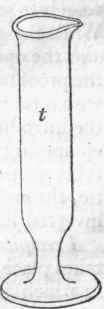
The best precipitating vessel is a very tall glass jar, t, narrower at the bottom than at the mouth, so that the precipitate may readily collect by subsidence, and the supernatant liquor be decanted off with more ease.
Precipitation is intended to separate solids from solutions in which they are contained; to produce new combinations which cannot readily be formed by the direct union of their constituents; and to purify solutions from perceptible impurities. A knowledge of those substances which produce precipitation is, also, of much importance in extemporaneous prescription, to prevent the virtues of remedies from being destroyed by improper combinations. The following Table displays the Precipitants of officinal substances.
1. | Alkalies. | Precipitants.1 |
Potassa........ | Tartaric acid, perchloric acid, muriate of platinum. | |
Soda........ | 0. | |
Ammonia...... | Muriatic acid vapour. | |
2. | Salts of Metallic Oxides. | |
Baryta............ | Sulphuric acid, sulphates, carbonic acid, carbonates. | |
Lime......... | Oxalic acid, oxalates. | |
Magnesia....... | Pure alkalies, carbonates, and phosphate of soda.2 | |
Alumina......... | Ammonia, potassa, alkaline carbonates, hydrosulphuret of potassa. | |
Silver.......... | Muriates, hydrosulphurets, cyanides. | |
Mercury.......... | Muriates, carbonates, acetates. | |
Copper.......... | Iron, hydrosulphurets, ammonia. | |
Iron........... | Succinate of soda, benzoate of soda, hydrosulphurets, alkalies. | |
Lead........... | Sulphate of soda. | |
Zinc........... | 0, alkaline carbonates? | |
Bismuth.......... | Water, ammonia. | |
Antimony.......... | Water, hydrosulphuret of potassa. | |
Arsenic........... | Nitrate of lead, hydrosulphurets. | |
3. | Acids. | |
Sulphuric........... | Muriate of baryta. | |
Carbonic............ | Muriate of an alkaline earth. | |
Boracic.............. | Sulphuric acid. | |
Nitric................ | 0. | |
Acetic............. | 0. | |
Benzoic......... | Muriatic acid. | |
Succinic......... | Sulphate of iron. | |
Oxalic.............. | Muriate of lime. | |
Tartaric........... | Potassa. | |
Citric.............. | Acetate of lime. | |
In some cases when decomposition is effected by the addition of another substance, the separated body is not precipitated, but rises to the surface, and is thence denominated a cream; thus, by the addition of any acid to a solution of soap, the alkali unites with the acid, while the oil is separated, and swims on the surface of the liquor.
1 In strict language no precipitation takes place, but the fixed alkalies added to solutions containing ammonia render it perceptible by its odour.
2 The precipitation of magnesia in this case is not direct; but to effect it a solution of carbonate of ammonia must first be added to the solution of muriate of magnesia; no precipitate will appear; but on adding phosphate of soda it falls down in an insoluble state, in combination with the phosphoric acid, Dr. Wol-laston suggested this method.
Continue to:


My Books

