


Of The Mechanical Division Of Bodies. Part 8
Description
This section is from the book "The London Dispensatory", by Anthony Todd Thomson. Also available from Amazon: PDR: Physicians Desk Reference.
Of The Mechanical Division Of Bodies. Part 8
In smaller operations, lixiviation may be conducted in glass matrasses, and the ley, which is the name given to the solution, filtered through a paper in a glass funnel.
Maceration is that operation by which the soluble parts of substances, chiefly of a vegetable nature, are obtained in solution by keeping them immersed in cold water or in spirituous fluids for a sufficient length of time. It is frequently employed as a preparation for infusion and decoction, which are always rendered more effective by the previous maceration of the materials.
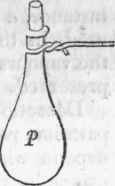
Digestion is an operation similar to maceration, except that the power of the fluid is aided by a gentle heat. It is usually performed in a glass matrass, p, and the evaporation of the liquid impeded by stopping the mouth of the matrass slightly with a plug of tow, or tying over it a piece of wet bladder perforated with small holes. When the menstruum is valuable, as alcohol, for instance, another matrass, with a smaller mouth, may be inverted over the former, and the joinings secured by a piece of wet bladder; or, what is perhaps preferable, a long open glass tube may be luted to the mouth of the matrass which contains the materials. By these means, any part of the liquor which is resolved into steam by the heat is condensed, and conveyed back upon the materials. The matrass may be heated either by a common fire, or a lamp, a water-bath, or a sand-bath; and, when either of the latter are used, the matrass should not be sunk deeper in the water, or the sand, than the portion that is filled. The process has been denominated Circulation, when the condensed vapours are returned upon the ingredients.
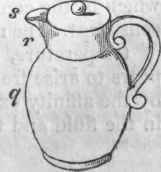
Infusion is intended principally to extract the volatile and aromatic principles of vegetable substances, which would be dissipated by digestion or decoction; and also those parts of vegetables which are more readily soluble in water, as gum, sugar, extract, tannin, the salts, and part of the resin, from the insoluble parts. The water is poured boiling hot on the materials, sliced, or reduced to a coarse powder, and kept in a closely covered vessel until they are cold; when the infusion or.liquor is decanted off for use. The best infusion pots are of a globular form in the body, g, with the neck, r, cylindrical, and having a very large lip or spout, s, furnished with a grating, which should incline inwards towards the top, so as to retain the ingredients in decanting off the infusion. Infusions differ according to the length of time the water has stood on the materials, and the heat employed. In some instances agitation is necessary. Infusions may be made with cold water; and these are in general more grateful, although weaker.
Decoction, or boiling, is intended to answer the same purposes as infusion: but in a more extended degree. The solvent power of the menstruum is increased by the degree of heat: hence the liquor is deeper coloured, and more loaded with the soluble principles of the vegetable. Decoction is employed with advantage to extract the mucilaginous parts of plants, their bitterness, and several other of the vegetable principles. It is generally performed in slightly covered vessels; but when the menstruum is valuable, as alcohol, for instance, a retort and receiver, or the common still, may be used, in the body of which the decoction is prepared, while the vapours that would otherwise escape are condensed and preserved.
Decoction, however, is often a prejudicial mode of preparation, particularly for those vegetables the virtues of which depend wholly or in part on the essential oil, or volatile principles they contain; and even some fixed principles, such as Extractive; the former are dissipated, the latter is oxidized and injured by it.
Extraction. If the liquor, which is obtained by either infusion or decoction, be subjected to evaporation, the watery part is dissipated, and the portion which was extracted by it is obtained in the solid form, and is denominated an Extract. The same objections may be urged against this species of preparation as were stated under Decoction.
All the forms of preparation in which water is the agent may be regarded as various modifications of solution. When alcohol or diluted spirits are employed as menstrua, the ingredients subjected to their action are generally macerated, and the filtered fluid, which is the product, is denominated a Tincture. (See Part III.) c. Of the operations in which changes are produced in bodies by chymical agents.
Under this division we have only to notice Coagulation, which is the conversion of a fluid into a solid more or less consistent. The means employed for this purpose are increase of temperature, alcohol, acids, and runnets. The effect appears to arise from a new arrangement of particles produced by the affinity exerted between the solid particles contained in the fluid and the coagulating substance.
d Of, the operations in which changes are produced by the chymical action of one set of bodies upon another.
These are - Decomposition, Dissolution, Precipitation, Crystallization, Fermentation.
Decomposition implies the separation of the component parts of bodies from one another. It is produced, in some cases, by heat, or the introduction of caloric into a body in sufficient quantity to separate the particles from one another to a distance beyond their sphere of attraction, to overcome the affinity which held them in combination. It may be effected, also, by electricity or galvanism; but in the greater number of instances it is the result of a superior affinity, which breaks the weaker affinity that holds the principles of the substance about to be decomposed in union, and produces new compounds. The influence of decomposing affinities is greatly modified by heat.
In pharmaceutical operations decomposition frequently occurs : and it is of the utmost importance in extemporaneous prescription, to be acquainted with the circumstances which cause it.
Continue to:


My Books

