


The Epidermis And Periderm. Part 3
Description
This section is from the "Histology of Medicinal Plants" book, by William Mansfield. Also see Amazon: Histology of Medicinal Plants.
The Epidermis And Periderm. Part 3
Unicellular Non-Glandular Hairs
True plant hairs are tubular outgrowths of the epidermal cell, the length of these outgrowths being several times the width of the hair.
The unicellular hairs are common to many plants. The two groups of non-glandular unicellular hairs are, first, the solitary; and secondly, the clustered hairs.
Solitary unicellular hairs occur on the leaves of chestnut, yerba santa, lobelia, cannabis indica, the fruit of anise, and the stem of allspice, senna, and cowage.
Chestnut hairs (Plate 7, Fig. 1) have smooth yellowish-colored walls, and the cell cavity contains reddish-brown tannin. These hairs occur solitary or clustered; the clustered hairs normally occur on the leaf, but in powdering the drug, individual hairs of the cluster become separated or solitary.
Yerba santa hairs (Plate 7, Fig. 4) are twisted, the lumen or cell cavity is very small, and the walls, which are very thick, are grayish-white.
Lobelia hairs (Plate 7, Fig. 5) are very large. The walls are grayish-white, and the outer surface extends in the form of small elevations which make the hair very rough. The hair tapers gradually to a solid point.
Cannabis indica hairs (Plate 7, Fig. 6) are curved. The apex tapers to a point and the base is broad, and it frequently contains deposits of calcium carbonate. The walls are grayish-white in appearance, and rough. The roughness increases toward the apex.
The hairs of anise (Plate 7, Fig. 7) are mostly curved; the walls are thick, yellowish-white, and the outer surface is rough; this is due to the numerous slight centrifugal projections of the outer wall.
Allspice stem hairs (Plate 7, Fig. 2) have smooth walls. The cell cavity is reddish-brown. The hair is curved.
The hair of senna (Plate 7, Fig. 10) is light greenish-yellow with rough papillose walls. The hair is usually curved and tapering, and it does not have any characteristic cell contents.
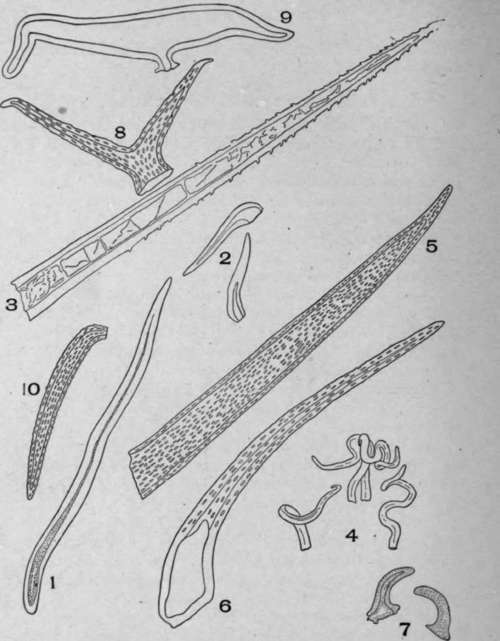
Plate 7. Unicellular Solitary Hairs.
1. Chestnut leaf (Castanea dentata, [Marsh] Borkh).
2. Allspice stems (Pimenta officinalis, Lindl.).
3. Cowage.
4. Yerba santa (Eriodictyon californicum, [H. and A.] Greene).
5. Lobelia (Lobelia inflata, L).
6. Cannabis indica {Cannabis sattva, L.).
7. Anise fruit (Pimpinella anisum, L.).
8. Hesperis matronalis (Hesperis matronalis, L.).
9. Galphimia glauca (Galphimia glauca, Cav.). 10. Senna (Cassia angustifolia, Vahl.).
Cowage hairs (Plate 7, Fig. 3) are lance-shaped, and they terminate in a sharp point. The outer wall contains numerous recurved teeth-like projections. The cell cavity is filled with a reddish-brown contents which are somewhat fissured.
Clustered unicellular hairs occur on the leaves of chestnut, witch-hazel, althea, European oak, etc. In European oak (Plate 8, Figs. 1 and 2) clusters of two and three hairs occur. The walls are yellowish-white, smooth, and the tip of the hair is solid.
In kamala (Plate 8, Fig. 3) clusters of seven or more hairs occur; the walls are yellowish, and the cell cavity is reddish-brown. In witch-hazel leaf (Plate 8, Fig. 4) clusters of a variable number of hairs occur. The hairs, which are of various lengths, have yellowish-white, thick, smooth walls, and reddish cell contents.
In althea leaf (Plate 8, Fig. 5) the hairs are nearly straight and the walls are smooth. The basal portions of the hair are strongly pitted.
Branched solitary unicellular hairs occur on the leaves of hesperis matronalis (Plate 7, Fig. 8), and on galphimia glauca (Plate 7, Fig. 9).
The hair of hesperis matronalis has smooth walls, and the two branches grow out nearly parallel to the leaf surface.
The hair of galphimia glauca has rough walls, and the two branches grow upward in a bifurcating manner.
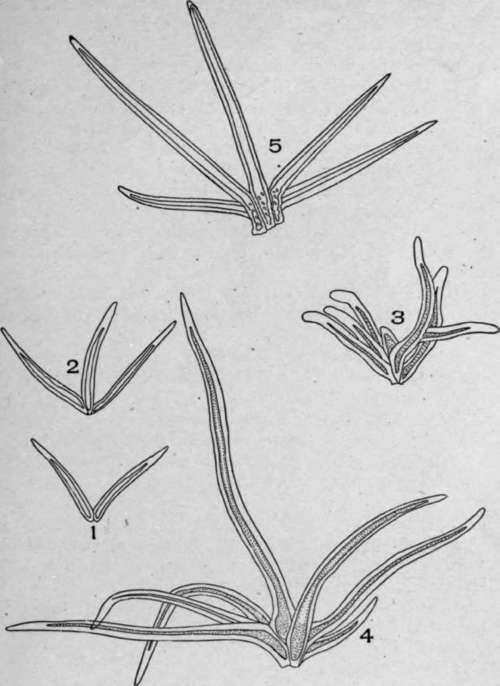
Plate 8. Clustered Unicellular Hairs.
I and 2. European oak (Quercus infectoria, Olivier).
3. Kamala {Mallotus philippinensis, [Lam.] [Muell.] Arg.).
4. Witch-hazel leaf (Hamamelis virginiana, L.).
5. Althea leaf (Althaea officinalis, L.).
Multicellular Hairs
Multicellular hairs are divided into the uniseriate and the multiseriate hairs. Both of these groups are divided into the branched and the non-branched hairs, as follows:
1. Uniseriate
(A) Non-branched.
(B) Branched.
2. Multiseriate
(A) Non-branched.
(B) Branched.
Multicellular uniseriate non-branched hairs occur on the leaves of digitalis, Western and Eastern skullcap, peppermint, thyme, yarrow, arnica flowers, and sumac fruit.
Digitalis hairs (Plate 9, Fig. 1) are made up of a varying number of uniseriate-arranged cells of unequal length, frequently placed at right angles to the cells above and below; the walls are of a whitish color, and are rough or smooth.
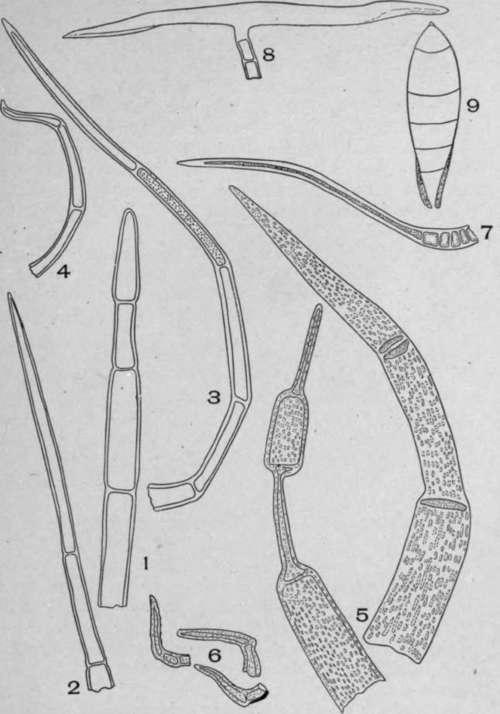
Plate 9. Multicellular Uniseriate Non-Branched Hairs.
1. Digitalis leaf (Digitalis purpurea, L.).
2. Arnica flower (Arnica montana, L.).
3. Western skullcap plant (Scutellaria canescens, Nutt.).
4. Eastern skullcap plant (Scutellaria lateriflora, L.)
5. Peppermint leaf (Mentha piperita, L.).
6. Thyme leaf (Thymus vulgaris, L.).
7. Yarrow flowers (Achillea millefolium, L.).
8. Wormwood leaf (Artemisia absinthium, L.).
9. Sumac fruit (Rhus glabra, L.).
Eastern skullcap (Plate 9, Fig. 4) has hairs with not more than four cells; these hairs are curved, and the walls are whitish, sometimes smooth, but usually rough. In Western skullcap (Plate 9, Fig. 3) the hairs have sometimes as many as seven cells. The walls are white and rough, and the individual cells of the hair are much larger than are the cells of the hairs of true skullcap.
Peppermint (Plate 9, Fig. 5) has from one to eight cells. The hair is curved, and the walls are very rough.
Thyme (Plate 9, Fig. 6) has short, thick, rough-walled trichomes, the terminal cell usually being bent at nearly right angles to the other cells.
Yarrow hairs (Plate 9, Fig. 7) have a variable number of cells. In all the hairs the basal cells are short and broad, while the terminal cell is greatly elongated.
Arnica hairs (one form, Plate 9, Fig. 2) have frequently as many as four cells, the terminal cell being longer than the basal cells. The walls are white and smooth.
Sumac-fruit hairs (Plate 9, Fig. 9) have spindle-shaped, reddish-colored hairs.
Multicellular multiseriate non-branched hairs occur on cumin fruit and on the tubular part of the corolla of calendula.
The hairs on cumin fruit vary considerably in size. All the hairs are spreading at the base and blunt or rounded at the apex. The cells forming the hair are narrow and the walls are thick. Three differently sized hairs are shown in Plate 10, Fig. 1.
The hairs of the base of the ligulate petals of calendula (Plate 10, Fig. 2) are biseriate. The hairs are very long and the walls are very thin.
Multicellular uniseriate branched hairs occur on the leaves of dittany of Crete, mullen, and on the calyx of lavender flowers.
The dittany of Crete (Plate 11, Fig. 3) hair is smooth-walled, and the branches are alternate.
In mullen (Plate 11, Fig. 1) the hairs have whorled branches, the walls are smooth, and the cell cavity usually contains air. The lavender hairs (Plate 11, Fig. 2) have mostly opposite
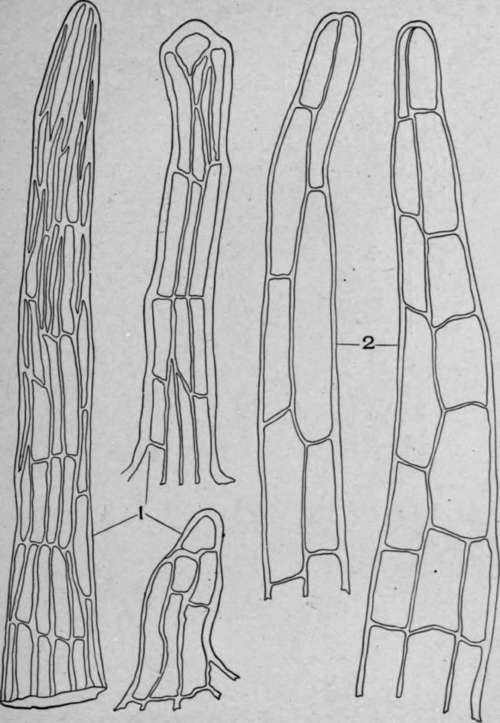
Plate 10. Multicellular Multiseriate Non-Branched Hairs.
1. Cumin (Cuminum cyminum, L.). 2. Marigold (Calendula officinalis, L.).
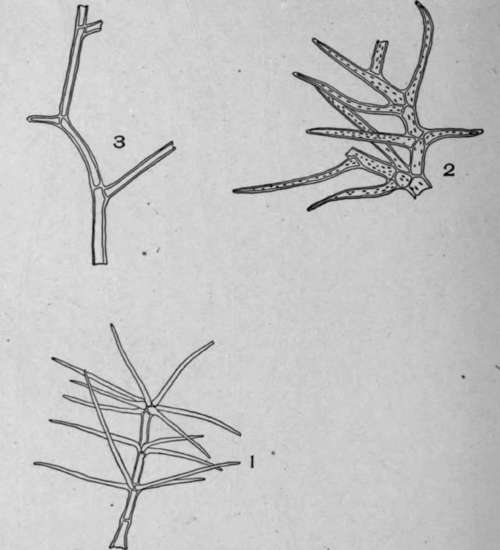
Plate 11. Multicellular Uniseriate Branched Hairs.
1. Mullen leaf (Verbascum thapsus, L.).
2. Lavender flowers (Lavandula vera, D. C).
3. Dittany of Crete (Origanum dictamnus, L.) branches, and the walls are rough. Thus the multicellular branched hairs may be divided into subgroups which have alternate, opposite, whorled, or in certain hairs irregularly arranged branches. Each class may be again subdivided according to color, character of cell termination, etc., as cited at the beginning of the chapter.
Continue to:


My Books

