


Chapter VII. Flowers
Description
This section is from the "Histology of Medicinal Plants" book, by William Mansfield. Also see Amazon: Histology of Medicinal Plants.
Chapter VII. Flowers
The histological structure of flowers is readily seen in the powder; therefore, in studying flowers, it is not necessary to section the various parts. Each part of the flower should be isolated and powdered separately and each separated part studied. In each case the powders will contain surface, cross-, and radial sections of the parts powdered. While studying flowers, special attention should be given to the pollen grains, to the papillae of the petals, to the papillae of the stigma, and, in certain flowers, to the style tissue. In the composite flowers special attention should also be given to the involucre scales, to the scales of receptacle, and, when present, to the pappus. In addition, attention must be given to secretion cavities, as in cloves.
Pollen Grains
Pollen grains are one of the most characteristic elements found in powdered flowers, because they are so small that they are not broken up when the drug is milled.
The two principal groups of pollen grains are, first, those with non-spiny walls (Plate 113); and, secondly, those with spiny walls (Plate 114), as shown in the two charts.
In lavender flowers the pollen grains have six constrictions of the outer wall. This wall is slightly striated and the cell contents are granular.
In clover flowers the pollen grains are mostly rounded in outline, the wall is uniformly thickened, and cell contents are coarsely granular.
In belladonna flowers the pollen grains terminate in three blunt points.
In Spanish saffron the pollen grains are spherical and the cell contents are granular.
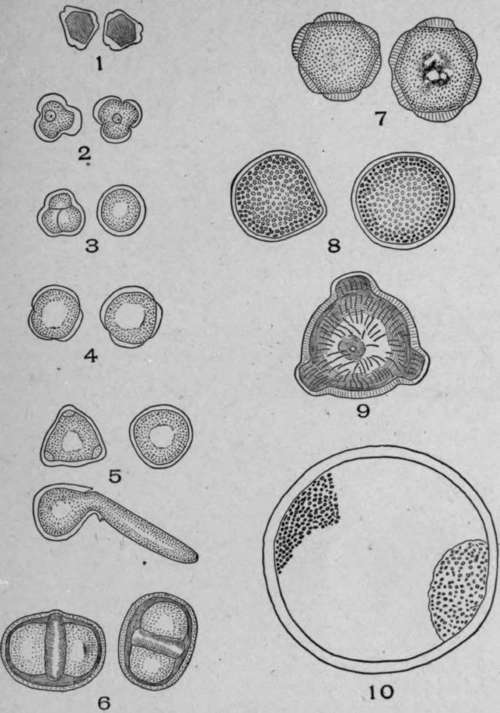
Plate 113. Smooth-walled Pollen Grains.
1. Cloves {Eugenia caryophyllata, Thunb.). 2. Santonica (Artemisia paucifiora, Weber). 3. Elder (Sambucus canadensis, L.). 4. Century minor (Erythrcea centaurium [L.], Pers.). 5. Pichi (Fabiana imbricata, R. and P.). 6. Cyani. 7. Lavender (Lavandula officinalis, Chaix.). 8. Clover (Trifolium pratense, L.). 9. Belladonna (Atropa belladonna, L.). 10. Spanish saffron (Crocus sativus, L.).
The non-spiny-walled pollen grains differ not only in microscopic appearance, but also in size. Clove pollen grains are the smallest, while Spanish saffron pollen grains are the largest.
Non-Spiny-Walled Pollen Grains
In cloves the pollen grains show a six-sided, angled cavity and an outer wall which terminates in three slightly pointed, narrowly notched portions, separated by nearly straight walls.
In santonica the pollen grains have smooth, unequally thickened walls, which are strongly constricted at three points, the outline resembling three half-circles placed together.
In elder flowers the pollen grains appear circular or three-parted. The wall is of nearly uniform thickness, even at the constricted part of the grain.
In century minor the pollen grains show three pronounced restrictions. The wall at these points is very thin. In pichi flowers the pollen grains are either circular or three-sided and three-pointed. Inside of each point there is a nearly white pore. In some of the grains the pollen tube has grown out of one of the pores.
In cyani flowers the pollen grains are longer than broad and the cell contents appear to be divided into two end portions and an elevated middle portion
Spiny-Walled Pollen Grains
In anthemis the pollen grains have unequally thickened walls constricted in three places. The spines are short, broad at the base, and sharp-pointed.
In arnica flowers the pollen grains show three light-colored pores and numerous short spines.
In calendula flowers the pollen grains show one or more pores, typically three pores. These pores appear as white spots, and the wall immediately over the pore is smooth and thinner than the remaining part of the wall; the spines are very numerous.
In cassia flower pollen grains the outer wall is extended into a number of rounded projections which are frequently arranged in sets of fours.
In American saffron flowers the pollen grains show one, two, or three light-colored pores; the spines are short and broad.
In blue malva flowers the pollen grains are spherical and the outer wall extends into numerous spinelike projections.
It will be observed that the spiny-walled pollen grains differ greatly in size, the smallest being the pollen grain of anthemis and the largest being the pollen grain of blue malva flowers.
In matricaria are numerous, greenish-brown, spiny-walled pollen grains. In anthemis are multicellular, uniseriate non-glandular hairs with three or four short, broad, yellow-walled basal cells and a greatly elongated, thin, gray-walled apical cell.
In arnica are multiseriated branched hairs of the pappus, and numerous large, yellowish, spiny-walled pollen grains.
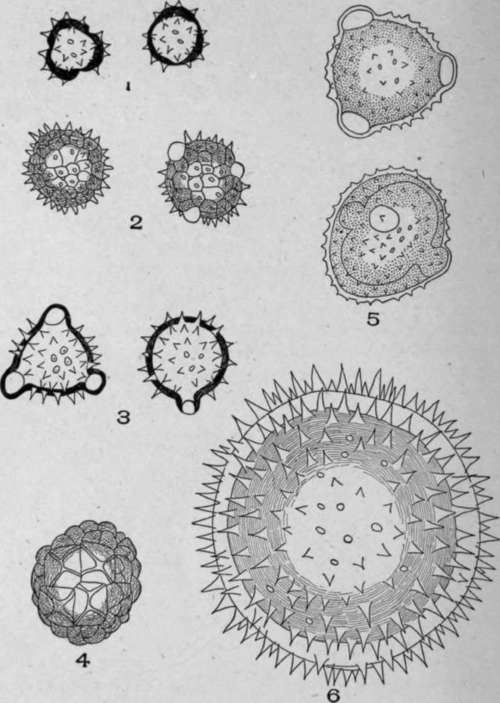
Plate 114. Spiny Walled Pollen Grains.
1. Anthemis (Anthemis nobilis, L.).
2. Arnica (Arnica montana, L.).
3. Calendula {Calendula officinalis, L.).
4. Cassia flowers.
5. American saffron (Carthamus tinctorius, L.).
6. Blue malva flowers {Malva sylvestris, L.).
Stigma Papillae
The papillae of the stigma of most flowers form a characteristic element even when the flower is powdered. In the case of composite flowers the papillae of the disk and ray flowers differ. In American saffron the papillae of the style differ in a recognizable way from the papillae of the stigma.
The papillae of the stigma of the ray and disk flowers of arnica, anthemis, matricaria, and insect flowers differ greatly. Even the papillae of the stigma of the ray and disk flowers differ. In all cases observed the papillae of the ray flowers are smaller than the papillae of the disk flowers.
The papillae of the stigma of saffron (Plate 115, Fig. 3) are long and tubular. These papillae are nearly uniform in diameter, and the apex is blunt and rounded. The wall is slightly granular in appearance. The papillae of the stigma of American saffron (Plate 116, Fig. 2) are short and tubular. Each papilla is broadest at the base and tapers to a slender point. The papillae of that part of the style which emerges from the corolla (Plate 116, Fig. 1) are large and curved, and the walls are very thick. The apex of the papilla is frequently solid.
The papillae of the stigma of the ray flowers of anthemis (Plate 117, Fig. 1) have thin, slightly striated walls; while the papillae of the stigma of the disk flowers (Plate 117, Fig. 2) are longer, the walls are thicker, and the cell content is denser.
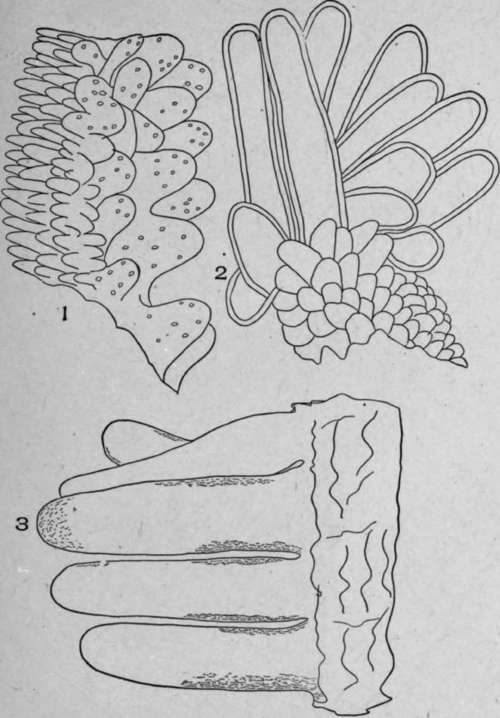
Plate 115. Papillae.
1. Arnica ray flowers (Arnica montana, L.).
2. Insect flower disk (Chrysanthemum cinerariifolium [Trev.], Vis.).
3. True saffron (Crocus sativus, L.)
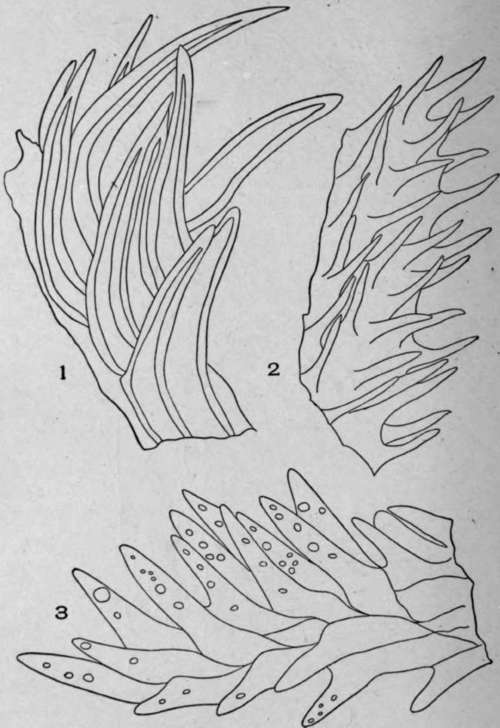
Plate 116. Papillae of Stigmas.
1. Stigma papillae of American saffron (Carthamus tinctorins, L.) from that part of the style that emerges from the corolla.
2. Papillae from the upper part of the stigma of American saffron.
3. Papillae of the stigma of the disk flowers of arnica (Arnica montana, L.).
The papillae of the stigma of the ray (Plate 117, Fig. 3) and disk flowers (Plate 117, Fig. 5) of matricaria are similar in structure, but the papillae of the disk flowers are larger.
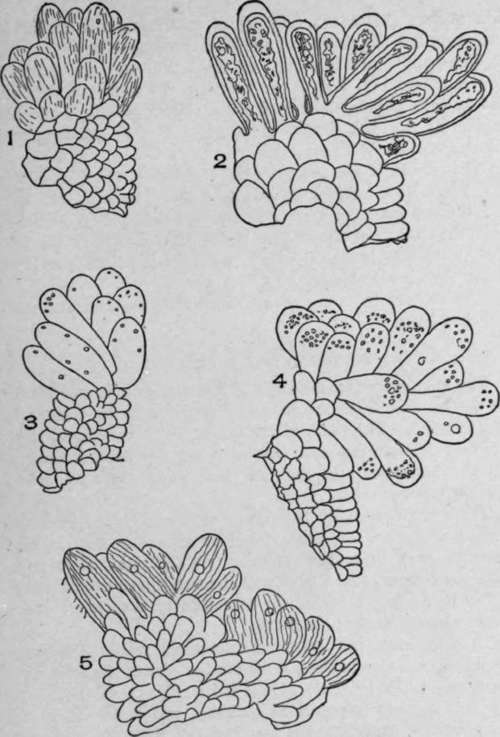
Plate 117. Papillae of Stigmas.
1. Stigma papillae of the ligulate flowers of anthemis {Anthemis nobilis, L.).
2. Stigma papillae of the tubular flowers of anthemis.
3. Stigma papillae of the ligulate flowers of matricaria {Matricaria chamo-milla, L.).
4. Stigma papillae of the disk flowers of matricaria.
5. Stigma papillae of the ligulate flowers of insect flower (Chrysanthemum cinerariifolium [Trev.], Vis.).
The papillae of the stigma of the ligulate flowers of insect flowers (Plate 117, Fig. 5) are tubular; the walls are striated, and in each papilla there is a small yellow globule, while the papillae of the disk flowers (Plate 115, Fig. 2) are long and tubular, and the walls are thick.
The papillae of the stigma of the ray flowers of arnica (Plate 115, Fig. 1) are very short and tubular. The walls are thin and the cell contents appear as small, bright-yellow globules, while the papillae of the stigma of the disk flowers (Plate 116, Fig. 3) are broadest at the base, the apex is pointed, and the yellow globules are larger.
The solitary hairs are divided into the branched and non-branched hairs.
Continue to:


My Books

