


Part 36. Herbage Vegetables. Part 3
Description
This section is from the book "Plants And Their Uses - An Introduction To Botany", by Frederick Leroy Sargent. Also available from Amazon: Plants And Their Uses; An Introduction To Botany
Part 36. Herbage Vegetables. Part 3
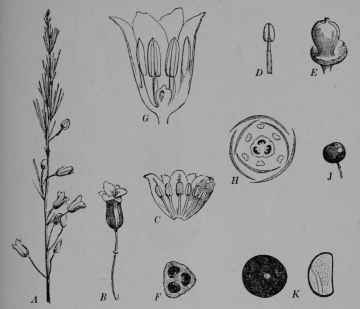
Fig. 62, II.-Asparagus. A, upper part of a flowering branch. X 3/4. B, flower, enlarged. C, perianth and stamens of the same spread out. D, stamen, outer view. E, pistil. E, cross section of ovary. G, flower cut in half vertically. H, Diagram showing the arrangement of the parts of the flower. J, fruit, natural size. K, seed, enlarged, and in vertical section. (LeMaout and Decaisne.)
The relatively large proportion of mineral matter in the dry substance, i. e., the entire substance free from water, of succulent vegetables and fruits deserves particular notice, for there is good reason to believe that certain salts here included impart to the fresh juice of these plants a peculiar value quite independent of their worth as nutriment. It has been observed that when, as on long voyages, men are deprived of food containing such vegetable juices, a serious and often fatal disease, known as scurvy, is likely to attack them. Sea captains and military commanders are now required by law to supply this need in the rations of their men (lime-juice is very largely used for the purpose), and scurvy is no longer feared. As these vegetable juices possess scarcely any nutritive value, the above facts clearly indicate that special salts dissolved in the juices have an important use in keeping our bodies in healthy condition.

Fig. 63. Wild Kale (Brassica oleracea, variety sylvestris, Mustard Family, Crucifera). A, plant in its first year showing rosette of leaves, much reduced. B, upper part of flowering stem developed the second year. Slightly reduced. C, a flower. D, a sepal. E, a petal, enlarged. F, essential organs of the flower. G. fruit. (A, Redrawn from Bailey, the others from Reichenbach.)-The plant is a biennial growing wild on rocky seashores, the first year producing only a rosette of leaves and the second year attaining often a height of 1 m.; stem and leaves rather fleshy, pale bluish green, smooth, covered with a waxy bloom; flowers yellow.
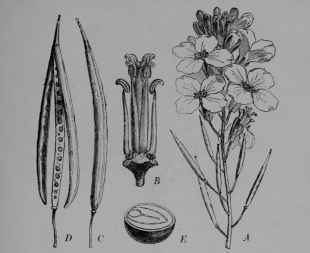
Fig. 64.-Wild Kale. A, flower cluster. B, flower with calyx and corolla removed to show the stamens and pistil. C, fruit. D, the same splitting open and exposing the seeds. E, seed cut across to show the folded parts of the germ within the seed-coat. (Baillon.)
The difference in chemical composition and food value between herbage-vegetables and the various underground parts and seeds already studied may be accounted for by the peculiar purpose which green herbage serves in the plant's life. Whereas food is stored abundantly in parts which are to live over the winter in order that new growth may be hastened at the return of favorable conditions, it is the foliage which makes the food that is stored away.
The making of food requires sunlight, and is accomplished by means of the green coloring matter characteristic of herbage. This pigment is termed chlorophyll.1 It dissolves in alcohol, and the extract possesses the peculiar property of showing two colors-green when the light shines through it, and red when the surface is strongly illuminated.
1 Chlo'-ro-phyll - Gr. chloros, green; phyllon, leaf.
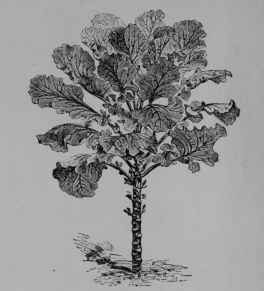
Fig. 65.-Garden Kale or Borecole (B. oleracea, var. acephala). Plant showing appearance at close of first year's growth, x 1/12. (Vilmorin.)
The raw materials out of which chlorophyll-bearing plants make their food are carbon dioxid (CO2), water (H2O), and dissolved mineral salts containing nitrogen, phosphorus, sulphur, iron, potassium, etc. The carbon dioxid, known as carbonic acid when dissolved in water, is a gas which forms about one twenty-five-hundredth of the atmosphere, and a somewhat larger proportion of all the natural waters of the earth. It is being breathed out continually by plants and animals, and so would increase enormously in amount were it not absorbed by the green parts of plants. Five per cent of the gas mixed with air acts like a poison when breathed in by animals, but even larger amounts are quite harmless to plants.
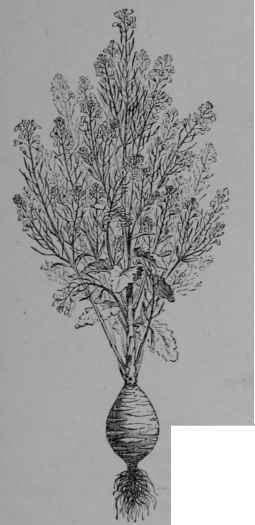
Fig. 66.-Kohl-rabi (B. oleracea, var. gongylodes). Plant in flower, much reduced. (Baillon.)
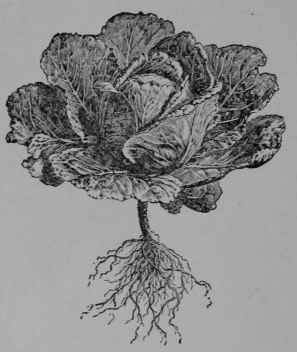
Fig. 67.-Common Cabbage (B. oleracea, var. capitata). Plant at close of first year's growth. Much reduced. (Nicholson.)
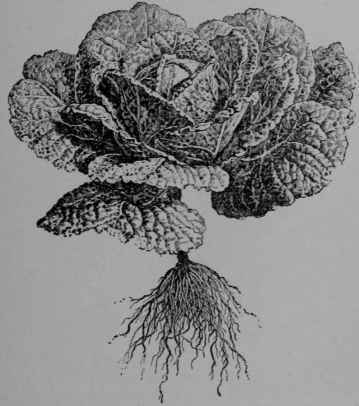
Fig. 68-Savoy Cabbage (B. oleracea, var. sabauda) Plant at close of first year's growth, showing the characteristically blistered leaves. Much reduced. (Nicholso.)
Continue to:


My Books

