


Gamboge - Coloring Matters Or Dyes
Description
This section is from the book "Plants And Their Uses - An Introduction To Botany", by Frederick Leroy Sargent. Also available from Amazon: Plants And Their Uses; An Introduction To Botany
Gamboge - Coloring Matters Or Dyes
Gamboge is a gum-resin obtained from the Siamese gamboge-tree (Fig. 274) and other Asiatic species of the same genus. The resinous material flows from the bark through cuts, and is collected in hollow joints of bamboo. In these it hardens into cylinders, which, after they are removed for export, are found to bear the marks of the curious receptacle. Gamboge mixes readily with water, and largely dissolves in oils and in alcohol. For this reason as well as for its bright transparent yellow color it is highly valued by artists as a pigment. It is widely used also to impart a golden tinge to varnish intended for certain purposes, especially in lacquer for metal work.
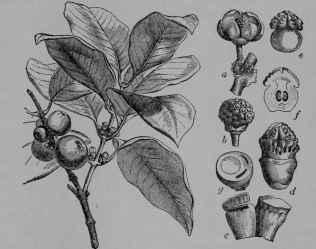
Fig. 274.-Siamese Gamboge-tree (Garcinia Hanburyi, Gamboge Family, Guttiferoe). Branch with pistillate flowers and fruit; a, pistillate flower; b, staminate flower; c, stamens; d, pistil surrounded by rudimentary stamens; e, pistil; f, same, cut vertically; g, ovary, cut across. (Baillon, Hanbury.)-Tree about 18 m. tall; leaves glossy; flowers yellowish; fruit cherry-like, reddish brown. Native home, Southern Asia.
Continue to:


My Books

