


July - Third And Fourth Weeks. July 16-31. Flowers
Description
This section is from the book "The Garden Week By Week Throughout The Year", by Walter P. Wright. Also available from Amazon: The Garden Week by Week Throughout the Year.
July - Third And Fourth Weeks. July 16-31. Flowers
Several important operations often come on during the second week of July, notably budding Roses, layering Carnations, and manipulating Chrysanthemum buds. In each of these cases the exact period is decided by the weather.
Budding Roses
Large growers of Roses get the greater part of their Rose budding done between the middle of July and the middle of August. Should there be a good deal of showery weather in June and the early part of July, they begin earlier. As a matter of fact, the budding of Roses may be done as readily and as successfully in June as in August if there is a supply of suitable wood for making buds, and the sap is flowing freely enough in the stocks for the pith to come out freely. Let me explain what I mean by "suitable wood." The part of a Rose which is taken when propagation by means of budding is practised is a slice about two inches long cut from a firm shoot of the current year's growth underneath a leaf. It seems remarkable that such a slip of wood will give a strong, healthy shoot, but it certainly will if it is handled properly. One piece of growth will give several such slips. If the base of the leaf-stalk be examined when the slip has been cut out it will be seen that there is a small green knot there. This knot goes through the bark, and its base is lodged in the pith or woody matter of the slip. The delicacy of the operation of budding is to remove the pith without tearing the knot out with it. Let the amateur practise on a few slips. So long as he finds that there is nothing but a small cavity left under the leaf-stalk when he has pulled out the pith he is under the obligation of confessing failure and trying again. But when he is able to point to a green, pin-head-like knot firmly seated in the bark under the leaf-stalk after the pith has gone, he can claim success. After having got so far, he might still fail if he let the bud get dry before putting it in; it is very important that it should be kept moist. The pith parts the most readily from the bark after rain. If a budder wanted to get his budding done at a particular time and the weather was dry, he would do well to give the plants from which he intended to take buds a good soaking of water.

Fig. 50. - Budding Dwarf Roses.
a. The bud.
b. Pith which must be carefully removed c. The top cut off at the dark line.
d. How to open the bark of the stock.
e. The bud inserted and tied in.
As regards stocks for working the buds on to, they must consist of standard Briers dug out of the hedgerows in autumn, or dwarf Briers two or three years old, raised from seed or cuttings. In the first case the buds should be inserted in the side shoots which break from the upper part of the standards in late spring, and which may be two feet long by midsummer. The cuts to receive the buds should be made near the base of the shoots, and should consist of one cross and one longitudinal cut, the latter being about two inches long, and coming up to the centre of the former. The edges of the bark can be raised to receive the bud with the flat polished handle of the budding knife. When the bud has been slipped down, it can be tied in with worsted or raphia. It should be made firm, but not bound very tightly. In the case of dwarf stocks, one bud can be put in the main stem just beneath the soil.
The necessaries for budding Roses may be summarised as follows: (1) a supply of stocks, either raised by propagating or transplanted from the hedgerows; (2) a supply of shoots of the current year's growth to yield buds; (3) a flat-handled, polished budding knife; (4) some tying material. The order of the operations may be summarised thus: (1) remove some strong, clean shoots of the current year's growth after showery weather between mid-July and mid-August; (2) remove the leaves, but allow half an inch of each stalk to remain, as it will form a handle; (3) take out a slice about two inches long, and about a sixteenth of an inch deep, beneath the leaf-stalk, with a sharp knife; (4) holding the slice by the leaf-stalk, pull out the pith without tearing away the little green knot in the centre; (5) instantly slip the bud down between the raised edges of a longitudinal cut in the stock; (6) tie it in. If the buds are inserted in June, they often make a great deal of growth the same year, and the plants may even bloom the same summer; but if put in later they do not grow until the following spring, and this is quite as well.
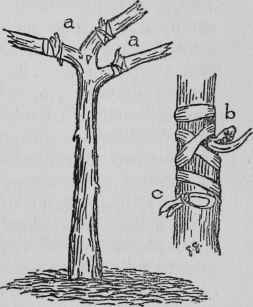
Fig. 51. - Budding Standard Roses.
a. Where to insert the buds.
b. The bud secured by strands of soft material, c.
Amateurs who fail with their first year's buds (and it is common to have a good many failures in early attempts at budding, for after all the operation is a somewhat delicate one) should pay particular attention to three points the following year: (1) that there is free growth both in Rose and stock when the work is started; (2) that the green knot is left in the bud when the pith is pulled out; (3) that the bud is kept fresh. If these matters are right, success will come. In the large Rose nurseries, labouring men with rough horny hands do the budding, and make few mistakes. They cultivate long finger-nails during budding time, on the ground that they can get hold of the pith better than they can when their nails are pared close! Perhaps the amateur may try this also.
Continue to:


My Books

