


Beurre Sprin - Bicton Pine Strawberry
Description
This section is from "The Horticulturist, And Journal Of Rural Art And Rural Taste", by P. Barry, A. J. Downing, J. Jay Smith, Peter B. Mead, F. W. Woodward, Henry T. Williams. Also available from Amazon: Horticulturist and Journal of Rural Art and Rural Taste.
Beurre Sprin - Bicton Pine Strawberry
Beurre Sprin
Size - medium. Form - obovate, obtuse pyriform. Color - pale yellow, slightly traced with russet, and with occasionally a blush cheek. Flesh - melting, juicy, rich, with a peculiar aroma. Season - October.
Beurre Sterckman
Mr. Cabot moved it be called Beurre* Hardy, as it has been pretty generally known by that name, and that it be carried to the list for general cultivation. The name was adopted, and the pear loft where it is. Mr. Barry: French Nurserymen say there is no such pear as Beurre Sterckman.
Beurrede Wetteren
Tree - vigorous, very thorny, suitable for a pyramid. It bore for the first time in 1847. Fruit - middle-sized, turbinate. Stalk - about an inch in length, rather thick, slightly curved, with some small plaits around its insertion. Eye - sunk in a wide, evenly-formed cavity. Skin - completely covered with russet, and slightly colored next the sun. Flesh - fine, yellowish-white, half-melting, buttery, with an abundant sugary, agreeably perfumed, musky juice. [In the Annates de Pomologie, where this sort is figured and described, p. 59, it is stated to have been discovered by M. Louis Berkmans, in his garden at Heyst-op-den-Berg, among a number of wild Pear trees, which were partly from his own sowings, and partly from those of the late Major Esperen, of Mechlin].
Bezi De Caen
Fruit - Size, medium; form, oblong, pyri-form; color, dull brown; skin, smooth, russet on a greenish yellow ground, scattering suffused dots of irregular size, and form dark, almost black, russet spots depressed; flesh, white, fine, granulated, melting, juicy, sweet, a very slight astringency, aromatic, perfumed; "very good;" stem, moderately stout, set without depression; calyx, small, with irregular, wavy, connected segments; basin, regular, shallow, smooth, and even; core, small; seed, small, plump, globular, acute, pyriform; season, December. The Bezi de Caen is a firm fruit, tree a good bearer, and promises to be of value as an early or mid-winter pear.
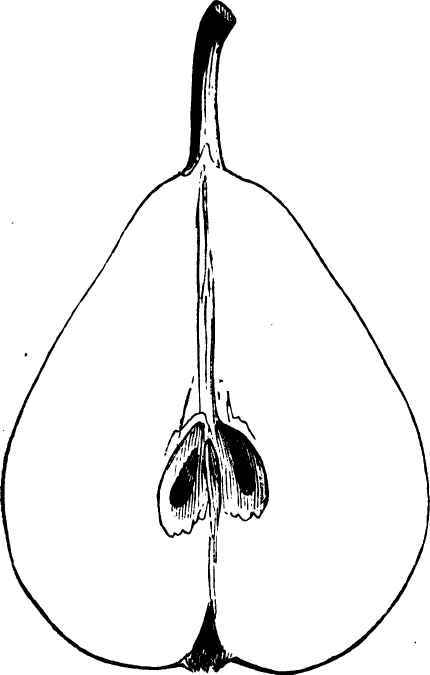
Fig. 27. - Bezi de Caen.
The Bhotan Pine. Pinus Excelsa
This variety resembles the white pine, except that its foliage is longer and its branches somewhat pendulous, but in our Northern States it can not be regarded as perfectly hardy. In the southern Middle States it is one of the finest among evergreens, and should be freely planted.
Bicton Pine Strawberry
This very showy berry is a desirable acquisition where a variety are cultivated; either by itself, or interspersed with the scarlets, it is highly ornamental, and deserves, also, for its other merits and size, to be in every collection. It is a foreign variety, received at first as not hardy, bnt time has shown that, with moderate protection, it may be wintered anywhere, and bear a fair crop of large, handsome berries, having an agreeable, musky aroma.
Large, roundish, pale flesh color, with a reddish tinge on the sunny side; fragrant, and tolerably high flavored. A moderate bearer. It is the largest and finest white Strawberry yet known. Flowers, hermaphrodite.
Continue to:


My Books

