


Beurre Kennes - Beurre Soulange
Description
This section is from "The Horticulturist, And Journal Of Rural Art And Rural Taste", by P. Barry, A. J. Downing, J. Jay Smith, Peter B. Mead, F. W. Woodward, Henry T. Williams. Also available from Amazon: Horticulturist and Journal of Rural Art and Rural Taste.
Beurre Kennes - Beurre Soulange
Beurre Kennes
Fruit medium, pyriform, of a dark hue, brown reddish with numerous dots, and a rather rough skin; a very conspicuous fruit in the garden. Quality good to very good; flesh half buttery, with a fine aroma, a little gritty at the core; but keeping well for its season, (end of September to middle of October); stem medium, sometimes fleshy and inclined obliquely. Calyx irregular with few or no segments. It was obtained by Alexander Bivort from the seedlings of Van Mons, and fruited in his grounds for the first time in 1845. The tree is a good grower and of a pyramidal shape. Succeeds upon the quince, but better upon the pear-stock.
Beurre Langlier
Size - large, three inches high by two and a half broad. Form - obovate pyriform, contracted in the upper part, and terminating obtusely at the stem. Stem - one inch or more in length, inserted without much depression, generally upright, but occasionally on one side. Calyx - medium size, sunk in coarsely plaited cavi
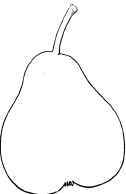
Beurre Langlier.
The tree is of a very strong vigorous habit, and succeeds well both on the quince and pear stock. The fruit adheres firmly until late in the season, keeps well, and promises to sustain its high reputation as a capital winter variety
Beurre Navez
Size - large. Form - roundish-turbinate. Stem - About one inch in length, inserted in slight cavity. Calyx - open, set in moderately deep-basin. Color - clear green, becoming yellowish when ripe, dappled with russet, and brown on the sunny side. Flesh - melting and buttery, with sufficient juice. Flavor - very rich, subacid, with a fine aroma. Season - October to November. Quality - "very good," superior. Tree - succeeds well on Quince root.
Beurre Samoyeau
Medium size; skin yellow, with a red cheek; flesh buttery and juicy; last of September and first of October. Madame Desportes.- Medium size; skin yellow with reddish dots; flesh melting and juicy; September and October.
Beurre Seringe
Size, medium; form, same as the Urbaniste; color, yellowish, with brown and red cheek; flavor, melting, juicy, and fine; quality, very good; tree, hardy and prolific; ripe in September.
Beurre Six
Tree - vigorous and fertile, but requires to be worked on the Pear stock and grown against a wall. It is not adapted for pyramidal training. Fruit - large, pyriform. Skin - smooth, light green, dotted with deep green and brown. Flesh - white, very fine, melting, buttery, and sugary, with a delicious perfume flavor* Its season of maturity is November and December, in Belgium. Raised by M. Six, nurseryman at courtray.
Beurre Soulange
Size - medium to large. Form - acute-pyriform. Stem - one inch in length, stout, curved, fleshy at the junction. Color - pale yellow at maturity, with occasional traces of russet Flesh - melting and very juicy. Flavor - rich, sugary, with peculiarly pleasant aroma. Season - October to November. Quality - "very good;" will probably be classed as "best" A desirable acquisition; imported from Brussells many years since, and of doubtful nomenclature.
Continue to:


My Books

