


Home Recipes, Custard Sauce, Marshmallow Pudding, Recipes For Meat Jellies, Jellied Chicken, Aspic Jelly, Lemon Sponge, Dinner
Description
This section is from the "Cooking" book, by Lilla Frich. Also see Amazon: Cooking.
Home Recipes, Custard Sauce, Marshmallow Pudding, Recipes For Meat Jellies, Jellied Chicken, Aspic Jelly, Lemon Sponge, Dinner
Home Recipes
SNOW PUDDING 1.
Materials:
2 Tablespoons Granulated Gelatine. 1/2 Cup Cold Water. 2 1/2 Cups Boiling Water. 1 Cup Sugar. 1/2 Cup Lemon Juice. Rind 1 Lemon.
Soak gelatine 20 minutes in cold water, then dissolve in boiling water.
Add sugar, the lemon juice and rind, strain into a mold and chill.
When jellylike, beat the lemon jelly with a Dover egg beater until white and fluffy.
SNOW PUDDING 2.
May be made by preparing 1/2 the recipe of Lemon Jelly. When thick, beat with a Dover egg beater until frothy, add the stiffly beaten whites of 3 eggs and continue beating until stiff enough to hold its shape. Serve this with a Custard Sauce.
Custard Sauce
1 1/2 Cups Scalded Milk. 1/8 Teaspoon Salt. 1/4 Cup Sugar.
1/2 Teaspoon Vanilla. Yolk 3 Eggs.
Beat the yolks slightly, add sugar and salt; stir continually until mixture thickens and a coating is. formed on the spoon; chill and flavor. If cooked too long, custard will curdle. Should this happen, beating the mixture with the Dover egg beater will restore the smooth consistency. When eggs are scarce, use 2 yolks and 1/2 tablespoon cornstarch.
Marshmallow Pudding
Prepare mixture as for Snow Pudding, adding one-half the amount of sugar, omitting the lemon juice, but adding 1 teaspoon vanilla and the beaten whites of three eggs. Beat vigorously. Serve with whipped cream to which crushed and sweetened fruit has been added.
Questions
1. How would you class gelatine?
2. From what is gelatine obtained?
3. How is it prepared?
4. What food value has gelatine?
5. How would you hydrate gelatine?
6. How is gelatine dissolved?
7. Why is it necessary to dissolve it?
8. Name 3 recipes where gelatine is 1 of the ingredients.
9. What is gelatine called?
10. For what is it principally used in cookery?
11. What function has it in the body?
12. What are proteins?
13. What is their chief office in the body?
14. Give general rules for broiling meat.
15. Give general rules for roasting meat.
Suggestions For Home Application
Recipes For Meat Jellies
Jellied Chicken
Jellied chicken may be made by omitting the thickening in the recipe for chicken stew and boiling the stock down to 3/4 cupful. The meat should be removed when it is ready to fall from the bones. Decorate bottom of a mold with hard cooked eggs and parsley, fill mold with the meat freed from skin and bone. Season stock highly and pour it on the chicken. Put in a cold place to mold; a little dissolved gelatine may be added to the stock.
Aspic Jelly
1 quart white or brown stock, highly seasoned and clarified, 4 tablespoon-fuls gelatine soaked in 3/4 cup cold water, juice 1 lemon.
Add soaked gelatine and lemon juice to the hot stock.
Taste and season, if necessary. Mold and chill.
Stuffed tomatoes, stuffed olives, boned birds, stuffed chicken or salmon may be molded in aspic jelly mixture. Finely chopped olives, almonds and celery may be used as stuffing for the tomatoes.
PROTEIN - TISSUE BUILDING FOODS. PREPARATION OF GELATINE DESSERTS.
An invalid always appreciates variety in the diet, if permissible. Gelatine desserts are usually allowed, and, if the physician permits its use, any number of attractive combinations may be made with eggs or eggs and milk.
School Recipe.
MATERIALS:
Lemon Sponge.
1 Teaspoon Gelatine.
2 Tablespoons Cold Water. 2 Tablespoons Sugar.
1 Yolk. 1 White.
1 Tablespoon Lemon Juice. 1/2 Teaspoon Lemon Rind.
Whipped Cream:
1/4 Cup Thick Cream.
1 Teaspoon Sugar.
1/4 Teaspoon Vanilla.
Lemon Sponge
The above is a delicious, nourishing pudding. It is easily digested and contains even more nourishment than an eggnog. The eggs are raw and beaten so that the digestive juices can reach each particle easily - the gelatine holds it in shape and the lemon gives flavor. The whipped cream furnishes fat in a desirable form.

Dinner
A SIMPLE DINNER may consist of 2 courses, meat or fish with vegetables and a dessert.
A Dinner may consist of 3 courses - soup, meat or fish with vegetables, and a dessert.
A Dinner may have more courses, as soup with rolls, croutons or baked crackers; fish, meat with vegetables, salad, dessert, coffee.
Arrange the Cloths, Knives and Forks as given in General Directions, Book 1.
Place at the right of each knife a soupspoon and a teaspoon, or more if needed.
A carving knife and fork should be placed at the right of the host, who usually serves the meat, and the tablespoons beside the dish to be served.
Bread sticks or dinner bread is placed in the folds of the napkin.
If the serving is done by the host or hostess, the hostess should serve the soup, vegetables, salad, dessert and tea or coffee; the host, meat or fish.
With a waitress, the hostess serves the soup, salad, dessert and coffee; the host, meat or fish; while the waitress passes the plates as food is served, and also serves the vegetables and entrees.
Place a ladle with the handle at the right, beside the tureen, before the hostess, and hot soup plates directly in front, almost touching tureen, to prevent dripping on the cloth.
In serving, soup should be dipped away from, not toward the person. The same rule holds good in eating it.
After the cover has been removed from the tureen, the waitress should stand at the left of the one who is serving, hold the tray in the left hand, and with the right place the filled plate on the tray. Take it to the right of each person, and, with the right hand, set it in front close to the edge of the table.
After the first course, remove the soup tureen and the plates, one at a time, on a tray, or by taking one in each hand. Never pile one on the other.
Arrange the meat and the plates for the second course.
If anything is served with the course, the dish containing it should be placed on the tray, with the handle of the serving spoon or fork toward the person. Pass it to the left side of each.
In removing a course, take large dishes or platters first; then the plates and knives and forks.
The carving knife and fork should be placed side by side on the platter.
The serving tray should be covered with the napkin.
Before the dessert is placed on the table, remove all dishes except the dessert spoons and glasses. Remove crumbs.
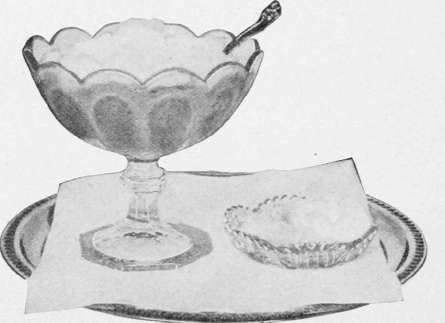
Place the dessert in front of the hostess, serving spoon or fork at her right, plates and saucers in front or at the left.
Working Directions To Be Followed By All Odd Numbered Girls
NOTE: In today's Lesson you are to break the egg and beat the white of egg for the pudding and prepare the whipped cream, while your partner prepares the gelatine mixture. Follow each paragraph closely.
See Recipe on Front Page.
Break the egg, see FIGURE 1, slipping the white on a plate and the yolk in a bowl. See FIGURE 2.
Pass the yolk to your partner.
Measure the lemon juice and add it to your partner's gelatine mixture, when it is dissolved.
Beat the white of egg on a plate with a wire whisk beater. See FIGURE 3. Pass it to your partner.
Measure the cream into your mixing bowl, put bowl into your dishpan, containing cold water. Beat cream with Dover egg beater until stiff, not too long, for then it will separate - add sugar and vanilla.
Serve it with the pudding.
You are to WIPE the dishes today according to directions already learned.
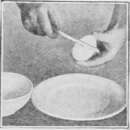
FIGURE 1.
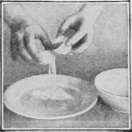
FIGURE 2.
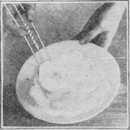
FIGURE 3.
NOTE BOOK WORK. LEMON PUDDING.
Materials:
1 1/2 Tablespoons Granulated Gelatine. 1/2 Cup Cold Water. 1/2 Cup Sugar. 4 Yolks. 4 Whites.
Juice and rind of 1 lemon.
Continue to:


My Books

