


Dishes With Pastries, Pastes, Rice. Part 13
Description
This section is from the book "Larger Cookery Book Of Extra Recipes", by Mrs A. B. Marshall. Also available from Amazon: Mrs A.B. Marshall's Larger cookery book of extra recipes.
Dishes With Pastries, Pastes, Rice. Part 13
Clarified Stock For Raised Fish Pie A L'lmperiale
Take the bones from the white fish, and the beards and liquor from the oysters, as well as the inside from the head of the lobster, and put all together into a stewpan with two sliced onions, a bunch of herbs, six peppercorns, two cloves, a pinch of salt, two wineglassfuls of white wine, and one ounce of glaze; cover with a little light stock or water, and boil for about one hour, then strain it, and add for each quart one ounce of Marshall's Finest Gelatine; clear with four raw whites and shells of eggs beaten up together; let it boil up and then strain it through a cloth; when it begins to set use as above.
Fish Pudding Pouding De Poisson
Line a well-buttered pudding basin with suet paste (vol. i. page 39), fill up the inside with any nice pieces of cold cooked fish, slices of hard-boiled eggs that are seasoned with chopped raw parsley, eschalots, mignonette pepper, and salt, and washed and finely-chopped fresh mushrooms; fill up the basin with the sauce prepared as below, wet the edges of the paste with cold water, and cover over the top with some more of the paste; trim the edges evenly, tie up the basin in a cloth, and cook the pudding in a saucepan of boiling water for about three hours; then take up, remove the cloth, turn out the pudding on to a hot dish, sprinkle over with a little raw parsley and lobster coral, and serve while quite hot for luncheon.
Sauce For Fish Pudding
Put one and a half ounces of butter into a stewpan with one and a half ounces of fine flour, stir together till well mixed, then add half a pint of water, the juice of a lemon, half a gill of cream; stir till it boils, tammy, and use.
Pheasant Pie A La Francaise Pate De Faisan A La Francaise
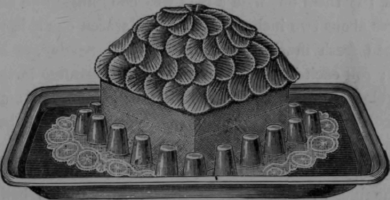
Take a square fleur mould, butter it inside, and place it on a baking-tin on a double fold of foolscap paper that is buttered; then line the mould about a quarter of an inch thick with short paste (vol. i.), pressing the paste well into the shape of the tin; take a picked, singed, cleansed and boned pheasant, cut it up in neat joints, lay these open and season them with a little mignonette pepper, a very little salt, and washed and chopped fresh mushroom, a little eschalot, thyme, bay leaf, parsley, and the livers of the pheasants finely chopped; place a little piece of pate de foie gras about the size of a Spanish nut in each piece of pheasant, and then roll up the pieces in cylinder shapes, and place these pieces one on the other in the pie until it is full. Wet the edge of the paste and roll out some more paste about half the thickness of that used for the lining of the mould, cover the pie over, and trim the edges; roll out the remainder of the paste perfectly thin like a wafer, and stamp it out in rounds about one and a half inches in diameter, and by means of a knife work out the rounds of paste in the form of small shells. Wet the top of the pie paste over with a little cold water, using a paste brush for the purpose, and then place the little shells on the top until it is quite covered; make a little hole in the centre of the top so as to be able to fill the pie up with gravy when cold; place a band of buttered paper round, so as to stand about three inches above the pie, and put it into a moderate oven, and bake for one and a half to two hours; during the baking keep the top of the pie covered over with a wetted paper to prevent the paste getting browned, as it should be a pretty fawn colour when cooked. Put it away till cold, then fill up with gravy made from the bones as below, and then remove the tin from it; place the pie on a dish on a dish-paper, and garnish it round with nice blocks of cut Aspic Jelly (vol. i.), and serve for any cold collation, such as for supper, luncheon, race meetings, etc.
Continue to:


My Books

