


Women And Practical Christianity - Distressed Gentlefolks' Aid Association
Description
This section is from "Every Woman's Encyclopaedia". Also available from Amazon: Every Woman's Encyclopaedia.
Women And Practical Christianity - Distressed Gentlefolks' Aid Association
Uncomplaining Poverty - How the Association was Started - Its Aims and Ideals - A Pathetic
Budget - The Beneficiaries he saddest of all poverty is that which Thides itself and makes no sign, and this is most frequently the case with gentlefolks who have known better days. They will endure the greatest hardships, even to the point of starvation, rather than appeal for public charity.
It was to help cases of this kind, without wounding the sensitive feelings of the recipients by publicity and needless restrictions, that the Gentlefolks' Aid Association was started in the Diamond Jubilee year of Queen Victoria, 1897.
The Association was originated by Mrs. Finn, the widow of the distinguished Hebrew scholar, James Finn, Esq., the British Consul for Palestine, and her daughter, Miss C. M. Finn, who became the secretary, and labours most arduously in that position.
The work was the outcome of keen sympathy with the distressed, and was founded on a common-sense basis without any flourish of trumpets. I think I may say that the Association owed its inception to the hard fate of the "poor relation."
A Pathetic Case
The story is simple and very human. Mrs. Finn and her daughter chanced to be guests in a house where a lady who had the misfortune to be an unwanted poor relation was receiving a few weeks' dole of maintenance. The slights which she endured and the ignominy of her position touched the hearts of her fellow-visitors. They invited her to their own charming old house at Brook Green.
This was not the only case which Mrs. Finn received into her house. For some years, indeed, she was seldom without some distressed person under her roof. Her friends became interested in her efforts, and it was suggested that some organised work might be started for the help of poor gentle-people.
How The Work Began
Captain Rolleston first suggested forming an association, and the first committee met at the house of the late Colonel Knollys, there being present Colonel and Mrs. Knollys, Captain Rolleston, Mrs. and Miss Finn, and a few others, and the association was founded, and a simple set of rules adopted.
Mrs. Finn thought that the subject might be introduced in an informal way at a drawing-room meeting. A friend was having a gathering at her house for music and recitations, and before the guests dispersed it was announced that Miss Finn would read to them an account of sad cases of distress amongst people of their own class which had come under her notice.
The audience was intensely moved and interested; many ladies present volunteered to take collecting cards and to solicit the help and co-operation of their friends, and in this way the Association was launched. Drawing-room meetings afterwards became a part of the scheme, and continue to be a very effective means of gaining sympathy and subscribers. The advance which has been made since that first gathering may be estimated by the fact that the Duke and Duchess of Westminster lent Grosvenor House for a meeting on behalf of the Association, and has kindly promised to do so again during the summer of 1912.
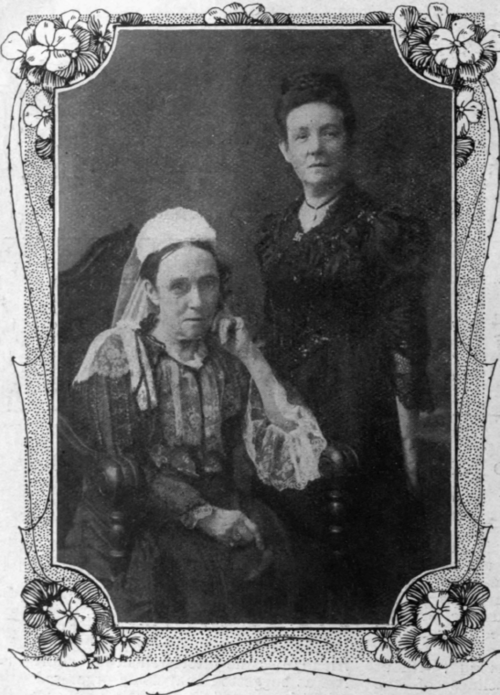
Mrs. Finn and Miss C. M. Finn, founders of the Distressed Gentlefolks' Aid Association, a society which endeavours to alleviate the poverty of those who have been in good circumstances and are now in undeserved need
Beneficiaries Of The Association
The recipients of grants must be of gentle birth and may belong to either sex - by far the larger number of beneficiaries, however, are, naturally, ladies - there is no age limit, for the founders felt that you cannot set any such gauge to the needs of the distressed. A case of a woman of twenty-five may be just as deserving of help as one of fifty-five, and, as nearly all the existing benevolent societies had an age limit, it appeared to be most helpful to the cause of the distressed that the new Association should be open to people of any age, There is no restriction as to nationality, religion, or politics.
Application must first be made in writing to the Secretary, Miss C. M. Finn, 75, Brook Green, Hammersmith. If the case is entertained a form is sent, which the applicant is asked to fill up, stating a few simple facts as to birth, parentage, profession, or occupation and cause of distress. This is laid before the committee, and the hon. lady visitor of the Association then proceeds to visit the applicant, and in-vestigate thoroughly the case and report. As election is not by means of the voting system, all the necessary investigation and correspondence devolves on the staff, involving an immense amount of work, all of which is carried on in Mrs. Finn's house, thus saving the Association office expenses. If all is satisfactory, the applicant, when without means of support, and unable to earn anything, receives, if funds permit, a grant not exceeding I0s. per week, which is paid in monthly instalments. The recipient is left perfect freedom in the use of the money. The founders of the Association make a special point of recognising personal independence. "If one of our poor ladies were to choose to spend the whole of her week's allowance on sausages," I once heard Miss Finn say jocularly, "we should not deprive her on that account."
As a matter of fact, how-ever, the recipients are usually most anxious to take the advice of the secretary and visitor as to the best way of laying out their tiny store. Many of them have been reduced from affluence to penury, and are as helpless as children in the matter of ways and means, and quite unfitted to cope with the greed of landladies.
The rapacity and heartlessness of landladies, particularly in London, towards reduced gentlewomen is appalling. Some of them take a savage delight in wounding the sensitive feelings of a "lady lodger," who, poor thing, is probably starving herself to pay an extortionate rent for some miserable attic. There are many cases in which the Association cannot send a present of coals to some suffering woman because the landlady would refuse to take them in, for fear of losing her sixpence a scuttle from the lodger.
The following account of what a lady of education and refinement, who had formerly been wealthy, spent a week on food, will
Religion serve to illustrate how many distressed gentlefolks live.
Quarter of a pound of tea at Is. 4d. ... ... 4
Quarter of a pound of butter at Is...... 3
One pound of sugar ............ 1 3/4
Bread .................. 3 1/2
Biscuits ... ... ...... ... ... 4
Fish for three days ............ 4 1/2
Meat ................... 5
Vegetables ............... 3
Milk and eggs............... I0 1/2
Total............3 3 1/4
If we add to this, three or four shillings a week for rent, the lowest for which a room can be obtained in a respectable neighbourhood in London, and the cost of clothes, laundry, coal, light, and a trifle for travelling and postage, it will be seen that even those who are so fortunate as to get Ios. a week granted have nothing left for little comforts or enjoyments and no provision for sickness.
Some ladies who have applied to the Association have been found trying to live on 2s. 6d. a week, and in one instance two sisters, who had been accustomed to luxury, were discovered trying to live on 2s. 6d. a week between them. One can realise what a rise of even a halfpenny per pound on the necessaries of life means to people thus situated and the suffering which is entailed by the rise in prices during winter.
The Association is making regular grants to one hundred and thirty-two cases, and giving casual assistance, such as paying arrears of rent to save a home from being sold up, or to tide over temporary loss of employment or a time of sickness, to some seventy ladies and gentlemen. But, alas, funds are never enough to meet the wants of all the deserving cases. This year some two hundred and seventy applicants had to be refused for want of funds.
Each month the committee places five pounds at the disposal of the secretary for pressing cases of need, to be used at her discretion, pending the consideration of the case by the committee. This is a most considerate and merciful rule, for in very many cases it is a question of help being immediate if it is to be help at all, and any delay may be a serious detriment to the benefit conferred. One cannot think of a more heartbreaking experience than the apportioning of that five pounds.
Yet, after all, there is the feeling that, infinitesimal as one's efforts may appear in the face of the overwhelming sea of modern poverty, a little good has been done and a heavy load here and there has been lightened, pending the day when the terrible problem of poverty shall receive its final solution. To be continued.
Photo, Dickenson
Continue to:


My Books

