


4. The Triumph Of Woman. Part 3
Description
This section is from "Every Woman's Encyclopaedia". Also available from Amazon: Every Woman's Encyclopaedia.
4. The Triumph Of Woman. Part 3
It was an easy deduction from the governess to the school board member, and although old-fashioned people might have preferred an advisory committee of ladies shut up in the national schoolroom to give recommendations to an exclusively male board, there was no strenuous opposition to the election of women school board members.
Women On The School Board
Dr. Elizabeth Garrett Anderson and Miss Emily Davies were elected to the first London School Board in 1870, and have been followed by a distinguished list of women members. The enthusiastic support given by the London constituencies to women candidates will be remembered as a feature of the old School Board elections. A notable case in point was the return of Mrs. Annie Besant at the head of the poll for the enormous constituency of the Tower Hamlets in 1887.
Mrs. Fen wick Miller was elected three times in succession to the Hackney Division of the School Board, and secured a unique triumph at her second election, involving a very important point to women as to their right to retain their maiden name after marriage.
When Miss Florence Fenwick Miller married Mr. Frederick Ford, she, being a well-known woman in public life and a
School Board member, retained her maiden name with her husband's consent. Now, here was a serious thing for the electors of Hackney to consider when their lady School Board member offered herself a second time for election! Could they as respectable citizens countenance such an action? The majority of the electors said "Yes," and Mrs. Miller was reelected. An objection was raised, but the highest legal authorities declared that her election was legal. Mrs. Miller went triumphantly on to yet a third election, and was returned.
County Councillors
A signal triumph was achieved in the recognition of woman's place in public education by the election of the late Miss Flora Stevenson, the second woman burgess of our modern Athens, to the chairmanship of the Edinburgh School Board, of which she had been a member upwards of thirty years.
The valuable work done by women on school boards and their departmental committees seemed in danger of being lost to the nation when the school boards were abolished and the county councils, upon which women were not then entitled to sit, became the education authority. This undoubtedly influenced the passing of the Qualification of Women Act of 1907, by which women were enabled to be elected for and to serve on county and borough councils and metropolitan borough councils. A similar Act for Scotland was passed simultaneously. Ireland waited longer, but 1911 saw the passing of an Act which secured to women the right of voting for and eligibility to sit on all local councils in Ireland.
This triumph of women was secured after years of strenuous agitation promoted by the Women's Local Government Society, and owes much to its founder and hon. secretary, Miss Leigh Brown, and her faithful henchman, the hon. deputy secretary,
Miss M. S. Kilgour, M.a. The committee, out of which the society sprang, was formed in November, 1888, to secure the return of women to the first London County Council. A Temporary Setback
Sex prejudice, however, survived. Three women, the late Lady Sandhurst, Miss Jane Cobden (now Mrs. Fisher Unwin), and Miss Cons were returned to the first London County Council. But a gentleman - whose name I will not hold up to execration - challenged the election of Lady Sandhurst, and the Courts decided that through the wording of the Act, involving a flaw not intended by its framers, women were ineligible to serve upon county councils. As a result, the three admirably qualified women, duly elected by large bodies of representative citizens, were forced to withdraw, to the great regret of the majority of the councillors. It was found possible, however, for the Council to make a woman alderman, and Miss Cons served for a time in that capacity.
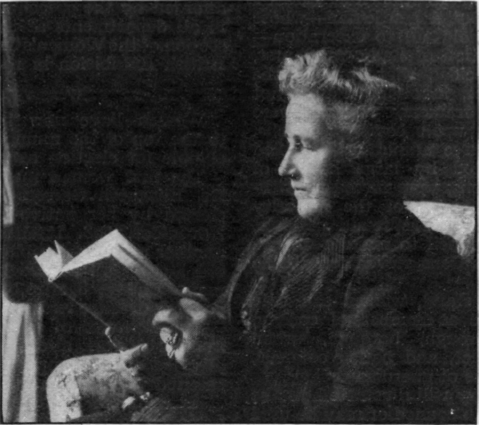
Mrs. Creighton, widow of the late Bishop of London, appointed to the Joint
Committee under the Insurance Act
Photo, R. Haines
As matters now stand, women can vote for and are eligible as members of county, town, London borough, borough, urban district, rural district, and parish councils, as well as for boards of guardians.
The following story will illustrate how the influence of a woman councillor may be used in the public health department in recommending facilities for washing to be provided for those who have no conveniences at home. A medical assistant in a large London hospital, desirous of taking off the frock of a little girl for examination, found himself much hampered, and at last had to call the child's mother to his assistance. He said: "I cannot see how to unfasten this frock." "No," she replied, "I don't suppose you can, for I have sewed her up for the winter." The Woman Inspector's Eye
Miss Henry, a rural district councillor for Thatcham, very truly said that a woman wishful to do good in her neighbourhood gets fifty more chances as a councillor than if working privately in connection with a church or parish. An incident from her own experience shows the kind of chances which public service gives. "One day in a school," says Miss Henry, "I was told: 'we had three inspectors yesterday - the diocesan inspector, the inspector of the Education Department, and the county council inspector.' I replied: 'well, now you have one more.' I went into the infants' room, and at once said: 'what is the matter with that child?' The child came to me, and was standing on her toes; she could not put her feet to the ground. Now, that child was crippled, and yet had to walk more than a mile every day to school. I felt we could not let that go on, or she would be in the workhouse by the time she was sixteen. So I went to our board of guardians, and they agreed to give me a ticket for a London hospital. The child went up to the hospital, and her legs and feet were made straight."
Countless instances of a similar character could be given to justify, if any justification were needed, the presence of women upon our local government bodies, the work of which deals so largely with the domestic, social, and sanitary legislation of the time. No more eloquent and convincing testimony to the value to the nation of women's work in public service could be given than that afforded by the speeches by women experts in all departments at the local government section of the Women's Congress at the Japan-british Exhibition in 1910.
Women Mayors
Women have now practically ascended to the top of the municipal ladder, and are eligible for election as mayors.
The first woman mayor in England was Dr. Elizabeth Garrett Anderson, who was elected by her native town of Aldeburgh, November, 1908. It fell to her lot to secure yet another unique triumph when, in the historic old Moot Hall at Aldeburgh, the first lady mayor on May 8, 1910, proclaimed George V. as King of these realms.
The entrance of women into the unpaid municipal work already related has naturally led to the appointment of women to salaried positions in the public departments.
A triumph in this respect has been achieved in the appointment of Miss Mona Williams, who has done excellent work on the Trade Boards as a Commissioner under the National Insurance Act at the same salary (L1,000 per annum) as the men Commissioners.
A further notable appointment of a different character is that of Mrs. Creighton, widow of the late Bishop of London, as a member of the Joint Committee, appointed under Clause 83 of the Insurance Act, to co-ordinate certain portions of the work of the different Commissioners. This is of great interest from the women's point of view, as the Joint Committee consists of the Chairman and probably one other member of the different Commissioners, with not more than two other persons appointed by the Treasury, and of these two nominees, the Treasury has selected a woman as one. It need hardly be said that Mrs. Creighton's qualifications for the position are of the highest order.
Women now act as paid sanitary inspectors in all departments of the public service, and this new occupation for women has grown rapidly of late years. Twenty years ago there were not more than two women sanitary inspectors in London; now there are forty-two, and there are few provincial boroughs which have not at least one woman inspector on their staff. Women are also employed as inspectors of schools, for midwifery, infant life protection, boarded-out children, the Poor Law and factories, and they also act as health lecturers, relieving officers, and registrars. In every department of the public service, paid and unpaid, women are doing valuable work for the State. To be continued.
Continue to:


My Books

