


True Love Stories Of Famous People. No. 4. - Madame De Maintenon
Description
This section is from "Every Woman's Encyclopaedia". Also available from Amazon: Every Woman's Encyclopaedia.
True Love Stories Of Famous People. No. 4. - Madame De Maintenon
But few ages can boast of a longer list of illustrious women than can the seventeenth century - women who by their talents created history; by their wit, literature; and by their beauty inspired art. In bold relief, however, pre-eminent among this galaxy of splendid womanhood stands out the name of Madame de Maintenon.
She was famous in her own generation; she has become famous in the eyes of posterity, and her chief, but not her only, claim to fame is her sterling goodness. She was a woman - a woman very human and very lovely. Unsullied she passed through the fire of the gayest Court of Europe. Surrounded by splendour and the most subtle of allurements, she emerged at the end a splendid example of purity and inspiration.
Louis XIV., in spite of his unbending dignity, in spite of his insatiate conceit, in spite of the transient nature of his affections, found in Madame de Maintenon a woman capable of awakening in him latent ideals, not of regal dignity, but of manhood And before this woman he humbled himself as a suitor and as a man - Louis, le Grand Monarque, the demi-god, who heretofore had recognised nothing in all the world as great except himself. Madame de Maintenon was born in 1634, and at her baptism was given the name of Fran-coise. The days of her childhood, however, if not actually unhappy, were singularly unfortunate. In the first place, at the time of her birth, her f at her, Constantine D'aubigne, a man of less noble character than birth, was undergoing a term of imprisonment, partly on account of complicity in political intrigue and partly because, as a means of meeting his liabilities, he had had recourse to the coining of bad money. Secondly, Madame D'aubigne, a woman worthy of little notice, throughout her life was so much engrossed in complex lawsuits, that she had but little time to attend to the affairs and interests of her children. Francoise, therefore, was virtually left an orphan. But eventually one of Constantine's sisters, Madame de Villette, took compassion on the little girl, invited her to her home, the Chateau de Mursay, and there cared for her as a mother.
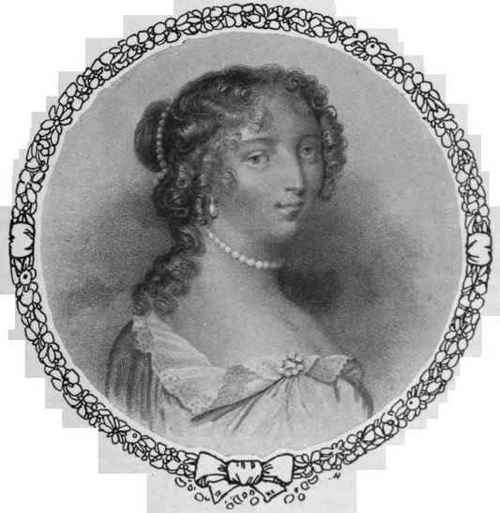
A great uncrowned queen: Madame de Maintenon, the wife of the most splendid of European monarchs.
In 1642, however, D'aubigne was released, and - for he still had influence in high quarters - was appointed Governor of Marie-galante, an island in the West Indies. But on finding his principality to be the abode of hostile savages, the new governor retired to Martinique, where he secured a subordinate government position.
Many romantic stories have been told of Francoise's life in Martinique, stories which, unfortunately, appear to be fictitious, for the child remained on the island barely a year. Soon, therefore, "la belle Indienne," as she came to be known, found herself again in France, and, since her father died shortly after his return, under the care of Madame de Villette. With her aunt, however, she was not allowed to remain for long; Madame de Villette was a devout Protestant, the D'aubignes were Roman Catholics. Accordingly, Madame D'aubigne entrusted her daughter to a certain Madame de Neuillant, a hard, severe woman, who, hoping to eradicate all traces of heretical doctrine, placed her charge in an Ursuline convent in the Faubourg St. Jacques, Paris. Here the child was treated with great severity - how great can be judged from a letter which she wrote to her aunt:
"Madam and Aunt, - The remembrance of the wonderful kindness you used to show to poor, forsaken children, induces me to beseech and implore you to use your influence to get me out of this place, where life is worse than death could be. You cannot imagine what a place of torment this house, called a religious house, is to me, nor the severity and cruelty of my custodians. I implore you, my dear aunt, to have pity on your brother's daughter and your humble servant.
"Francoise D'aubigne."
To this letter, for some inexplicable reason, Madame de Villette did not reply. The result was that, in due course, Francoise became converted to the Roman faith. With her conversion came romance, and with romance came the poet Scarron. Paul Scarron was, perhaps, the most extraordinary man in Paris of the day. He was well born, and began life in affluent circumstances '; a poet, a social genius, the idol of Parisian society, aided by influence, he secured ultimately the Canonry of Mans. His fortune, however, he soon squandered, and, thanks mainly to a fantastic freak, soon dissipated his health and looks.
At Mans, during a certain carnival week, he smeared his body with honey, rolled in a bed of feathers, concealed his face behind a mask, and, thus disguised, sat in a sedan-chair at a street corner and poured witticisms on the passers-by. At length a crowd assembled, and Scarron, in his endeavours to escape, dived into the river and hid among the reeds. The result was disastrous. His sojourn in the water chilled him to the marrow, his limbs became paralysed, his face distorted, and the man was rendered a caricature of his former self. In short, nothing about him remained unaffected except his sight and wit.
And this was the man who became the first husband of Francoise D'aubigne.
His salon at the Hotel de Troyes was the centre of a most brilliant and polished society, and thither Madame de Neuillant often escorted her protege, since, conscious of the girl's beauty and grace, she hoped there to find a suitable husband. The poet first met the child in 1652, and immediately evinced a deep interest in her; he admired the forlorn maiden immensely, saw that she was unhappy, and understood the reason.
"Your beauty and grace," he pointed out to her one day," procure you many admirers, but you are not too young to understand that their admiration for a penniless young lady is not likely to lead to matrimony. In a situation like yours, I see only two alternatives - to accept a husband or to enter a a convent. If you decide for the convent, I will pay your dowry. If you do not wish to become a nun, and if, in spite of my face, figure, and helplessness, you will consent to marry me, to be my companion and bear my name, I will do everything possible to make you happy; and I guarantee in advance that if you weep in my house, it will only be on the day of my death."
Continue to:


My Books

