


True Love Stories Of Famous People. No. 4. - Madame De Maintenon. Continued
Description
This section is from "Every Woman's Encyclopaedia". Also available from Amazon: Every Woman's Encyclopaedia.
True Love Stories Of Famous People. No. 4. - Madame De Maintenon. Continued
And so Francoise married Scarron. Why? It is possible to imagine, but it is impossible to define the motives which prompted the mind of the girl bride. Love and pity are close akin, and at the time of her marriage Francoise was but seventeen years of age.
But later, in a letter to her brother Charles, she said:
"He had a good heart. Everyone admired his wit. Though he was without fortune or other attractions, he drew the best of society to his house."
Scarron idolised his wife. Of this there can be no doubt, and his work bears the stamp of her influence, his later writings being marked by a polish and sense of moderation which distinguished them completely from the work of his earlier years. At the time of his marriage, Scarron sold his canonry, but from his work he derived an income sufficient for his requirements. He saved nothing, however, and when he died, in 1660, he left his widow penniless.
Of Madame Scarron as a widow, Mademoiselle de Scudery has drawn a delightful portrait:
"She was tall, had a beautiful figure, and air of distinction. Her complexion was pure and perfectly white, her hair of a light
Love chestnut tint. She had a well-shaped nose, a finely cut mouth, and the most beautiful eyes conceivable - black, brilliant, expressive, changing from archness to sweetness with every thought. She spoke simply and without affectation in a dulcet, fluted voice, that was one of her greatest charms."
At her feet lay the wealth and talent of Paris; men of means and men of position offered their hearts and fortunes to the beautiful widow, but she would have none of them. Although among her friends she numbered the gayest of Parisiennes, she remained true always to her highest traditions. The friend of Ninon de l'enclos, the confidante of Madame de Monte span, never was she infected by the shallowness or self-seeking natures of her friends, and she aspired to something higher than a union with one of the social butterflies of the day. And it is for this reason, perhaps, that Madame de Maintenon has often been de-clai m ed a hypocrite.
For the first nine years of her widowhood, Madame Scar-ron resided in an apartment which she had taken in the convent where she had been converted. Here she was able to live in comparative comfort, for her friends persuaded the queen to continue paying to his widow the pension which she had allowed to Scarron, and to increase that pension to 6,500 francs per annum.
In 1669, however, after the birth of Madame de Montespan's third child, the Duc du Maine, Madame Scarron became gouver-nante to the king's children.
" I undertook this charge," she declared, "out of respect for the king, and because my confessor considered it a good work. At the commencement I believed that I should never get to the year's end without disgust. Little by little I silenced my emotions and regrets. A life of activity and occupation, by separating us, as it were, from ourselves, extinguishes the exacting niceties of our sensibility and self-conceit."
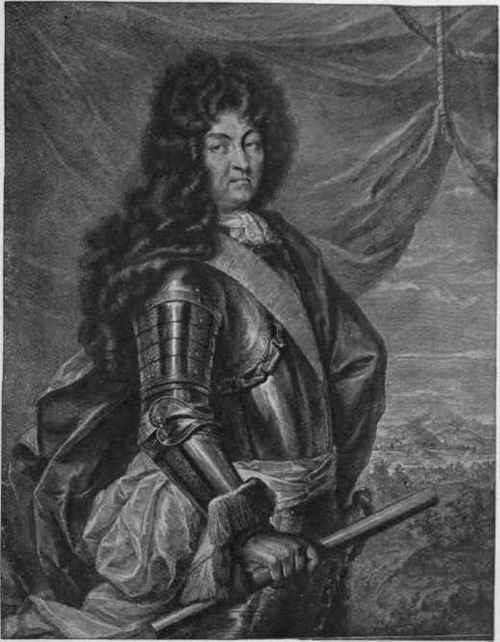
Le Grand Monarque (Louis XIV. of France) After Jean de la Haye
Louis, however, although he regarded her as eminently suited to take charge of his and Madame de Montespan's children, disliked Madame Scarron intensely; he regarded her as a prude and a bore, and as such, indeed, it would be extremely easy to regard her were it not for the fact that she established herself indisputably as the centre of the cultured society of Paris, the most splendid in the world.
So great, indeed, was the king's dislike for Madame Scarron that if, when paying a visit to Madame de Montespan, he found the two women to-gether, he would withdraw immediately.
One day, however, while crossing the vestibule he heard peals of laughter issuing from her room. He stopped and listened at the door, and was greatly amused by a story which Madame Scarron was narrating. At the conclusion of the story he walked into the room and complimented her.
"I thought you were of a serious, melancholy disposition," he said; "but, as I listened to you through the open door, I am no longer surprised that you have such long talks with madame la marquise. Will you do me the favour of being as amusing some other time, if I venture to make one of the party ? "
From this day Madame Scarron rose rapidly in favour with the king; in 1674 he presented her with ten thousand pounds, with which to realise the desire of her heart and buy the estate of Maintenon, and, in the same year, he authorised her to sign herself merely "Maintenon."
Madame's affection for her charge, the Due du Maine, no doubt, did much to endear her to the king, for Louis was inordinately fond of his son. The due, however, was slightly lame, and Madame de Maintenon took him to Begere to try the waters. The treatment
Love proved most beneficial. Louis was delighted. On the day of his son's return he dined en famille, and devoted his attention entirely to Madame de Maintenon. Madame de Monte-span was furious, and, perhaps, not without reason; she now saw in Madame de Main-tenon a rival, and, moreover, a rival who was poisoning the king's mind against her.
Indeed, Madame de Maintenon now addressed the king with the utmost candour, and from her he accepted rebuffs which he would not have tolerated from any other being alive.
"Sire," she said to him one day, "Madame de Montespan is dear to you, and gave herself to you by excess of love; but it was selfish love, which wounded her husband and your wife, dishonoured herself and her son, and connected scandal with your name, to the sorrow of all that is best in France."
Next, Madame de Montespan became frightened; she endeavoured to remove her rival from court, and strove to arrange for her some suitable marriage. But all in vain; Madame de Maintenon was now a favourite of the king, and he preserved her presence at court by appointing her lady-in-waiting to the wife of the Dauphin. In this the queen encouraged him, for Marie Therese had the utmost respect for Madame de Maintenon, and on July 30th, 1683, when she lay on her death bed, she drew a ring from her finger and gave it to madame, exclaiming, "Adieu, dearest marquise, to you I confide the king."
At this time, however, Louis fell under the influence of a certain Mademoiselle de Fontagnes, of whom Madame de Montespan once remarked, "God has never before made anything so beautiful." This affection on the part of the king, however, was purely superficial; in his heart of hearts he was deeply in love with Madame de Maintenon, and nothing shows more clearly how indispensable she had become to him than the fact that when she became ill, in March, 1683, he visited her three times a day.
To this period, moreover, belongs the only one of Louis's love letters which has survived. Before her death, Madame de Maintenon most carefully destroyed all her private documents.
"I take advantage of Montchevreuil's departure," he wrote, "to assure you of a truth that pleases me too much for me to tire of repeating it. It is that I cherish you always, and consider you to a point that I cannot express, and, in short, whatever friendship you have for me, I have more for you, being with my whole heart entirely yours.
"Louis."
Morganatic marriages nowadays are common occurrences, but Louis ruled in the hey-dey of monarchial power, at a time when kings were accredited with a divine right. In his own, moreover, and in the eyes of the world, the Grand Monarque was the human embodiment of kingship in its highest form.
If Louis had given even a minute's consideration to the idea of marrying Madame de Maintenon, even then his affection for her would have been revealed as no ordinary attachment, but when we find him consulting his confessor, not merely as to the advisability of the action, but also as to whether madame would be likely to accept his offer, then and then only can we appreciate the true depths of his passion. Pere la Chaise, the confessor, approved warmly of the marriage, and promised to sound madame's feelings. She, however, on hearing of the king's desires, was overwhelmed.
"Oh, God," she exclaimed, "for what a fate have you reserved me, what a spectacle I shall provide for the world! What will France say! And the royal family! Even my own friends! Of what intrigues will they not accuse me!" .
However, she accepted Louis's offer; that offer was her king's request.
At midnight, on January 12th, 1684, in the Royal Chapel at Versailles, Pere la Chaise conducted the marriage ceremony, and afterwards the bridal pair set out for Maintenon to receive the Communion.
Madame de Maintenon was now a queen in all but name, and, until his death, she controlled Louis absolutely. Her courtiers addressed her with the title of majesty; Louis merely as madame. She drove in the royal carriages; at public functions she sat beside the king, and did not rise from her seat even to receive royal visitors.
Louis always had been devout, but only as befitted one belonging to his creed and a great Catholic monarch. Madame de Maintenon, however, made him truly humble, truly religious, almost fanatical. To her influence has been attributed the fatal error of the year 1685, the revocation of the Edict of Nantes, the edict which had granted toleration to the Huguenots, the best and most loyal servants of the king. This accusation, however, is unjust. Madame de Maintenon always was opposed to persecution, and Louis revoked the edict merely because the Huguenot element in France jarred with his dogma of absolute authority.
Indeed, it was at once the sorrow and tragedy of Madame de Maintenon's life that, as Louis improved as a man, he declined as a king. As a good man he proved a failure as a king; as a bad man he had been the most magnificent of monarchs.
And when Louis died, in 1715, he died among the debris of his former greatness.
During his last illness Madame de Maintenon nursed her husband with great devotion; it was only with much difficulty that she could be persuaded ever to leave his room, and sometimes she attended him for fourteen hours consecutively
On August 26th, however, Louis begged her "to leave him and not to return, as her presence affected him too much." Madame de Maintenon, therefore, retired to St. Cyr, and did not return until September 1st, the day on which France's greatest king breathed his last.
Continue to:


My Books

