


The Pug
Description
This section is from "Every Woman's Encyclopaedia". Also available from Amazon: Every Woman's Encyclopaedia.
The Pug
His Ancestry - " Points " - Various Breeds - Some Famous Dogs - Advice to Would-be Purchasers
"Time was when the pug reigned supreme in Mayfair. Now, however, his place has been usurped by other breeds; but still the pug has many adherents, and at no time have his interests been more jealously guarded. Has he not clubs to see to his representation and secure the awarding to him of "specials" at our great shows ?
In history he claims a most respectable ancestry, even if, like that of many another noble family, somewhat shrouded in the mists of time. Some ascribe his origin to Holland (for at one time he was termed the Dutch pug); others, with no clear proof, to Russia. And, again, so great an authority as Mr. Fred Gresham inclines to trace his descent to China, alleging that from that flowery land have come most of the toys that curl their tails and blunt their noses. Be all this as it may, he is here to stay.
The Pug as a Pet
As a pet, the pug has many merits, not the least of which are the facts that his coat and breath are free from any sort of unpleasant odour, his size is suitable for the average house or flat, and his short coat does not require the grooming and attention of the Pekinese and other long-haired toys now in vogue.
The Points of a Pug
The popular idea of the pug seems, unhappily, to be that of an obese, panting, and more or less snappy little beast. Any truth that may lurk in this fallacy only proves that the pug, like the rest of us, has "the defects of his qualities." Treated on rational principles, he is a merry, cheery creature, full of affection, and an alert house-dog. True, he has a tendency towards embonpoint beyond most small dogs, but careful dieting and sufficient exercise will keep him in good trim. Like many short-nosed dogs, he has a habit of snorting and snuffling if he contracts a cold. It is necessary, therefore, to see that he is protected from draughts, and at the same time to keep him as hardy and fit as possible.
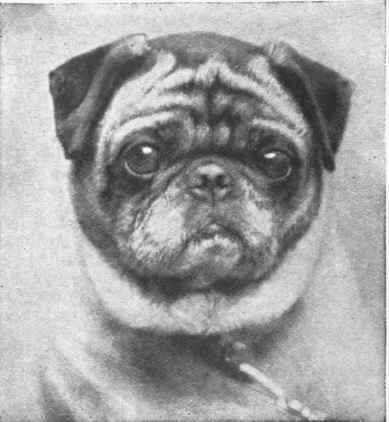
Miss L Burnett's Champion Master Jasper - an excellent example of correct expression
Photo, Russell, Crystal Palace
As regards looks, the pug is decidedly-prepossessing. In colour he may be either fawn or black. In fawn, the most prized shades are a silvery grey or a soft apricot, with, though not invariably present, alas! a "trace" or line of black running from occiput to tail. This trace is, of course, absent in the black variety. The muzzle should be short and blunt in form, but not what is technically called " upfaced." As, however, the majority of present-day pugs are more or less undershot, they are to a certain extent upfaced. The nails should be black, the back short, the bone good but not coarse, and the colour clear. Black pugs should be free from any rustiness of shade. The face should be wrinkled, with, if possible, for the fawn varieties, a thumb-mark or diamond on the forehead. This, unfortunately, like the coveted spot on the Blenheim, is rarely found nowadays. The eyes should be lustrous and of a sympathetic expression.
Size
Size is an important factor in the making of a good pug. If much over the London and Provincial Pug Dog Club standard weight - 13 to 17 pounds - a pug is apt to become coarse. The perfection aimed at in the breed is a Well-proportioned, active, small animal, compactly built, yet Without any suspicion of clumsiness or unwieldiness. As in other small breeds, there is a tendency for some of the best-bred specimens to come big.
Strange ideas as to the perfection of puggish beauty formerly prevailed in the bad old days, before specialist clubs and the Kennel Club undertook the task of canine reformation, for we find that cropped ears and a protruding tongue - sure sign of something physically amiss in any dog - were considered beauty-points of importance.
The black pug, perhaps the more popular variety, was not introduced into this country until the late Lady Brassey showed one in 1886 at the Maidstone show. Queen Alexandra, when Princess of Wales, had several beautiful specimens. Queen Victoria, also, had a fine black pug, of which she was very fond. The points of this Variety are no different in any essential particular from those of the fawn breed. It is a matter of taste, and, at times, of fashion.
Some Famous Pugs
In the early days of pugdom, the fawns were classified as either Willoughby or Morrison pugs, owing the distinction to those pioneers of the breed the then Lady Willoughby d'eresby and Mrs. Morrison. The Morrison pug was of a more brilliant and somewhat redder tinge than the Willoughby pug. But that is now ancient history, and no such distinction is now recognised. Interbreeding of the two varieties has gradually obliterated differences, and the nomenclature itself is practically dead.
"There were giants in old times," and some of their names, as founders of families, and so, likely to appear in modern-day pedigrees, and therefore interesting to any reader whose "fancy" is the pug, are: Mr. Proctor's Champion Confidence, and his famous son York; Mr. Mayo's Champion Earl of Presbury; the late Mr. Sheffield's Champion Stingo Sniffles; the late Miss Jenkinson's Champion Duke Beira; and Mr. Harvey Nixon's Champion Royal Rip. Amongst living dogs those of Miss C. Rosa Little and Mr. Culshaw are famous.
For those fond of figures can be added the fact that such prices as 200 (for Champion
Chloc) and £250 (for Jack Valentine) have been paid for specimens, though these, of course, are record prices.
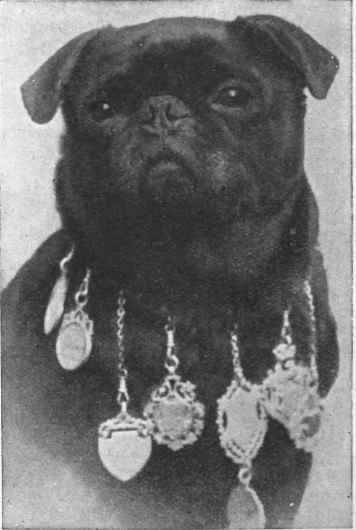
Miss Daniel's Bouji. The black pug was not introduced to this country until Lady Brassey exhibited one in 1886. Queen Victoria owned a black pug, of which she was very fond, and Queen Alexandra, as Princess of Wales, possessed several
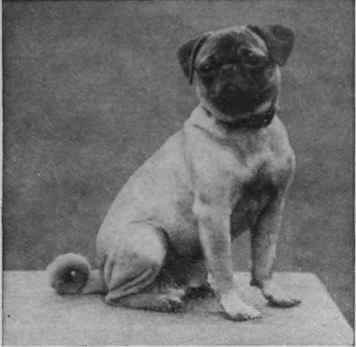
A splendid example of a magnificent pug - Champion the Marquis - the property of Miss C. Rosa Little
Advice To Pug Owners
It is advisable to buy pugs as young as possible, and then only from someone in whom you can place complete confidence - a well-known breeder, if you can, rather than an unknown dog-dealer. Do not be above asking the vendor or the doggy friend of experience how to feed the youngster. See that the instructions you receive are as carefully carried out as would be those of your medical man. If possible, feed and exercise and train your dog yourself. Groom him daily, and be as firm as kind--if not more so. The result will be a dog of which you need not be ashamed, affectionate and intelligent, good-looking, and reasonably hardy, and it will be your own fault if he resembles the disgusting, unhappy obesity of popular fiction and caricature.
Continue to:


My Books

