


Chinchilla Persian Cats
Description
This section is from "Every Woman's Encyclopaedia". Also available from Amazon: Every Woman's Encyclopaedia.
Chinchilla Persian Cats
Markings and Appearance of the Chinchilla - Difficulties of Breeding - The Kittens - How to keep the Cat Clean - Prices, etc.
Perhaps no breed or variety of long-haired cat has been so much thought about, talked about, and fought about in the fancy as chinchilla Persians.
At the present time chinchillas, or silvers, are the most fashionable breed after blue Persians.
It is, however, much more difficult to breed a good chinchilla than a blue, and the notoriety that this charming variety enjoys has been in a great degree brought about by the efforts of breeders and exhibitors to produce a perfect specimen.
Difficulties Of Breeding
There is a greater delicacy amongst chinchilla cats and more difficulty in rearing the kittens than in any other breed. This may be accounted for by the immense amount of inbreeding which was carried on indiscriminately at the beginning of the rage for silver cats. Originally these cats were bred from silver tabbies, and the ambition of breeders is now to obtain an unmarked chinchilla; that is, a cat without any shadings or tabby markings.
It is not easy to give a correct idea of the real colour and appearance of these aristocratic-looking cats. Strictly speaking, the name " chinchilla " is a misnomer as applied to them. The soft, grey coat of the little animal whose lovely fur is so much prized as an article of ladies' dress differs diametrically from the cat called chinchilla. The fur of the chinchilla is dark at the roots, and shades to quite a pale grey at the tips. The cat's fur, on the contrary, is of the palest grey, almost white at the roots, and is just tipped or shaded with a sort of silvery grey on the extreme outer edges.
To the uninitiated a really perfect silver cat appears as a slightly soiled white cat, but when anything pure white is placed beside a cat of this variety a difference will be observed. The tabby markings, which should not exist in this breed, are generally on the legs and head, and frequently there are dark rings round the tail. Some cats are heavily shaded on the body, although there are no visible tabby side markings.
To the novice breeder of chinchillas, it is always a surprise to find, when a litter of kittens is born, that the kittens are nearly black or very heavily barred and striped. The experienced fancier, however, will " possess her soul in patience," knowing that every day the little mites will grow paler, and that the tabbiness will disappear like magic, if, of course, the parents are correct in type.
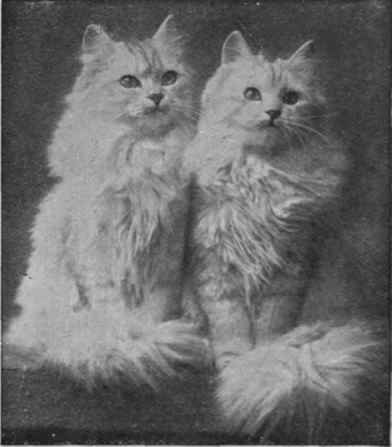
A magnificent pair of silvers owned by Mrs. Todd. The owner of chinchillas, especially the would-be exhibitor, should bestow great care on the coats of their cats Aylward
In making a selection from a litter of young silver kittens it is advisable to choose the one with the least markings on head and face.
The question as to the correct colour of eyes for a chinchilla, or silver, cat has only been decided of late years. Formerly green or yellow eyes were admissible, but the prizewinners of to-day must have bright emerald green eyes. This colour certainly tones better with the silvery coat than yellow or orange.
The Eyes Of Chinchillas
There is one rather peculiar feature in the eyes of some silver cats. This is the dark rim which often encircles the eye, and certainly enhances its beauty, making it appear larger than it really is. Fluffy ear-tufts and toe-tufts are adjuncts which go to make up a perfect chinchilla. The nose is a dull brick red, darkening slightly towards the edges.
All Persian cats suffer severely in appearance during the process of shedding their coats, but silvers present an extra ragged appearance at this period of their existence. The lovely, fluffy, light silver under-coat almost disappears and the top markings stand out very distinctly, so that a cat that in full coat would be considered a light, unmarked specimen will appear streaked and dark after the coat has been shed.
As regards the mating of chinchillas, it is best to keep to the same breed, the only other variety With which silvers may safely be crossed is With smokes. It is, however, more than probable that some nondescript sort of kitten or kittens will result. These light silver smokes are exceedingly pretty cats, and make fascinating pets, but they are useless for breeding purposes or exhibiting. Several experiments have been made of crossing white Persians with silvers in order to get pale-coloured kittens, but this appears seldom to succeed unless the whites have a silver strain in them.
Some breeders have tried blues, but there is a danger of introducing a smudgy appearance, and of destroying the purity of colour in the silvers.
Chinchillas are not suitable cats to keep in large towns, as their delicate-coloured coats are so easily soiled. It is never advisable to wash long-haired cats, as there is always a risk of their catching cold, and cats are not partial to water. It is better to give them a bran bath, or to rub in fine white fuller's earth, and then use a soft brush.
Chinchilla and white Persians require special preparation for the show pen, and the most successful exhibitors are those who pay the greatest attention to the condition of their cats. An almost perfect chinchilla as regards points will fail to catch the judge's eye if it is penned with a soiled coat and draggled fur.
There is a specialist society to look after the interests of chinchilla Persians, and the following is the standard of points drawn up for the benefit of judges and exhibitors.
" Silvers, or chinchillas, should be as pale and unmarked as it is possible to breed them. Any brown or cream tinge is a great drawback; the eves to be green."
Value of Points | ||
Points | ||
Head.................... | 20 | |
Shape........................ | 15 | |
Colour of coat............................ | 25 | |
Coat and condition.......................... | 20 | |
Colour, shape, and expression of eyes.................. | 10 | |
Tail............................ | 10 | |
At some of the large cat shows classes are given for silvers and shaded silvers. This latter variety is really a dark chinchilla or silver, and though shadings down the spine line are correct, yet tabby markings on both head and legs should be just as slight as it is possible.
Very high prices are asked and obtained for unmarked pale chinchillas. A well-known breeder and exhibitor of this variety recently sold a silver male to America for £100.
Value Of The Short-Haired Cat
This is the highest sum ever paid for a long or short-haired cat. As regards the sale of chinchilla kittens, if pure in colour and fairly free from tabby markings the price, at about eight weeks old, Varies from £3 3s. to £5 5s.
Silver kittens, however, are very speculative purchases. A kitten at three months old may be a thing of veritable beauty, and before it has reached the age of eight months, bars and stripes will possibly set in, and the unmarked chinchilla may turn into a poorly marked silver tabby.
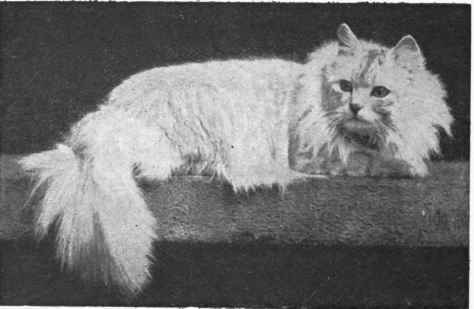
Another example of a magnificent chinchilla, beautifully groomed. Mrs.
Slingsby's "Silver Dragon" [Davey
By T. Peddie.
Her First Lesson In Embroidery
Continue to:


My Books

