


Dress In The Empire Period
Description
This section is from "Every Woman's Encyclopaedia". Also available from Amazon: Every Woman's Encyclopaedia.
Dress In The Empire Period
Napoleon the Critic - The Empress Josephine as a Leader of Fashion - Modern Toilettes Founded on Those of the Empire Period - The Craze for Gauze - Long Chains and Scarves ow closely dress and history are connected students of both subjects will recognise. A queen's whim, the accident that overtook a dame of high degree, a battle, a play - to cite instances from our own time, the flights of airmen - these and other such unforeseen happenings have started vogues, some of them still extant though their origin has been forgotten.
It is scarcely surprising, then, that the palpitating events of the early years of the nineteenth century, so intimately and poignantly connected with the great Napoleon, should have given us a series of fashions, and that the Empire modes, as those fashions are called, should, like the man whose approval they gained, rank amongst the immortals. The last word surely is deserved in this case, for, by their new appearances time after time in our midst, the Empire vogues are proved to be far from evanescent.
That Napoleon the Great stooped to notice what women wore would seem to some minds so incompatible with his stupendous intellect and gigantic achievements as to be unbelievable. Nevertheless, the fact is there, and the further one also that he not only observed what was worn, but dictated what should be. His was that uncommon and most masterly union of wits, a grasp of matters as a whole and a care for details mosaic-like in their definition.
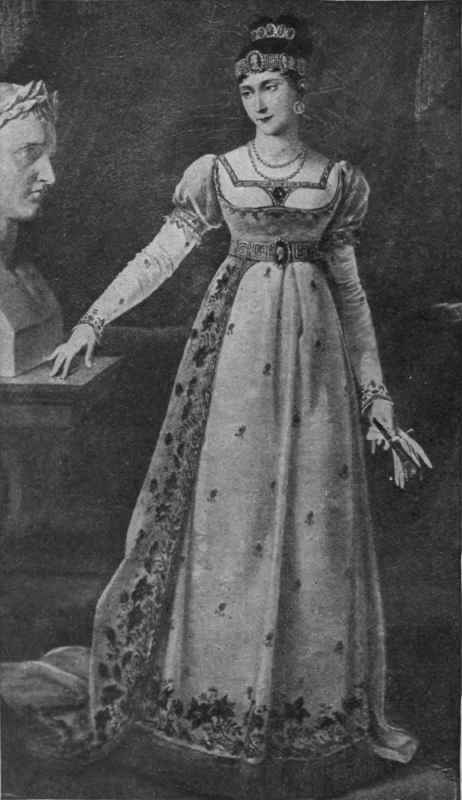
Marie Pauline. Princess Borghese, sister of Napoleon Buonaparte, in a superb toilette a I'empire. Her hair is elaborately adorned with jewelled bandeaux
From a tainting by Lefohra
Furthermore, in Josephine, his wife, the idol of the French nation, whom he crowned Empress in 1804 after he had crowned himself, he had a wife who loved pomp and circumstance, dress, jewels, and display.
It is by the name of Josephine that the high-waisted frock, with a corsage like that of a baby's robe extending only just below the armpits, and a short, clinging skirt, is now known to fame. And it is of that characteristic costume that we think first of all when the Empire period of dress is mentioned. Nevertheless, it is not exactly fair to the preceding periods of history in France - to the Consulate and the Directorate - to connect the Josephine frock with that of the Empire alone.
As a matter of fact, when Josephine became Empress she continued to wear the
Dress style of frock, with some little alterations such as the still narrower bodice, that she had worn when her husband was made First Consul in 1799, and even earlier during the Directorate. With the Directorate, however, we modern exponents connect the fashions in men's attire which we have adapted to feminine needs, amongst them the double-breasted long-tailed coat with a sash round the waist fastened at one side, the immense pointed revers, and the high collar with an overturned flap. "Le vrai salon du Directoire, ce fut la rue," says Octave Uzanne in his famous work "Les Modes de Paris," and it is certainly to the fashions of the street of the late eighteenth century that many a survival of to-day is traceable.
Every great event was seized upon by the elegantes of the Court of Napoleon for creating a fashion, for the Emperor disliked seeing the same toilette often, and rebuked a lady of the Court on one occasion in these words: "Madame la Marechale, your cloak is superb; I have seen it a good many times." So when a certain Turkish ambassador arrived in Paris his fez was copied, and worn ornamented with an aigrette and pearls.
Borrowed Plumes
But it was the military campaigns of the period that offered the largest field to the designers of dress, who coquetted specially with the headgear of the soldiers, producing bonnets and hats that did not too closely resemble those of the military, which would, of course, have been presumptuous on their part, but were certainly suggestive of them with their tall crowns and severe outlines, beneath which frivolous-looking little feminine caps, charmingly ruffled, were seen. The Mameluke turban was a direct souvenir of the Egyptian campaign.
Artificial flowers were a novel production at that time, and after Napoleon returned from Elba for the Hundred Days' reign violets were worn by all his supporters. The sabretache reticule with a long strap arranged to hang over the arm, the tassels, the high stock, the tricorne and bicorne hat (invariably associated with Napoleon), all fashions of the winter of 1910-11, are adapted from the military coats of the First Empire, and are as characteristic, if not more so, of the fashions of a hundred years ago as the Josephine dress with its high waist and straight, short skirt.
So closely concerned was the dress of the period with the political events of the times that the supporters of Louis XVIII. wore skirts with eighteen tucks upon them, and cashmere shawls edged with vermilion, the colour of the Royalist party.
Napoleon's preference for white dresses was respected by the Empress Josephine, who wore robes made of white tissu de mousseline de l'lnde. The tissu Orientale in which she gloried cost from one hundred to one hundred and fifty francs a yard, a sum that did not daunt the extravagant lady, whose immense expenditure, it is said, Napoleon, though he disliked economy in dress, was moved to protest against. The Empress spent much of her time in dressing, for she changed her linen three times a day, and never wore any stockings except new ones.
From Persia and the Levant came exquisite materials, and from far Cashmere the shawls that Josephine loved. The Egyptian campaign started the fashion for stuffs from Cairo - robes a l'egyptienne, turbans a l'algerienne, bonnets en crocodile, and fichus en Nil. Such vogues were the craze of the year 1807. At the same time the hair was dressed a la Titus and Cara-calla - that is to say in a crop, one mass of tight little curls.
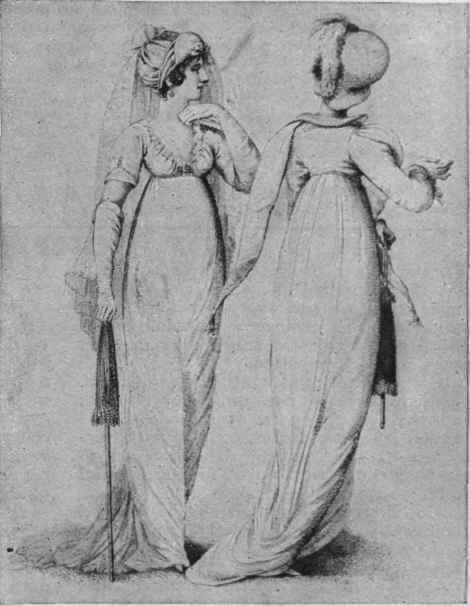
Dresses in vogue in 1806. The fashion of high-waisted, low-cut, shortsleeved dresses made of clinging, flimsy material prevailed for many years.
These "nymph" robes were a fruitful cause of fatal illness
The preference of the Empress for antique classical ornaments brought the wearing of cameos into vogue, set as earrings, bracelets, and bandeaux for the hair. Long chains, attached by agrafes, or clasps, to the dress upon the decolletage, were also characteristic ornament, or the " beloved eye," painted upon ivory and enshrined in a locket, took the place of the clasp or dangled beneath it.
Continue to:


My Books

