


The Stable-Yard And Its Occupants. Part 3
Description
This section is from the book "Warne's Model Housekeeper", by Ross Murray. See also: Larousse Gastronomique.
The Stable-Yard And Its Occupants. Part 3
Plans
The plan of the building will vary very much according to the aspect disposition of land and other premises, and other local circumstances. These should be very carefully studied, and the plans well matured, as the success of the building will greatly depend on the disposition of its various parts. We will lay down as one of the first principles, that no stall should be less than six feet wide by ten feet long, no loose box less than ten feet square, and no stable less than ten feet high from floor to ceiling. Passage in rear of stalls, five feet wide.
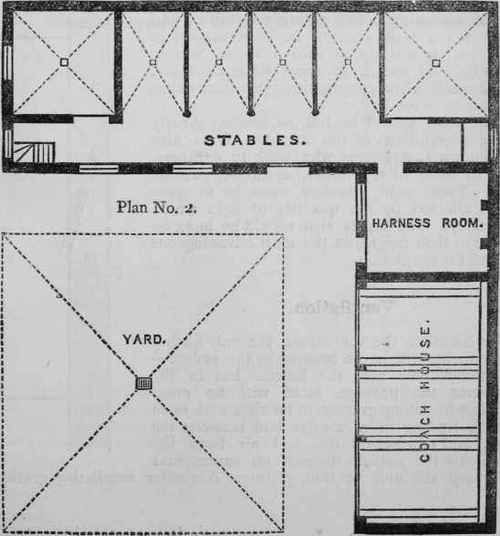
Such arrangement as will put all the horses' heads the same way, with the light and ventilation behind them, will be the most preferable, as enabling the doors and windows to be opened without placing the horses in a draught. (See Plan No. 2).
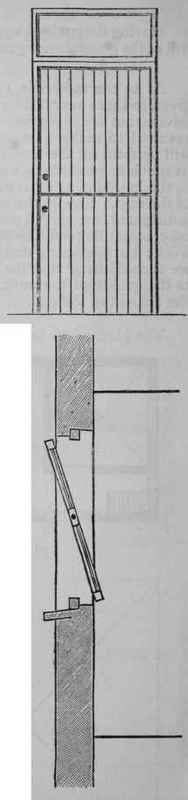
The doors should be wide and high, and hung in two heights, with fanlight over (four feet by seven feet at least), that the horses may go in and out freely without a chance of knocking themselves about. One often sees a horse hesitating before entering a stable; and when after a little coaxing he is persuaded to come on, he will do so with a rush. Such a horse has no doubt, at some time or other, hurt himself when passing through a door either too narrow or too low.
The light should be full, as tending greatly to the cheerfulness of the interior. It is also well known that horses who work in darkness, such as those in the mines, eventually become blind. Their sight, therefore, must be to some extent affected by the quantity of light which they enjoy. The sashes also should be hung on centres in their height, as the most advantageous method for ventilation.
Ventilation
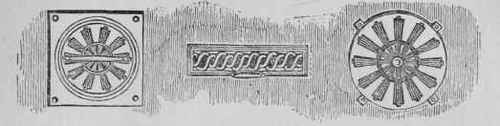
To complete the ventilation, the only further requirements will be an opening in the ceiling - not immediately over the horses, but in the rear over the passage, fitted with an ornamental ventilating grating, to be shut and open at will, leading to an air-flue laid between the joists, and conducting the foul air from the stables to the outside through an ornamental perforated air brick or iron grating. A similar ventilating grating, to regulate the admission of fresh air, will only be necessary where the doors and windows are small, and fit very accurately.
Paving
The materials for paving should be of the hardest quality, on good sound ballast or concrete foundation. Any absorbent materials must be rejected - first, because they will not be of sufficient durability; and, secondly, because from their nature they will retain part of the manure, and the stables will never be sweet. The paving of boxes and stalls should be laid with a regular gentle slope to the drain, which should always be in the centre. Irrespective of other advantages, the horses stand on the level, and take their rest more comfortably.
An occasional sprinkling of gypsum (sulphate of lime), when cleaning the stables, will be found to act as a great purifier. Its great affinity for ammonia causes it to absorb a great quantity of the gases generated in the stables, which will thereby lose all their offensive smell, and none of the ammonia will be lost, but will be retained in a condition serviceable as manure.
Continue to:


My Books

