


The Stable-Yard And Its Occupants. Part 2
Description
This section is from the book "Warne's Model Housekeeper", by Ross Murray. See also: Larousse Gastronomique.
The Stable-Yard And Its Occupants. Part 2
Sewers
There are four conditions which are to be regarded as indispensable in the construction of all drains from all buildings whatsoever. These conditions are: - Firstly, that the entire length of drain is to be constructed and maintained with sufficient declivity towards the discharge into the cesspools to enable the average proportion and quantity of liquid and solid matters committed to it to maintain a constant and uninterrupted motion, so that stagnation shall never occur. Secondly, that the entire length of the drain is to be constructed and maintained in a condition of complete i?npermeability, so that no portion of the matters put into it shall accidentally escape from it. Thirdly, that the head of the drain shall be so efficiently trapped that no gaseous or volatile properties or products can possibly arise from its contents. And, fourthly, that the low extremity of the drain or point of communication with the cesspool shall be so completely and durably formed, that no interruption to the flow of the drainage or escape shall there take place, and that no facility shall be offered for the upward progress of the sewage in case of the cesspool becoming surcharged.
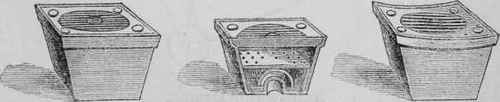
For most purposes a fall of two and a half inches in ten feet will be sufficient, and the drain should be of three inch glazed stoneware pipes (four inches for w.c), with carefully made socket-joints laid in the direction of the current, and cemented. For the head of the drain we would recommend the bell-trapped horse pots, which are to be had at all stable furnishing ironmongers, taking care that they are sufficiently large and of good strong quality.
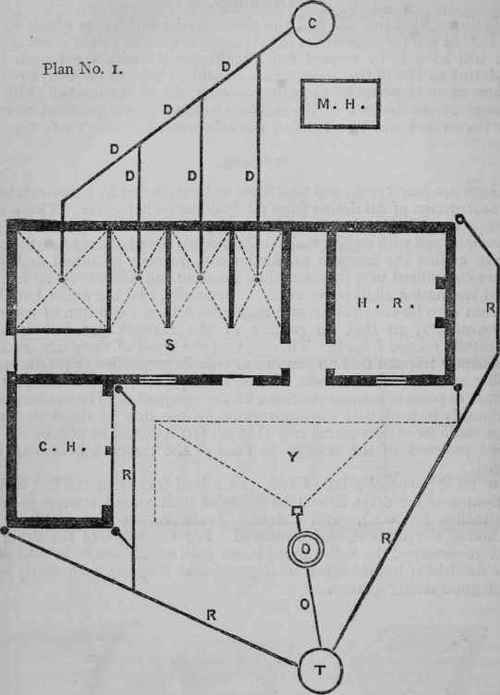
The cesspool for sewerage should be well away from the tank provided for the reception of the rain-water, and well puddled with clay on the outside and cemented inside. Precaution should also be further taken that all sewage drains should be laid below the rain-water drains, so that in case of any accidental defects no matter will by any possibility taint the water supply. (See Plan No. I).
Rain-water Drains.
These will subdivide themselves into two, those laid to collect the drainage of yard, etc, and which may be common pipes laid dry, and leading to an ordinary cesspool made of bricks laid without mortar, where the water will collect and gradually lose itself; the others connected with the down pipes from roofs and leading to a rain-water tank. These should be laid with the same care as the sewer drains, the tank constructed in the same way with an overflow pipe to lead to cesspool just mentioned.
Buildings
Having determined upon the site for the stables, the next point to study will be the general arrangement of the plan, and the materials for construction.
Materials
As to the materials, economy will dictate that preference should be given to those supplied by the immediate neighbourhood; and we should advise that where a professional architect is not employed, the builder be required to make a drawing and a specification of the works which he will perform for the named price. Also, that all the requirements should as much as possible be foreseen, so that afterwards no alterations be made in the building, as otherwise it will be impossible to determine the limit of the cost. Should the estimated price come to a higher sum than was anticipated, we should not recommend to attempt to get the builder to take something off the amount, as he will only do so by scamping the work; but premising that he is a respectable and well-recommended man, we should advise that the extent of the building be reduced in preference to the quality of the work. Cheap work and cheap materials are always the dearest in the end.
Continue to:


My Books

