


Prescriptions For Drowning, Or Suspended Animation
Description
This section is from the book "Warne's Model Housekeeper", by Ross Murray. See also: Larousse Gastronomique.
Prescriptions For Drowning, Or Suspended Animation
The following instructions, compiled by the Royal National Lifeboat Institution, are the result of a wide field of experience: -
Restorative Treatment
Send immediately for medical assistance, blankets, and dry clothing, but proceed to treat the patient instantly, on the spot, in the open air, with the face downwards, whether on shore or afloat; exposing the face, neck, and chest to the wind, except in severe weather, and removing all tight clothing from the neck and chest, especially the braces. The points to be aimed at are - first, and immediately, the restoration of breathing; and secondly, after breathing is restored, the promotion of warmth and circulation. The efforts to restore breathing must be commenced immediately and energetically, and persevered in for one or two hours, or until a medical man has pronounced that life is extinct. Efforts to promote warmth and circulation, beyond removing the wet clothes and drying the skin, must not be made until the first appearance of natural breathing. For if the circulation of the blood be induced before breathing has recommenced, the restoration to life will be endangered.
How To Restore Breathing
Place the patient on the floor or ground, with the face downwards, and one of the arms under the forehead, in which position all fluids will more readily escape by the mouth, and the tongue itself will fall forward, leaving the entrance into the windpipe free. Assist this operation by wiping and cleansing the mouth.
If satisfactory breathing commences, use the treatment prescribed below to promote warmth. If there be only slight breathing or no breathing, or if the breathing fail, then, to excite breathing, turn the patient well and instantly on the side, supporting the head; and excite the nostrils with snuff, hartshorn, and smelling-salts, or tickle the throat with a feather, if they are at hand. Rub the chest and face warm, and dash cold water, or cold and hot water alternately, on them. If there be no success, lose not a moment, but instantly - to imitate breathing - replace the patient on the face, raising and supporting the chest well on a folded coat or other article of dress. Turn the body very gently on the side and a little beyond, and then briskly on the face, back again; repeating these measures cautiously, efficiently, and perseveringly, about fifteen times in a minute, or once every four or five seconds, occasionally varying the side. On each occasion that the body is replaced on the face, make uniform, but efficient pressure, with brisk movement on the back between and below the shoulder-blades or bones on each side, removing the; pressure immediately before turning the body on the side.
During the whole operation, let one person attend solely to the movements of the head and of the arm placed under it. Whilst the above operations are being proceeded with, dry the hands and feet, and as soon as dry clothing or blankets can be procured, strip the body, and cover, or gradually reclothe it, but taking care not to interfere with the efforts to restore breathing.
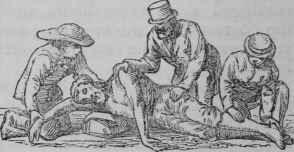
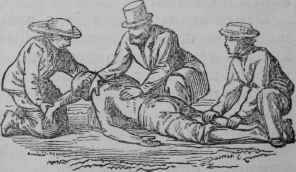
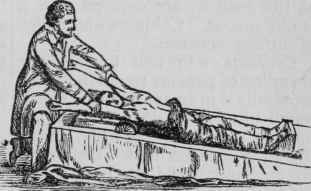
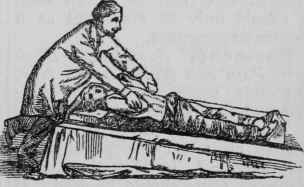
Should these efforts not prove successful in the course of from two to five minutes, proceed to imitate breathing by Dr. Silvester's method, recommended by the Royal Humane Society, as follows: - Place the patient on the back on a flat surface, inclined a little upwards from the feet; raise and support the head and shoulders on a small firm cushion or folded article of dress placed under the shoulder-blades. Draw forward the patient's tongue, and keep it projecting beyond the lips - an elastic band over the tongue and under the chin will answer this purpose, or a piece of string or tape may be tied round them, or by raising the lower jaw the teeth may be made to retain the tongue in that position. Remove all tight clothing from above the neck and chest, especially the braces. To imitate the movement of breathing: - Standing at the patient's head, grasp the arms just above the elbows, and draw the arms gently and steadily upwards above the head, and keep them stretched upwards for two seconds. (By this means air is drawn into the lungs.) Then turn down the patient's arms and press them gently and firmly for two seconds against the sides of the chest. (By this means air is pressed out of the lungs.) Repeat these measures alternately, deliberately, and perseveringly, about fifteen times in a minute until a spontaneous effort to respire is perceived, immediately upon which cease to imitate the movements of breathing, and proceed to induce circulation and warmth.
Treatment After Natural Breathing Has Been Restored
Commence rubbing the limbs upwards, with firm, grasping pressure and energy, using handkerchiefs, flannels, etc. (By this measure the blood is propelled along the veins towards the heart.) The friction must be continued under the blanket or over the dry clothing. Promote the warmth of the body by the application of hot flannels, bottles, or bladders of hot water, heated bricks, etc, to the pit of the stomach, the armpits, between the thighs, and to the soles of the feet. If the patient has been carried to a house after respiration has been restored, be careful to let the air play freely-about the room. On the restoration of life, a teaspoonful of warm water should be given; and then, if the power of swallowing have returned, small quantities of wine, warm brandy and water, or coffee, should be administered. The patient should be kept in bed, and a disposition to sleep encouraged.
Appearances Which Generally Accompany Death
Breathing and heart's action cease entirely; the eyelids are generally half closed, the pupils dilated, the jaws clenched, the fingers semi-contracted, the tongue approaches to the under edges of the lips, and these, as well as the nostrils, are covered with a frothy mucus. Coldness and pallor of surface increases.
Cautions
Prevent unnecessary crowding of persons round the body, especially if in an apartment. Avoid rough usage, and do not allow the body to remain on the back, unless the tongue is secured. Under no circumstances hold the body up by the feet. On no account place the body in a warm bath unless under medical direction, and even then it should only be employed as a momentary excitant.
Continue to:


My Books

