


Etiquette Of A Dinner Party
Description
This section is from the book "Warne's Model Housekeeper", by Ross Murray. See also: Larousse Gastronomique.
Etiquette Of A Dinner Party
The lady who gives a dinner party should be very punctual, especially if she is one of those who have no house-keeper nor a very large number of efficient servants. She should be in the drawing-room some few minutes before her guests are expected, that she may glance around and see that everything is arranged as she would wish - chairs and sofas placed where they can be easily used, etc.
There is a sad fashion, amongst people of the middle class, of receiving their guests in a drawing-room which is not always inhabited, and in which the fire is not lighted till about half an hour before the arrival of the visitors - nothing more uncomfortable can be imagined. The room feels cold - is often damp, the fire looks newly-lighted, and there is a general sense of discomfort in it.
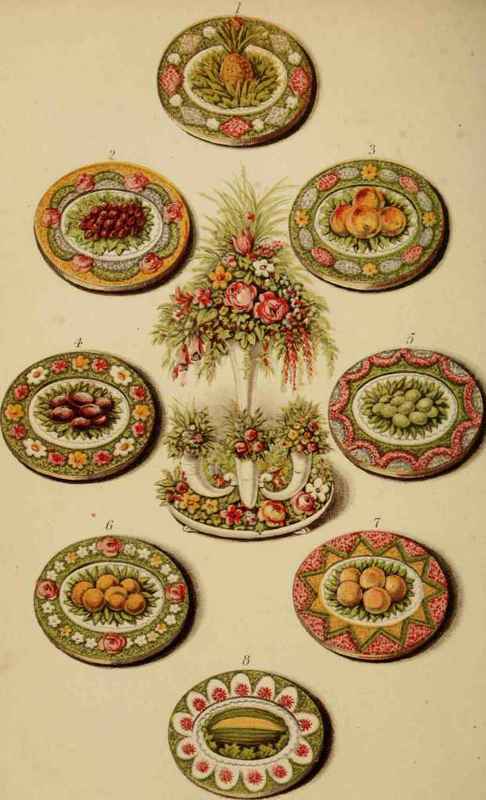
1. Pineapple.
2. Grapes.
3. Apples.
4. Plums.
5. Greengages.
6. Apricots.
7. Peachess.
8. Melon.
Now if the family habitually occupy the library or breakfast-room, they should take care that a fire be lighted in the drawing-room on the morning of the day on which they expect guests, so that the room may be well warmed in time. Plenty of light, well distributed, is another means of ensuring the success of a party.
The lady should advance a little way to receive her guests; the chairs should be arranged so as not to create any confusion on their entrance; and the welcome should be smiling and cordial, not stiff and formal.
Should a guest be late, or the cook unpunctual, the lady must not show any outward signs of annoyance or impatience, but endeavour to make the guests forget it by pleasing and amusing conversation.
Very soon after the last guest has arrived, the servant ought to announce dinner, and the host, after directing the gentlemen whom to take in, should offer his arm to the lady of the highest rank in the room, the gentleman of highest station taking the lady of the house.
Now this order of precedency in going in to dinner being likely, if violated, to give offence, it is well that the lady of the house should arrange with her husband how to marshal their guests before they arrive.
With respect to persons of title, these take precedence according to their titles; though, as eldest sons of peers have intermediate places in the scale (so to speak), we advise the lady to have by her, Lodge's "Orders of Precedency/' that she may make no mistakes. Foreign ambassadors are given the precedence of our nobility, out of courtesy, and with respect to their mission; archbishops rank with dukes; bishops with earls.
Ordinary foreign counts and barons have no precedency of title in England, but rank about with English baronets or great landed proprietors.
For untitled precedence:
An earl's grandson or grand-daughter, and all near relations (untitled) of the aristocracy precede the esquires or country gentlemen.
Then come -
Wives of country gentlemen of no profession.
Clergymen's wives.
Barristers' wives.
Naval officers and their wives.
Military men and their wives.
There is no specified place for physicians, who, however, are ranked in the royal household as next to knights, and whose wives therefore would go out after those of barristers.
These rules appear doubtless to many unnecessary and absurd, but they are not really so; and perhaps there is no truer sign of good breeding than to know how to render " honour to whom honour is due." Assuredly they are of great use to prevent personal piques at supposed preferences and neglects.
The lady of the house should be at leisure to give her whole attention to her guests. If a clergyman be present he is asked to say grace; if not, the gentleman of the house does so.
The present fashion of giving dinner parties a la Russe, is far preferable to the old mode of having the joints, etc., on the table; but it supposes that you have a sufficient number of waiters, as otherwise it would be impossible and ridiculous.
The table, then is laid thus: in the centre is some exquisite ornament - an alabaster stand crowned with pine-apples, beneath which hang clusters of grapes; or a frosted-silver tree, with deer, etc., beneath it, holding on its branches glass dishes filled with the most picturesque fruit; or any of the centres of which pictures are given in this book; but it is now the fashion to have the centre ornament of flowers very low. Round it the dessert dishes are put, intermixed with dishes of preserve, sweetmeats, etc. At the house of a nobleman, with whom we occasionally dine, the table - a round one - is encircled by small silver camels, bearing on their backs silver baskets, holding tiny fruits or sweetmeats.
Menus, or dinner cards, are placed the length of the table, one for the use of two persons; on these the names of the dishes are written, so that the guests may select whatever they prefer.
Soup is then handed; sherry is offered after it. Fish follows soup.
Then the made dishes (which would be side dishes were they on the table) are handed, duplicates of each being handed simultaneously on each side of the table.
After these follow the pieces de resistance - turkey, lamb, mutton, etc. Then follow game, puddings, tarts, jellies, etc. etc.
During dinner the hostess should chat pleasantly with her guests, and not be too much engrossed with the dinner, or with watching the servants waiting.
Any mistake or slight solecism will be much less noticed if an anxious glance does not direct attention to it.
We have described a dinner d la Russe; but as our book is meant also for readers of small income, we shall describe a dinner on a smaller scale, and in the present mode of combination of the old and new fashions.
In the centre of the table an ornament, holding fruit, etc. (as we have described already), should be placed; close round it the dessert-dishes with fruit, etc.
Continue to:


My Books

