


Domestic Pets. Birds. Part 4
Description
This section is from the book "Warne's Model Housekeeper", by Ross Murray. See also: Larousse Gastronomique.
Domestic Pets. Birds. Part 4
Many of the foreign finches do well in cages or aviaries where a moderate degree of warmth is always preserved: they are very beautiful, and many sing as well as their English relations; but they are rare and expensive. They are fed on the same kind of food - canary, hemp, poppy, rape, millet-seed, etc, and generally require the same treatment as the canary. Many other seed-eating birds are more easily procured, and do equally well in confinement. It is impossible to enumerate half of these, and every year adds to the list of imported foreign birds; I will only mention a few of those which I know personally as domestic pets.
The Java sparrows are very pretty and affectionate, and very happy in confinement; and they are hardy, and can be kept even in an aviary where canaries would live. They are about the size of a bullfinch, and like it in shape; grey in plumage, and so neat and smooth that the feathers seem to be arranged so as never to stand apart from one another, and all appear covered with bloom like that of plums; the head and throat are black, the cheeks white; the beak thick like that of a bullfinch, but of a bright rose colour. The song is very poor and monotonous. They eat canary and millet-seed, but might well be fed on rice, one should think, as they are most destructive in Java and China in the rice-fields, and are called Paddybirds (Le Padda, on oiseau de riz - Buffon) on that account.
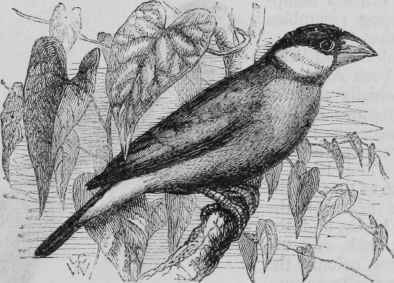
Java Sparrow.
The cut-throat and diamond sparrows are very pretty birds, about the size of a goldfinch, and their feathers are beautifully marked and spangled; but they are not interesting birds, and their harsh twittering is not agreeable. Their food is the same as that of the Java sparrows, with the addition of chickweed and cracknels, of which they are fond.
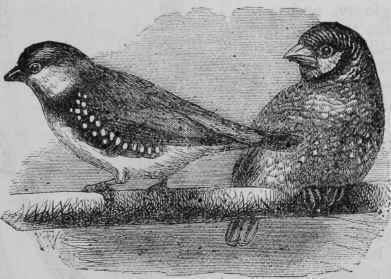
Diamond and Cut-throat Sparrows.
The indigo bird, Dominican, and Whidah bird, are all buntings, easily to be procured, and very beautiful. The former comes from Carolina and the neighbourhood of New York: its plumage is bright blue throughout, excepting the larger quill feathers and tail, which are brown. It may be kept in a bell-shaped cage, and fed on millet, canary, poppy, and bruised hemp-seed. The song resembles that of the linnet.
The Dominican and Whidah bird are both Africans: the latter is chiefly remarkable for its long and curious tail, for the accommodation of which it requires a very large cage. The body is about the size of that of the linnet. The head of the male bird is black, and the throat, wings, back, and tail are of the same colour; the back of the neck is orange, and the breast and upper part of the stomach white. The four outer feathers of the tail are about four inches long, and very broad; the next two are thirteen inches long, broad in the middle, and running almost to a point at the ends; the two centre feathers are glossy, and a little arched, like those of a cock; thread-like filaments spring from the longer feathers and float about with every movement of the bird, which is very lively, and seems to take great delight in bathing and trimming its feathers: it moults twice in the year, and is without its tail from November to May. The female is entirely brown, almost black, but does not acquire its full plumage until it is two or three years old. The Whidah bird has a low, soft, rather melancholy song. It should be fed on canary and millet-seed and barley-meal, with lettuce, endive, and other green food from time to time, and will live in confinement from eight to twelve years.
The same treatment will answer for the Dominican, but a large bell-shaped cage is more suitable for this bird, whose tail is not so long.
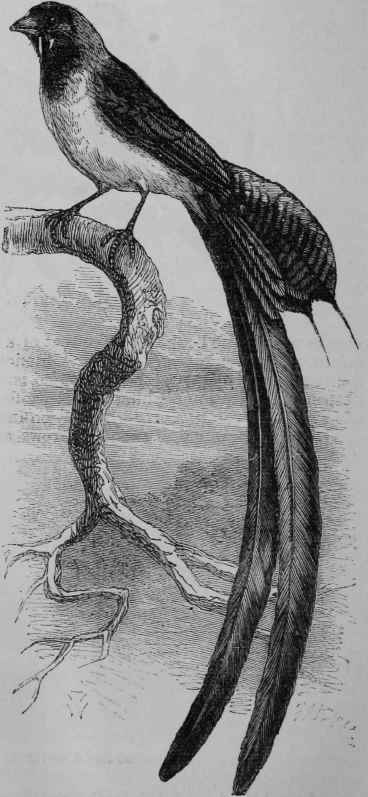
Whidah Bird.
The cardinal grosbeak, or Virginian nightingale, is a very beautiful red bird, with glossy black feathers about the head and neck. It is about eight inches long, of which the tail measures three. The song is varied and constant, and continues all through the year, except while it is moulting. The hen, which is of a reddish-brown colour, is said to sing nearly as well as the cock; and perhaps that is the reason why these birds are better apart - the cock is jealous of his mate's rivalry of voice. Bird dealers have so often pronounced an unfavourable opinion of the cardinal grosbeak as regards his capabilities as a domestic pet, that I was surprised to hear of one which was so exceedingly tame that he would carry his favourite tit-bits to his mistress, and try to make her eat crushed hemp and caterpillars! The bird is naturally, I believe, very nervous and sensitive, so that it would fret and chafe in a shop surrounded by other birds, and its wild fluttering would give the idea that it could never be tamed; but patient kindness and gentleness will make it a most attractive and pleasant pet.
It should be fed chiefly on canary-seed, but should have a few hemp-seeds every day, and four or five mealworms, or spiders, grubs, or caterpillars - some animal food, in short, to keep it well and vigorous. Spanish nuts, almonds, walnuts, and Indian corn, may be given as a treat; and a lump of basalt and a little piece of chalk should be put in the cage, and the bird should always be allowed a bath, and should be kept out of draughts. I give the directions which have been given to me by a lady whose Virginian nightingale has flourished under her judicious care many years. I have never had one myself.
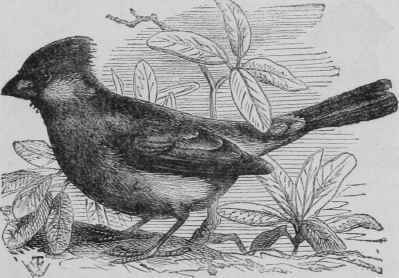
Virginian Nightingale.
Continue to:


My Books

