


Domestic Pets. Canaries
Description
This section is from the book "Warne's Model Housekeeper", by Ross Murray. See also: Larousse Gastronomique.
Domestic Pets. Canaries
If my readers desire to have a nursery of young birds, they will find canaries the best in every respect to rear. There is no doubt about their happiness in a cage, if proper attention be paid to them; and I would fain believe that no one who reads these pages would willingly cause them suffering from want of care, or would attempt to keep pets upon whom they are not ready to bestow all the time and trouble necessary to keep them in health and comfort. People are not worthy of their birds if they neglect them, and leave them to the care of servants, to whom they are either troublesome or indifferent. And their attention will be received with such expressive gratitude and delight - their feathered pets will welcome them so gladly, and show so plainly how much their happiness depends upon their care - that they will be sufficiently rewarded for its bestowal. They should become intimately acquainted with their birds' dispositions, too, and learn their language thoroughly, and they will find a fund of amusement in their society.
This is more easily accomplished when one or two pet birds are kept in a cage alone, than when there are a number of canaries together in a very large cage or aviary, but I always ike best to see them under such circumstances - they seem so thoroughly happy when they have room for flying and frolicking about; some birds, too, will sing best when they are excited by emulation with others, but occasionally a good songster is sulky when in company, and prefers being alone. One of my birds who had been accustomed to a small single cage, never seemed at ease when in a large one, and resented being jostled by others. He was an old bird, too, and did not like his saucy young companions, and showed his displeasure by total silence whenever he was placed with them; so I had to restore him to solitary grandeur.
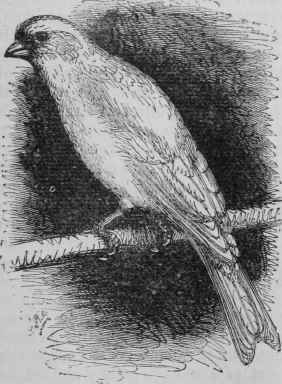
Canary.
All through the autumn and winter months, about twenty or thirty birds will live very happily together, in a cage from 3 to 4 feet long, and 2 feet high and wide. This should be made of tin wire, as brass is apt to corrode, and communicate its poisoned green rust to the birds, when they rub their beaks against it; the iron rust is very good for them. The wood may be either mahogany or varnished deal. The arrangements for seed and water should be carefully attended to. If the former is put into the cage, the bird-hoppers are best to use, because the seed is kept clean, and only falls down as the birds peck and scatter away the husks beneath. A good plan is to have the seed and water in long covered boxes outside the cage, with china or glass trays to take in and out of them. These can be kept perfectly sweet and clean, and the birds cannot make the seed or water dirty. Objections are made to the old-fashioned bird-glasses, because they are sometimes carelessly put into the wires which hold them, so that they slip aside, and the poor little birds cannot get at the water; but no provision for their comfort can succeed if carelessness be allowed at all.
I do not advocate their use, however, for if they are very full, the seed or water often gets spilt into the cage, and if not, the birds have to stretch their little necks painfully to reach their food. Sometimes, too, a young bird will contrive in some mysterious fashion to get into the glass, and having got in, cannot extricate itself. One of mine was nearly suffocated by getting into a seed-glass, and it was a long time before I could pull it out again. I had to pour all the seed out first, and at last I contrived to rescue it; but another bird, of which I heard at the time, got into the water-glass, and was drowned before its danger was discovered. Nothing looks prettier at first than a fountain in the middle of the cage; but it becomes so dirty in a few hours that it is not well to use it. A bath, wired round like the cage, should be made to hang on the doorway, and the birds will go in and out and splash about in this, with the greatest delight. It must be taken away when they have all had a good washing, in cold weather especially, as some of them will go into the bath again and again, and get completely chilled. In winter the water must have the chill taken off, and whenever the sun shines they may have a bath safely.
They must always have sand spread on the board at the bottom of the cage; and the coarse gravelly sand is best for them. It is a good plan to have a second board and two sets of perches for a large cage; this gives opportunity for washing and drying them thoroughly, and when the board gets wetted by the splashing of the birds, it can be dried before it is returned to the cage. Of course the perches must be made to take in and out of the cage; they should be round and smooth like a bamboo. A swing suspended from the centre is a source of pleasure to the birds, and if the cage has a domed top, looks very pretty underneath it. They much enjoy having a pot of mignonette or of chickweed put in; and all perch eagerly about it, and soon devour every leaf and flower. No plant that would be injurious to them must be put either in or close to the cage, for they are sure to eat the leaves, and the beauty of the plant is destroyed in a few hours. My cage stands on a flower-stand and has flowers all round it, but the plants are kept out of the bird's reach. A fir branch put into the cage occasionally gives them a good deal of amusement, and seems to do them no harm; but it is very-soon reduced to a bare pole. Plantain is very good winter food for them, and they enjoy picking it from the stalk.
Their food should have plenty of variety, to keep them in health and good humour. They must not have sugar or sweet cakes, but plain biscuits - cracknels, for instance, are good for them. Their staple food should be canary and bird turnip (the small brown summer rape) seed, a small quantity of hemp-seed each day, and occasionally, in cold weather, a pinch of maw, or poppy-seed, always to be given while the birds are moulting. When they are building they must have a mixture of hard-boiled egg and finely-crumbled stale bread, with a pinch of the same seed mixed with it every morning. It must always be made and given freshly, or it will turn sour and kill the birds. This food may be dispensed with while the hen is sitting; but as soon as she is about to hatch, it must be put in the cage for the young to be fed upon.
Canaries ought to have green food three or four times a week, chickweed, groundsel, or lettuce. It is better for them to have a little constantly than a great quantity now and then, when they are apt to eat over-eagerly of it. They should have some whole oatmeal or grits every day; sometimes a little piece of bread soaked in milk, not boiled, unless it is given as medicine; a little lump of basalt to peck at, or a bit of apple, or pear, or potato, or rice pudding. All these tit-bits are, of course, to be considered as delicacies, to be given by the birds' owner, and they will help very much to win their affection. They require warmth and nourishing food during moulting: if they seem weak, a rusty nail in the water gives them a little tonic, and a small piece of Spanish liquorice is good for hoarseness. By way of physic, I think I have rarely found any of the many nostrums recommended as specifics of much use, excepting boiled milk. If they have been eating too freely of green food, a lump of chalk may be useful. Some bird-fanciers give ants' eggs and a spider occasionally, and it is likely that this animal food would be good for them now and then. Most birds are, to a certain extent, insectivorous in their wild state.
Continue to:


My Books

