


24. Territorial Division Of Labor. Principle Of The Territorial Division Of Labor
Description
This section is from the book "Elementary Economics", by Charles Manfred Thompson. Also available from Amazon: Elementary Economics.
24. Territorial Division Of Labor. Principle Of The Territorial Division Of Labor
Quite as important as the division of labor among individuals and among groups where each performs a highly specialized piece of work, is the division of labor among localities and regions. This we may call territorial division of labor; and its development has depended in large measure on improvements in transportation, particularly railway transportation, and on the use of money as a medium of exchange. In medieval England and during our own colonial period each section or region was well-nigh self-sufficing; that is, it produced practically all the goods consumed by its inhabitants. Similar conditions existed on the western frontier during the greater part of the nineteenth century.
Territorial division of labor, as has been noted, waited for its development on improved methods of transportation and on a money economy; yet the underlying causes for its existence are as old as time itself. Soil, climate, water power, mineral deposits, and a variety of other natural resources create differences among the various sections of a large country like the United States and among the smaller countries of Western Europe. As a result, the people of one section can best afford to spend their energies in raising wheat, of another in growing grapes, of another in herding sheep, of another in building ships, and of another in manufacturing iron or cloth. Each section, assisted by nature and by an increased skill and knowledge due to specialization, produces commodities of a greater value than it could produce were it compelled to engage in other and less productive industries. Hence, it produces a surplus, which it exchanges for the surpluses of other sections.
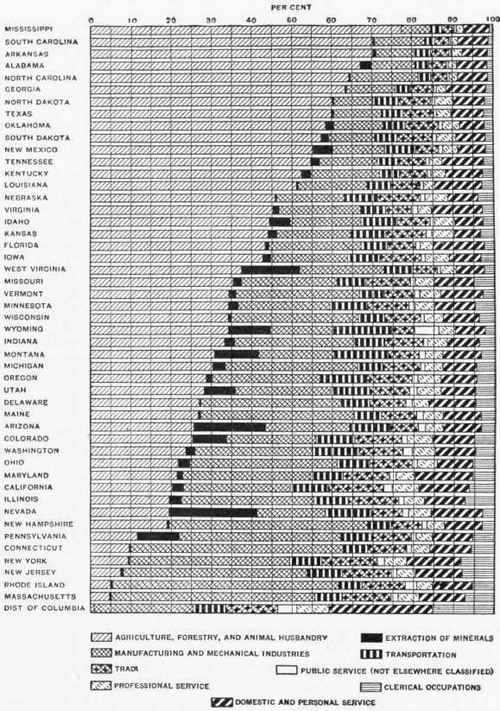
Proportion of Population 10 Years of Age and over, in Each State, Engaged in Each General Division of Occupation: 1910.
Continue to:


My Books

