


Sharpening A Cabinet Scraper
Description
This section is from the book "Things To Make In Your Home Workshop", by Arthur Wakeling. Also available from Amazon: Things to Make in Your Home Workshop.
Sharpening A Cabinet Scraper
If the scraper is of the usual square-edged type, first drawfile it with strokes taken horizontally away from you as shown in Fig. 8 at A. Lift the file when it is pulled back on the return stroke. Continue until there is a burr on the cutting edges.
Lay the scraper flat on an oilstone as shown at B, and smooth it. Use a fine stone and one that is straight on the surface. Do not lift the outer edge of the scraper while doing this. Alternate between this position and that shown at C until the burr or wire edge is removed. A square piece of wood may be placed against the steel blade, if necessary, to help to hold the scraper upright.
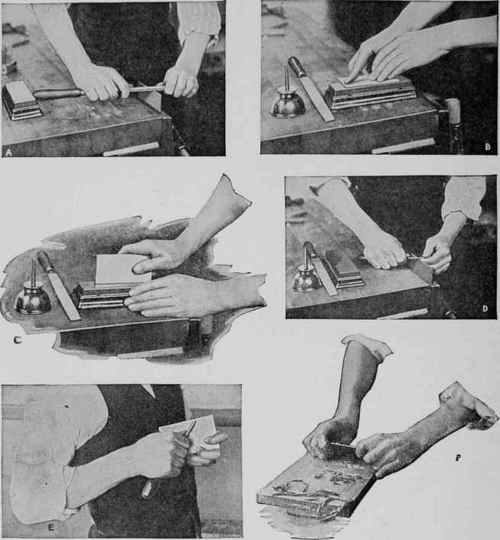
Fig. 8. - Steps in sharpening a cabinet scraper, first by draw filing, second by rubbing it on an oilstone, and third by burnishing it. How a scraper is held in actual use.
Hold a burnisher (the tool sold for burnishing scrapers) or a nail set at about 75 degrees to the flat side of the scraper as shown at D. Press hard and push away from you. One firm stroke should be sufficient. If accidentally turned too far, the cutting edge can be raised with the burnisher point as shown at E.
Knife-edge or beveled scrapers are sharpened like plane irons and the edge is then turned with a burnisher in the same way as a square-edged scraper. How the cabinet scraper is held and pushed is shown at F. It should be keen enough to cut fine shavings when held at an angle of from 60 to 45 degrees.
Continue to:


My Books

