


Horology. Part 3
Description
This section is from the book "The Engineer's And Mechanic's Encyclopaedia", by Luke Hebert. Also available from Amazon: Engineer's And Mechanic's Encyclopaedia.
Horology. Part 3
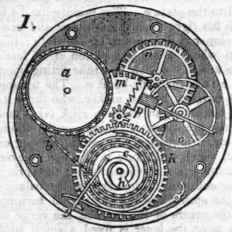
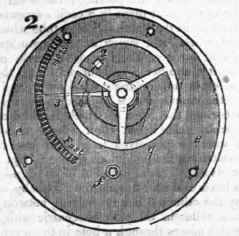
Having thus explained the nature and operation of the regulator, and of the maintaining power, we shall endeavour to describe the construction of an ordinary watch, with the assistance of the annexed engravings. Fig. 1 represents the works, the upper plate being removed; Fig. 2 is the upper plate, with the cock removed to show the balance; and Fig. 3 a general elevation, supposed to be set out upon a straight line, in order to show the whole at one view. The same letters of reference are used to denote the same parts in all the figures, a is the spring barrel; b the chain attached by one end to the barrel, and after being wound several times round the barrel, hooked by the other end to the fusee c, mounted on pivots turning in holes in the two plates e e; one of these pivots f projects a considerable distance, and is cut square to receive a key, by turning which the fusee is turned round so as to wind the chain upon it, which causes the spring barrel to revolve also, and coils up the spring into a closer spiral than it was when at liberty; and upon the key being removed, the spring reacts upon the chain, and by that means turns the fusee.
To prevent overwinding, a guard is added, which consists of a small lever g, which, when the fusee has received a certain number of turns of the chain, presses against a stop h on the top of the fusee, k is the great wheel attached to the base of the fusee by a ratchet and click, by which means the fusee can be wound up without turning the great wheel; this latter has 48 teeth, and turns a pinion of 12 teeth on an arbor in the centre of the watch, which carries the minute-hand upon this arbor is fixed the centre wheel m, of 54 teeth, working in a pinion fixed upon the arbor of the third wheel n, of 48 teeth, which turns the pinion of the contrate wheel o, of 48 teeth; the contrate wheel gives motion to a pinion of 6 teeth, which is fixed upon the arbor of the crown or balance-wheel p, which has 15 large teeth, that stop against two pallets alternately upon the verge or arbor of the balance q; these pallets are two small teeth projecting from the verge at nearly right angles to each other, and constitute the escapement, the object of which, as in a clock, is to prevent the train running down rapidly by the action of the main spring, as would be the case if there were no check to it; but at each vibration of the balance, one of the pallets engages a tooth of the crown, thereby retarding the motion of the train, and imparting fresh impetus to the balance; and no sooner has the pallet swung clear of the tooth, but the other pallet engages another tooth on the opposite side of the wheel.
One of the pivots of the balance works in a small frame r called the potence; the lower pivot of the verge works in it also, and the upper pivot turns in a cock s screwed to the plate e. The minute-hand t is fixed upon the outer end of a tube which fits tight upon the arbor of the central wheel, and which carries upon its inner end a pinion of 12 teeth; this pinion turns a wheel v of 48 teeth, on whose arbor is a pinion of 16 teeth turning another wheel of 48 teeth, the arbor of which is a tube fitting upon the other tube on the central arbor, and carries the hour-hand x. The tension of the main spring is adjusted in the first instance by the maker, who turns its arbor, on the head of which is fixed a ratchet y, in which a click takes and thereby holds it fast when wound up to the proper pitch; subsequently, when a watch is perceived to gain or lose time, it is regulated by strengthening or weakening the pendulum spring 1, Fig. 2, which will cause it to move quicker or slower. This adjustment of the pendulum spring is effected thus: the spring is fixed to a stud 2 upon the plate e by one end, and to the verge of the balance by the other; 3 is a lever lying betwixt the spring and the plate, and turning in a collar in the plate concentric with the centre of the balance, the verge of which passes through a hole in the lever; upon the lever is fixed a small stud l with a notch in it to receive the spring; the acting part of the spring is from l to the centre, therefore by turning the lever in either direction the length of the spring is altered, and in order to regulate this length with precision, the arc through which the end of the lever can be made to traverse on the plate, is divided into a number of equal parts or degrees.
In Figs. 1 and 3 are shown four pillars, by which the two plates of a watch are held together; and in Fig. 2, the heads of the same pillars are represented coming through the upper plate, with small pins put through them to keep the plate down.

Chronometers are portable time-keepers, in which, by the nature of the escapement, and the compensations for heat and cold, mean time is kept with sufficient accuracy to determine the longitude at sea. The relation between time and longitude, will be found explained under the head Longitude. As the principal differences between chronometers and other watches consist in the escapement and the balance, we shall not detain the reader with a description of the other parts of these machines, but shall proceed to describe more fully the various modes of constructing those grand essentials in all time keepers, the regulator and escapement, noticing particularly those employed in chronometers.
Amongst the various steps by which horological machines were brought to their present state of perfection, the most important is the addition of the pendulum, which furnishes at once the most simple and accurate measure of time that we are yet acquainted with. Various claims have been made for the honour of this grand improvement, but the person to whom mankind is really indebted for bringing it into universal notice, is the celebrated Christian Huygens, of Zuylichem, who, in his excellent treatise De Horologio Oscillatoreo, has described the construction of a pendulum clock, and proved that he made one before the year 1658. His method of supporting the pendulum in the figure on the following page, in which a contrivance is resorted to for the purpose of insuring its isochronous motion, is ingenious, although it is not quite correct, as has been shown by Mr. Cummings, in his Treatise on Watch-Making. It consists of two cycloidal cheeks of brass, forming a curve, in which the silk line by which the pendulum is suspended moves.
Continue to:


My Books

