


Founding Of Iron. Part 3
Description
This section is from the book "The Engineer's And Mechanic's Encyclopaedia", by Luke Hebert. Also available from Amazon: Engineer's And Mechanic's Encyclopaedia.
Founding Of Iron. Part 3
Section.
Plan.
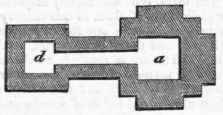
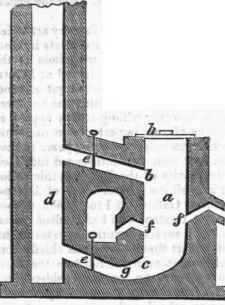
The founding of iron cannon is conducted in a similar manner to other castings; the pattern is moulded in the sand, and the metal run into the mould through a gutter. Small guns are moulded on tables, one half of the mould being formed on one table, and its counterpart on another; they are fitted together by pins, and screwed up by nuts and bolts to keep them firm together whilst the hot metal is run in. About fifty years ago cannons were cast with a hollow cavity for the bore, which was afterwards enlarged and cleaned out by a machine adapted to the purpose. Guns are now invariably cast solid, owing to the difficulty of getting them perfectly sound by that mode of casting, being more or less spongy in some parts, which the subsequent turning did not wholly remove. For the method of boring and turning great guns, see the article Cannon.
The manner of casting bells is similar to that of statues, except that bell-metal contains about one-fifth of tin to four-fifths of copper, while the metal of statues contains no tin. The dimensions of the core and wax in modelling a bell, if it be one of a ring of several, must be formed on a kind of scale or diapason, which will give the height, aperture, and thickness of the shell necessary to the several tones required. Our proportions of bells consist in making the diameter fifteen times as thick as the brim, and its length twelve times. See the article Bell, under its initial letter.
We now come to the description of that department of the foundry art which must be regarded as the most valuable and important when its effects in ameliorating our condition as intellectual beings is considered: we allude to the art of founding type. This invention is supposed to have originated at Mentz, in the early part of the fourteenth century, when types were carved out of wood. Some time afterwards they were cut of metal, and one Laurentius was honoured as the inventor of this improvement, which, however trifling it may appear as an advance in any mechanic art, proved to be of vast importance in its result. The art of founding or casting types quickly succeeded, which appears to have had its origin also in Germany, as we find they were first introduced into Hol-land from Strasbourg. By the mercantile activity of the Dutch at this period the new metal type was rapidly dispersed into all the capital cities of Europe. The earliest use of them in this country was at Oxford, in 1468, when a book was printed there by one Bouchier.
In 1471 Caxton, who had studied the art in Holland and the Low Countries, established several printing presses in this country.
The art of reading, which, but a short time before, was chiefly confined to a portion of the clergy and nobles, was soon extended to the other gradations of society; and the ability to read was no longer considered the highest climax and finish of an education, but was made the first step to it, by the introduction of printed books into every school and seminary. As the rudiments of education became improved, books became rapidly multiplied, printing encouraged, and ever since a progressive improvement has been gradually developing itself. Until the seventeenth century types continued to be cast with very few improvements, excepting such as arose from alterations in the form of the letters. Caslon set up a foundry in 1720, and succeeded in making several improvements, to which some valuable additions were added by Basker-ville, of Birmingham. Messrs. Fry and Son's foundry was established in 1764 In 1770 Mr. Jackson cut some very extraordinary and beautiful types, by a mould and matrix, which were previously cast in sand. Mr. V. Figgins, in 1792, produced some beautiful types for the Persian, Greek, and Hebrew characters, never before attempted in this country. In 1800 Messrs.
Caslon and Catherwood set about recutting and improving the whole business; and the superior taste and elegance displayed in their manufacture occasioned a spirit of rivalry in the other type founders, particularly Messrs. Fry, Figgins, and Thome, who exerted themselves individually so as not to be surpassed by their competitors; the effect of which has been the production of types of that high degree of excellence, which marks the character of all our books printed since that period. The preparation of the moulds and matrices for the purpose of casting the letters requires the utmost precision of workmanship; the matrix itself is simply a piece of copper or brass, about an inch and a half long, and of a thickness in proportion to the size of the letter to be cast. In this piece of metal is sunk the face of the letter, by means of a steel letter-punch. These punches being made with every size and kind of letter, are, of course, very numerous; and the making of them, requiring the utmost nicety of execution, necessarily forms a branch of the type-founder's business of considerable importance. There are about twenty different sizes of each kind of type in general use, all of which are cast in moulds and matrices, besides several larger sorts, which are cast from patterns in sand.
The following table gives the designation of the twenty sizes alluded to, and the spaces they occupy in printing. They are sold to the printer by the pound, at prices varying from two to thirteen shillings, according to their size: -
Lines to each foot. | |
Diamond type .... | 204 |
Pearl....... | 178 |
Nonpareil..... | 143 |
Minion...... | 128 |
Brevier...... | 1121/2 |
Bourgeois..... | 102 |
Long Primer .... | 89 |
Small Pica..... | 83 |
Pica....... | 711/2 |
English...... | 64 |
Lines to each foot. | |
Great Primer | 51 |
Paragon | 441/2 |
Double Pica..... | 41 1/2 |
Two-line Pica | 854 |
Two-line English.... | 32 |
Two-line Great Primer. | 251/2 |
Two-line Double Pica . . | 203/4 |
Canon | 18 |
Four-line Pica | 173/4 |
Five-line Pica | 141/4 |
When the moulds and the set of matrices are duly prepared, they are brought to the furnace, and consigned to the hands of the caster. The furnace is built of bricks upright, with four square sides; the stove for the fuel is at the top, with a round hole made through it, to receive the pan which holds the metal. In a large foundry there are several of these kinds of furnaces. The caster begins his work by taking the mould in his left hand, and with his right puts back a spring, which keeps the matrix close up to the face of the mould, and then with a small ladle adapted to the size of the work, he dips out of the pan over the furnace a sufficient quantity of fluid metal to fill the mould, and at the same instant that he turns the metal from out of the ladle into the mouth of it, he throws up his hand, in which is held the mould, with a sudden jerk or shake, and by this movement forces the melted metal down into the face of the matrix. In this operation great expertness is necessary. After the letter is thus cast, he relieves the spring, and takes the face of the type from the matrix, which is done by pressing the thumb of the right hand against the top of the matrix; he then picks out the type, and goes on with the casting.
Continue to:


My Books

