


Photographic Lenses Of Different Angles
Description
This section is from the book "Cassell's Cyclopaedia Of Mechanics", by Paul N. Hasluck. Also available from Amazon: Cassell's Cyclopaedia Of Mechanics.
Photographic Lenses Of Different Angles
The angle of a lens refers to the amount of subject it includes in the picture, and therefore depends upon the size of the plate it is used to cover. The term is only comparative. If, for example, a wide-angle lens of 8-in. focus, intended for a 10-in. by 8-in. plate, is used to take a picture on a half-plate, the lens ceases for that specific purpose 10 be a wide-angle lens. When the focus of a lens is Less than the diagonal of the plate for which it is used the lens is termed a short-focus or wide-angle lens. If the focus is considerably greater than the diagonal of the plate, the lens is called a long-focus or narrow-a gielens. In Fig. 1 the courses of rays proceeding from six points and passing through a lens are traced. Those ra ys issuing from A and A' and focussing at Y and Y' are assumed to make an angle of 90' with X. So that if these rays were used the lens would be a wide angle. Similarly, if the rays B and B' only are included, a minimum angle of 53 would be obtained, whilst the rays C and C give an angle of 28 The angle of a lens must, therefore, lie measured as shown in Fig. 2. Draw a line A is equal to the diagonal of the plate: from the centre erect a perpendicular the length of the focus. Connectingthe three outside points gives the angle. It happens, however, that if so great an angle as shown between A and A (Fig. 1) is used, curvature of field will prevent the rays being focussed on a tl:it surface unless the lens is specially constructed for such a purpose. Short-focus lenses must he of small diameter. The shorter the focus the sharper the curve, and the sharper the curve the smaller the circle, of which the surface of the lens is a segment. It must even be proportionately smaller, and work with a small stop, to cause the centre of the picture to be formed by the centre of the lens (and vice versa) and prevent spherical aberration.
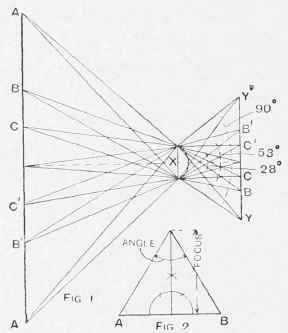
Photographic Lenses of Different Angles.
Continue to:


My Books

