


How To Make A Head For A Waggonette
Description
This section is from the book "Cassell's Cyclopaedia Of Mechanics", by Paul N. Hasluck. Also available from Amazon: Cassell's Cyclopaedia Of Mechanics.
How To Make A Head For A Waggonette
Below are given instructions on making a waggonette head. Fig. 1 snows a side view and Fig. 2 a back view of the head as finished, worked out to desirable sizes. Birch seats, as shown at A in the section, Fig. 3, can be used, the pillars being half checked into them, and the seats being strengthened by light steel plates across. The two standing pillars to form the doorway at the hind part are 1 1/2in. wide, got out to the size of the door pillars in Fig. 4, and let in to the end of the seat, having a 1 1/8-in. half-round plate fixed on the top of the seat and up the pillar for about 1ft. The four corner pillars, 2 in. square, are got out to the shape of B (Fig. 3); the four pillars to form the side lights are 2 in. thick by l 1/2in. wide, and when in place should measure lft. 9 1/2in. between. The cant-rails C (Fig. 3) are 2 1/4n. deep by 1 1/2in. thick, and the front and hind roof cross-bars 21/2in. wide by 1 3/8 in. thick; these are stoutly made, to give a good fixing for the iron eyes, by which the head is slung up when not in use. In panelling round, 1/2-in. birch may be used at the bottom part D (Fig. 3), screwed to the pillars and seats, the top edge going above the bottom edge of the top quarter panels 5/8 in., and being planed off on the outside to give a level bearing. The top panels are of mahogany or white wood full; in. thick, well canvassed on the inside, fixed on with panel pins, and mitred together at the corners; the roof boards are of 3/8-in. yellow pine, covered over with moleskin or prepared canvas, being brought well over the edges and tacked; a 3/4-in. wood cornice is alterwards put on to hide the tacks and give a finish, also to prevent rain running down the sides. To hide the screws fixing the bottom panels, mouldings 1 3/8 in. wide and full 1/4in. thick are planted on, mitred at the corners, and cleaned off level with the top panels. The overhang (2iin.) at the back of the body is taken up by the thickness of the door pillar, but should ith3 necessary to make the overhang wider at this point a fillet can be screwed on inside, or the door bottom can be made wider than the pillar.
The door pillars are 1 1/2 in. thick, got out to Fig. 4, from which it will be seen how the glass course is boxed out. The fence rail of the door may be made in the solid, lin. thick, and boxed out at the top part, or a piece |in. thick can be screwed on and panelled to form the moulding. It is customary to have single or double sliding glasses in the front. If double, they should work sideways, as in a brougham; it' single, up and down, when suitable provision must be made in the pillars. For fixing the head, the same method as is employed for the seate should do, the holes through which the key-bows pas-being got in the plates on the seats if possible.
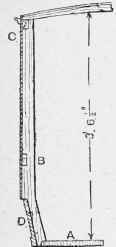
Fig. 3.
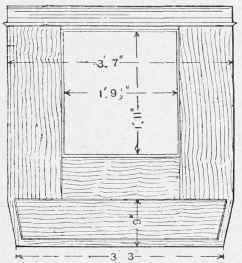
Fig. 1.
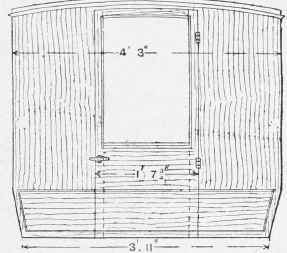
Fig. 2.
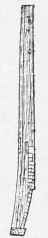
Fig. 4. Making a Head for a Waggonette.
Continue to:


My Books

