


Wise Planning Helps You To Enjoy The Unrationed Outdoors
Description
This section is from the book "Boy's Fun Book Of Things To Make And Do", by Grosset & Dunlap Publishers. Also see: The Pocket Dangerous Book for Boys: Things to Do.
Wise Planning Helps You To Enjoy The Unrationed Outdoors
MANY pleasures, especially long vacation trips, are subject to curtailment for various reasons, but the great outdoors remains unrationed, and the enjoyment that can be derived from hikes and outings is unlimited, provided such ventures are carefully prepared for and equipment is judiciously selected. The following suggestions, which will help greatly in making life in the outdoors as pleasant as it is healthy, are from the writer's own experience and from a pamphlet published by the New York State College of Agriculture, Cornell University, Ithaca, N. Y.
Hiking clothes should be comfortable and sturdy. Wear thick-soled shoes with soft uppers, and be sure they are large enough since you may have to wear an extra pair of woolen socks. Always equip yourself for rainy weather. A waterproof poncho is the best for this purpose, for it can be conveniently folded away when not in use.
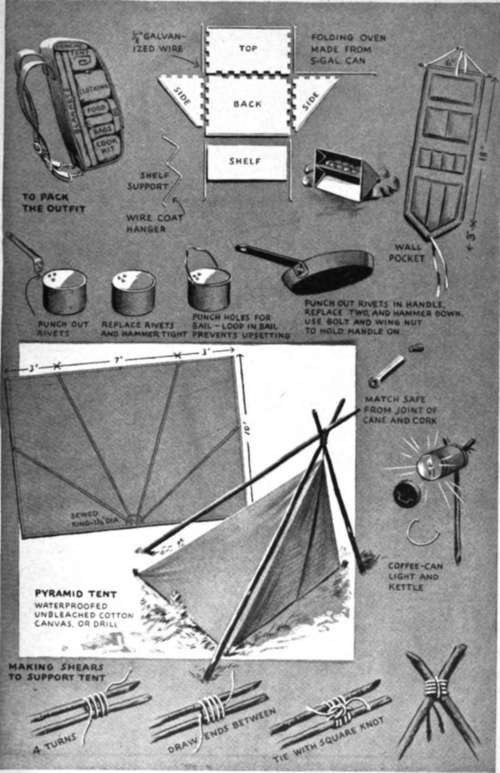
An easily made pack is shown in one of the illustrations. The " material is 10-oz. duck sewed or riveted together. Web trunk straps make the best carrying straps, with the buckles arranged to permit easy adjustment. The pack when loaded should not weigh over one third of your own weight.
A hatchet or light ax is needed on even, a short trip. The ax should have a sturdy handle- one as long as you can carry. Grind the edge to a long cutting bevel and keep it sharp, but never carry it in your belt without having a leather sheath over the cutting edge to protect yourself against serious injury in case of a fall. An ordinary jackknife will also be needed.
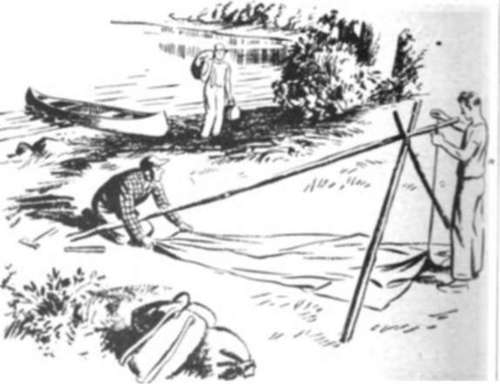
The tarpaulin shown in an accompanying drawing is made of unbleached cotton. The material should be shrunk before being made up, and then waterproofed. It makes a serviceable tent with a front flap that may be left open for sleeping in fine weather or tightly closed to keep out wind and rain.
To waterproof the tent, use two tubs or wash boilers. In one dissolve alum in hot, soft water in the proportion of 1/4 lb. to the gallon. In the other, using the same amount of hot, soft water, dissolve sugar of lead (lead acetate-a POISON) in the same proportion. Let the solutions stand until clear; then add the sugar-of-lead solution to the alum. After four hours, pour off the clear liquid and work the tent in it with the hands until every part is thoroughly penetrated. Let the tent soak overnight, and in the morning rinse well, stretch, and hang it up to dry.
Comfortable brush beds can be made of twigs and boughs. Make the first layer of heavy boughs 2' and 3' in length. These are the "springs" of the bed. Smaller pieces are laid on next in overlapping shinglelike layers. The bed when complete should be approximately 2' by 2' by 6'. A lightweight, waterproofed canvas bag will also serve as a good bed. This may be stuffed with any soft material such as leaves, straw, rushes, evergreen twigs, and the like. A rough flooring of dead branches placed under the bag will make sleeping warmer and also provide a store of dry wood for the morning fire. The bag should measure about 21/2' by 61/2' when finished.
A piece of mosquito netting, hemmed and fitted with tie strings, is a seasonal requirement. It can be folded up in the tarpaulin for safe carrying.
Cooking utensils should be cut to a minimum, for they are too heavy and bulky to carry for great distances. Most important of all your cooking equipment is the frying pan. Be sure to choose one that has plenty of depth, for it can also be used to make stew or soup. Pans with detachable handles are good since they are easy to pack.
The folding oven shown in a drawing can be used to make biscuits or pastry, to heat canned goods, and to keep pancakes and the like warm. It was made from a 5-gaI. square kerosene can, and when folded takes up no more room than a schoolboy's tablet. The size can be worked out according to the dimensions of the pack used and the material that is available.
Kettles for camp use should have broad bottoms rather than high sides. Two or three should suffice. Pack them with bags of supplies such as flour, corn meal, baking soda, coffee, powdered or canned milk, sugar, and other cooking needs. These, plus the oven and frying pan, are all the cooking utensils needed-but he sure to carry matches. Many a camping trip has been ruined because they were forgotten. The large kitchen matches are best, and they should be carried in a tin or waterproof container along with a piece of sandpaper that can be kept dry for use in wet weather.
One of the banes of camping is sunburn. Great care should be taken to avoid being burned unless your skin is accustomed to it. If you are mildly burned, treat the affected areas with a solution of cold tea, lemon juice, or vinegar before exposing yourself to the sun again.
Poison ivy and sumac are also sworn enemies of the camper. Learn to recognize both, and never make camp near them. A good preventive measure is washing the hands and other parts of the body that might become exposed to the poison with a strong alkali such as yellow laundry soap. A 5-percent solution of potassium permanganate painted on the skin will cure mild cases.
Nettles, though annoying, are seldom serious, for the sting passes quickly. If the camper moves through a clump of nettles very slowly he will seldom be stung at all.
Take along some simple remedies such as ammonia for insect bites, aspirin, and toothache wax. Sulphur tablets are good in chig-ger country.
Continue to:


My Books

