


The Right Ways To Build A Camp Fire
Description
This section is from the book "Boy's Fun Book Of Things To Make And Do", by Grosset & Dunlap Publishers. Also see: The Pocket Dangerous Book for Boys: Things to Do.
The Right Ways To Build A Camp Fire
EVERY camper should develop caution in his use of matches and wood; he should be able to decide when and where a camp fire will be safe, when and where it must be carefully watched, and when and where it shouldn't be started at all.
A camp fire under control is a good servant but out of control it is destructive, terrible. It spreads at a speed that is almost inconceivable; a single unwatched spark may lay waste an entire district.
Every woodsman worth his salt knows this, and never relaxes his vigilance where fire is concerned. He sizes up his surroundings, the weather, the proximity of inflammable material, and builds his camp fire accordingly. In a good many places campers are forbidden by regulation to have open fires without a permit, and it is wise for a prospective camper to find out just what restrictions there are in the district he plans to camp in. Here is where a modern oil stove may be used to advantage. If you do not need an open fire for heat, one of these light camp stoves may fit the bill.
If you must kindle a wood fire in a very dry area you should take extra precautions. For one thing, scrape up and remove all inflammable matter from the ground for a good distance around the fire bed until you get down to bare earth. Then, when you build your fire, keep it small, and have a pile of dirt or a pail of water handy in case it starts to get out of hand.
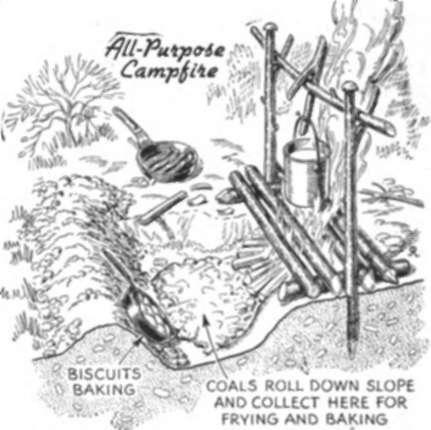
A cook can work fast with this type of fire.
In a brisk wind the safest place for a camp fire is in a shallow hole. Loosen up the soil with your ax and scrape it out to form a wall all around the fire. Again, keep the fire small; it needn't be any wider than the bottom of your skillet.
Don't build fires against fallen trees or stumps except when you actually need a back-stop to reflect heat into your tent in cold weather. Even then be sure that the fire can't spread, even if the backstop should catch fire. Never start a fire against a standing tree, dead or alive. If the tree is alive the flames will probably kill it, and if it's dead you're running a risk that it may catch fire. A dead tree can quickly turn into a giant blowtorch, to the danger of all the timber in the vicinity.
When you're ready to make camp, start looking for a safe spot to build your camp fire. And if you can't find one, move on until you do. If you build your fire on peaty soil, for instance, it may burn down below the surface and keep going long after you think it's out. Never leave a fire until you are sure that every ember is extinguished. Fires build up beds of ashes mixed with smoldering coals, and a sharp wind might easily lift one out and deposit it in dry grass or leaves. If possible, douse the fire with water, but at least cover it completely with damp earth before you leave the spot or climb into your sleeping bag for the night. It is safer not to leave a fire unguarded, even for an hour, when you are in permanent camp. Put it out if you have to leave.
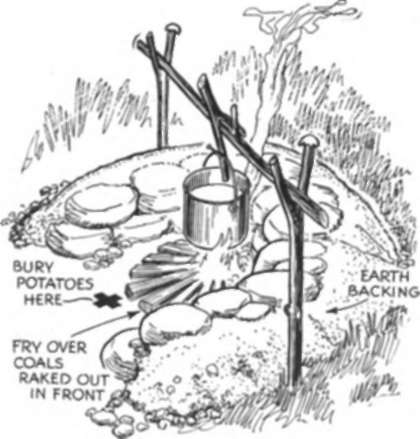
Not so elaborate, but efficient nevertheless.
Always build a camp fire out in the open, away from low-hanging limbs. Even green leaves and twigs can gradually dry under heat, and turn into tinder. Then a tongue of flame may ignite them, and a blaze envelop the whole tree before you can do anything about it. But if in spite of your precautions, a fire gets beyond your control, make haste to get in touch with the nearest fire warden -your map should show where he is stationed in your vicinity.
All this is precautionary, but very important. When you have the proper respect for fire you won't have trouble with it.
Here are some hints about camp fires which may help you on your next trip. First, be sure of an unfailing supply of dry matches, by carrying a pair of waterproof (not merely dampproof) match cases, each well filled with strike-anywhere matches. These cases should be simple, without any trick opening or cover devices, and should be easy to open even when your hands are numb from cold or slippery with rain. If the case lid is hexagonal in shape you can open it easily even with mittens on. As an added precaution, glue a piece of sandpaper to the underside of each box lid; then you'll be sure of a dry striking surface. Carry one of the cases buttoned into a pocket so that it couldn't fall out even if you stood on your head; pack the other away in your duffel as a reserve. Don't depend on safety or paper matches even if you carry them-water ruins them quickly and permanently.
Matches may be treated by a camper at home before he starts on his trip, to make them burn longer, to burn even in a brisk wind, and to resist dampness. One treated match may do the work of two or three ordinary ones. Preparing them is easy; just dip half of the match stick (including the head) in shellac, collodion, nail polish, model-airplane cement, or melted paraffin.
One of the best and most popular fire starters is a piece of thick candle. Light it and set it under a heap of finely shredded kindling until the fuel catches. Some campers carry a tightly covered tin filled with kerosene-soaked sawdust with which to start fires. Any of these aids is better than old camera film or pieces of celluloid because they burn steadily and for a longer time.
Continue to:


My Books

