


Reflection And Refraction
Description
This section is from the book "Boy's Fun Book Of Things To Make And Do", by Grosset & Dunlap Publishers. Also see: The Pocket Dangerous Book for Boys: Things to Do.
Reflection And Refraction
Why light is bent as it passes from one medium into another can be illustrated by a simple mechanical stunt Spread a thin layer of salt sugar, or fine sand in a strip across a smooth board, as shown in the photos at right and let it represent glass, water, or some other refracting medium. Then use a pair of wheels and an axle from a toy wagon to represent a ray of light.
Now tilt the board slightly so the wheels will roll down at right angles to the strip of salt They will continue across in a straight line. Let them roll obliquely, however, and the wheel that reaches the strip first will be slowed by the resistance of the salt and will swing downward from its line of travel. Then, when the second wheel hits, it also will be retarded. When the first wheel emerges from the salt it will swing back toward the original line and, by the time the second wheel clears the salt, they will be again traveling in the original direction. A dense medium similarly slows down and deflects a ray of light.

You can pipe light to any point by holding one end of a bent glass tube or rod against a hole in a mask over a lamp. Viewed anywhere except at its other end, the tube hardly appears luminous. How the light gets around the curve is explained by refraction, that is, by repeated reflections that so bend it at the surfaces between the glass and air that it can't escape. This is the principle of the recently developed piping of light through transparent plastic and glass bars for microscopic, industrial, and medical examinations.
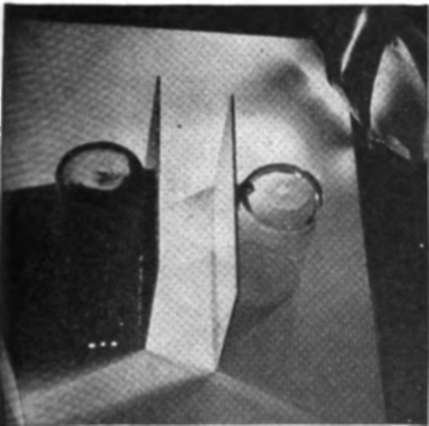
Two PARALLEL MIRRORS set up facing each other and with the ends staggered, as shown in the photo above, demonstrate the principle of piping light in a transparent tube, their opaque reflecting surfaces acting much the same as refraction does in the tube. Let light from a slit fall at an angle on the extended end of one of the mirrors. It will be reflected to the other mirror, and then, since it can't escape as long as the two mirrors face each other, it will be reflected back and forth between them until it reaches the open end, where it may be caught on a card that serves as a screen.

Continue to:


My Books

