


How To Put On A Chemical
Description
This section is from the book "Boy's Fun Book Of Things To Make And Do", by Grosset & Dunlap Publishers. Also see: The Pocket Dangerous Book for Boys: Things to Do.
How To Put On A Chemical
A white cloth and a blank piece of paper are transformed into a waving flag and a flaming motto in a bit of chemical magic that makes a stirring patriotic finale for a scientific program at your home, school, or club.
WOULD you like to stage a program of chemical magic at your school assembly, at the church entertainment, or in your own home? Here are some sure-fire stunts around which you can build such a show.
"Dancing moth balls" provide an exhibit which you can stand at one end of your magic table, to mystify the spectators throughout the show. Without apparent cause, these balls repeatedly rise to the top of a liquid in a jar, hesitate there a moment, and drop to the bottom again. The secret is carbon dioxide gas which adheres to their surfaces and buoys them to the top, where it frees itself and permits them to drop again. Fill any tall glass with water and add a little sodium carbonate. Then drop in a few moth balls, and add, without stirring, a little tartaric acid. After the first violent bubbling, gas will continue to be generated invisibly.
A liquid which continually changes color may stand at the other end of the table, in a beaker which sits on a small electric hot plate, and is illuminated from behind. It is made by dissolving a few crystals of cobaltous chloride in denatured alcohol. Because the alcohol absorbs water from the crystals, the solution appears blue. If you now warm the solution a little, and add cold water, drop by drop, until the solution turns pink, it becomes an extremely sensitive indicator of changes in temperature. Warm it, and it becomes blue; cool it, and it changes back to pink. By having an assistant secretly turn on and off the heat in the hot plate, during your show, you can make the spectators imagine they are "seeing things" when the color changes.
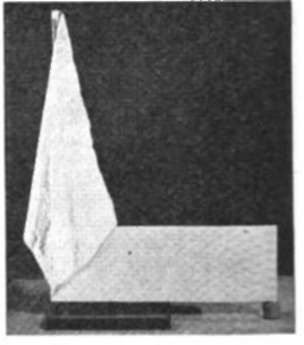
Borrow a small handkerchief from a member of your audience. Quickly dip it in a clear solution, wring it a little and, while holding it away from you with a pair of pliers or tongs, light it with a match. The handkerchief blazes fiercely, flames rising a foot in the air. The lender is certain his handkerchief is gone. When the flame show burns out, however, the handkerchief is found to be as good as ever-unburned and even unscorched!
The liquid is merely rubbing alcohol mixed with an equal volume of water. Wet the handkerchief thoroughly with it. When the handkerchief is lit, the alcohol vapor burns, while the water keeps the cloth below burning temperature. If your table is inflammable, burn your cloth over a pan or dish, to catch it if it should drop accidentally.
After handing back the handkerchief to its surprised owner, you pull out another one from your own pocket-this time a blue one. Show everyone its color. Then crumple it in your cupped hands and blow your breath through it a minute. Open your hands again, and the handkerchief is white.
Again, cobaltous chloride is the secret of the color change. Make a weak solution of the crystals in plain water, and soak a small, thin handkerchief in it. If you now dry the handkerchief carefully over heat, its color will be bright blue-the color of the dehydrated crystals. Slight moisture, however, as from your breath, will turn it back to an extremely pale pink, which is practically white. The change may be repeated endlessly.
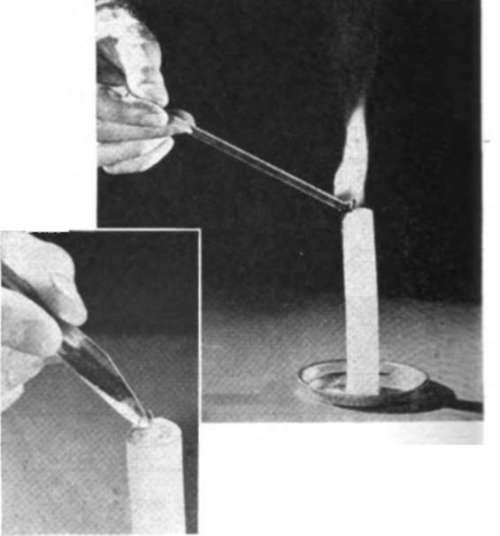
You can appear to light a candle with a glass rod, by first piling a little mound of a mixture of powdered potassium chlorate and powdered sugar around the wick. Prepare only a very small quantity of this mixture at a time. Do not rub or grind the ingredients together, but mix them gently, as the friction of rubbing might ignite them spontaneously. You now light the candle merely by touching the mixture with a glass rod that has a drop of strong sulphuric acid clinging to its tip. The acid extracts water from the sugar, leaving hot charred carbon which bursts into flame with the oxygen liberated by the potassium chlorate.


"Dancing moth balls" mysteriously rise to the top of a jar of water, then sink again. Carbon dioxide bubbles generated in the water are the explanation.
A stunt in which smoke seems to be blown into sealed and covered drinking glasses is puzzling to the layman. The magician produces two empty glasses, places them mouth to mouth, and covers them with a cloth. He then blows smoke from a cigarette, or a piece of burning paper, toward the glasses. A moment later he uncovers the glasses, lifts off the top one, and a cloud of smoke billows forth.
The smoke is, of course, generated inside the glasses. Before the trick, a few drops of hydrochloric acid are poured into one glass and a few drops of strong ammonia into the other. Rotate each glass to distribute the liquid in a thin film over its inside surface, and pour out any excess. Keep the glasses as far apart as possible before the trick is performed, and finally bring them together quickly, as the reaction is almost instantaneous. The fumes of the two substances form a fine precipitate of ammonium chloride, which resembles white smoke.
"Smoke" appears inside two covered glasses. Ammonia in one and hydrochloric acid in the other react to form ammonium chloride.

To "make the lady blush," obtain a portrait and paint the cheeks carefully with a little phenolphthalein dissolved in alcohol. Just before you attempt the trick, dampen the cheeks again by spraying with a little water from an atomizer. To carry it out, let several members of your audience compete with each other in telling the lady stories. When someone tells a particularly good one, hold a finger that has been dipped in strong ammonia in such a position that the fumes will contact the moistened cheeks. Immediately they turn pink, owing to the reaction of the alkaline ammonia with the phenolphthalein.
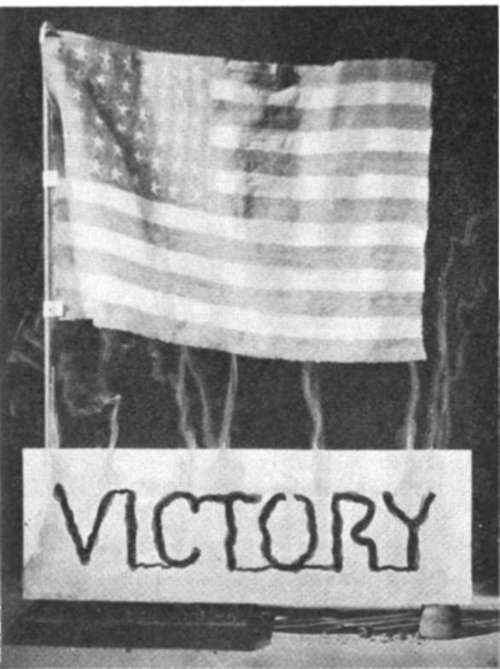
For a patriotic finale, you can change a white piece of cloth into an American flag. Outline lightly a flag on a piece of cloth, and fill in the red stripes with a strong solution of potassium thiocyanate, and the blue field with a solution of potassium ferrocya-nide. By spraying this cloth from behind with an atomizer filled with a solution of iron chloride you can make the colors come forth vividly.
"Making the lady blush." If a good story is told, the cheeks of the girl in the photograph turn crimson! The picture is prepared by painting the cheeks with a phenolphthalein solution. If the finger is moistened with strong ammonia and held near the picture, the cheeks turn red. The color vanishes as the ammonia evaporates
Lighting a candle by touching the wick with a glass rod. Prepare the candle by rubbing into the wick some powdered sugar mixed with powdered potassium chlorate and piling a little more around it, as in the inset below. Light by touching it with a rod to which clings one drop of sulphuric acid
You can couple this flag appearance with some word outlined in fire. The word should be written on a piece of heavy paper, with a strong solution of potassium nitrate in water, and allowed to dry thoroughly. You may ask the audience to suggest a word, having a stooge call out the one you have already written. When you touch a lighted cigarette or match to the writing, the letters will burn, outlining the word.
Continue to:


My Books

