


Radio Is Easy And Cheap To Build
Description
This section is from the book "Boy's Fun Book Of Things To Make And Do", by Grosset & Dunlap Publishers. Also see: The Pocket Dangerous Book for Boys: Things to Do.
Radio Is Easy And Cheap To Build
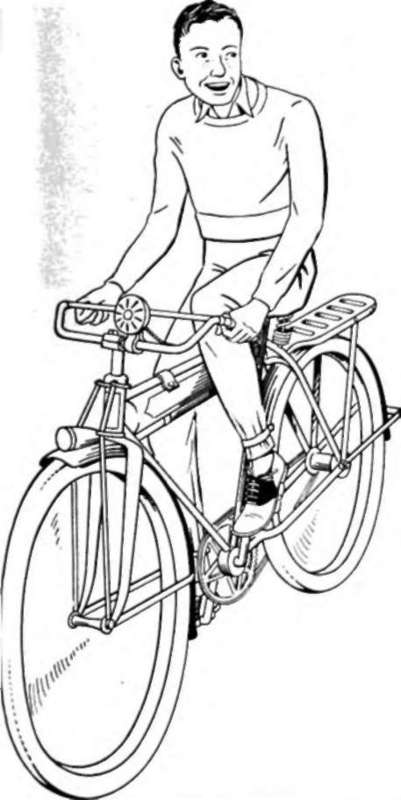
The bicycle frame provides excellent counterpoise capacity for this purpose.
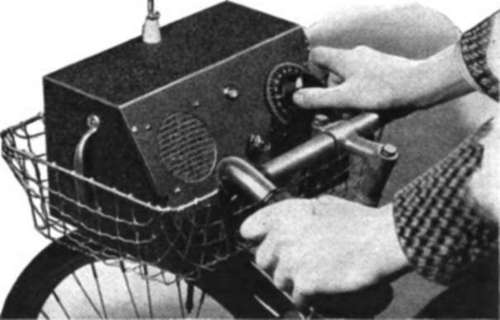
The steel cabinet used for housing the chassis and batteries measures 61/2" by 7" by 11" and is small enough to fit inside a standard-size bicycle luggage basket The panel is attached to the cabinet by means of self-tapping screws. The two "B" batteries that fit inside the cabinet along the back are the new small-size portable type employing the special flat cells with expanding seals. A 11/2 -volt "A" battery fits in between the two "B" batteries, with the .41/2-volt "C" battery directly in front of it. The "A" and "B" batteries are of the plug-in type and use clip-in plugs with Fahnestock terminals. This system makes it an easy matter to change batteries whenever necessary.
In order to obtain ample volume from the speaker, two stages of audiofrequency amplification are used after the detector. Both stages are resistance-coupled and use the latest-type tubes for maximum sensitivity. Type 1N5GT tubes are used in the radio-frequency, detector, and first audio-frequency stages. A beam power tube, 1T5GT, is used in the output stage, and provides a relatively high output with a very low filament drain.
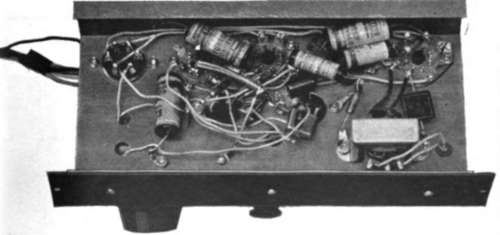
A 15,000-ohm, %-watt resistor is used in the grid circuit of the first audio tube. Any increase in value of this resistor will only cause instability and will fail to halt's as easy to tune as a car radio. View below shows the parts underneath the chassis crease the amplification. Volume is controlled by a 100,000-ohm potentiometer placed in the screen circuit of the radio-frequency tube.
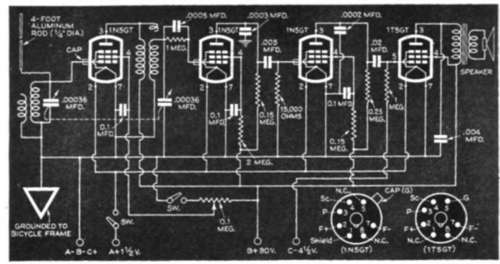
These circuit and tube-socket diagrams should be followed to the letter in constructing the set.
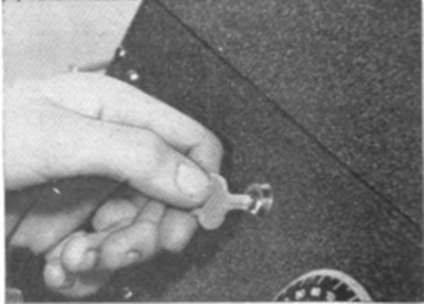
The key-lock switch is of the double-pole, single-throw type and breaks two circuits at one time, the positive "A" supply and the ground lead of the volume control. This is done to avoid any drain through the "B" supply while the set is turned off.
As a safety measure, it is a good idea to lock the set in the basket or to the bicycle frame. The key switch prevents any one else from turning on the set.
List Of Parts
Midget 2-gang tuning condenser, .00036 mfd.
Shielded antenna coil. Shielded radio-frequency coil. Volume control, 100,000 ohm. Output transformer. Carbon resistor, watt, 15,000 ohm. Two carbon resistors,1/2 watt, 150,000 ohm.
Carbon resistor, 1/2 watt, 250,000 ohm. Two carbon resistors, 1/2 watt, 1 meg. Carbon resistor, 4 watt, 2 meg. Mica condenser, .0002 mfd. Mica condenser, .0003 mfd. Mica condenser, .0005 mfd. Mica condenser, .004 mfd. Tubular condenser, .005 mfd., 600 volt. Tubular condenser, .02 mfd., 600 volt. Three tubular condensers, .1 mfd., 600 volt.
Miscellaneous: tubes. four octal wafer sockets, three bantam-tube shields, six-prong speaker plug and wafer socket, key switch, six-way battery cable, batteries, 3" p.m. speaker, cabinet, chassis, antenna, 3" dial, etc.
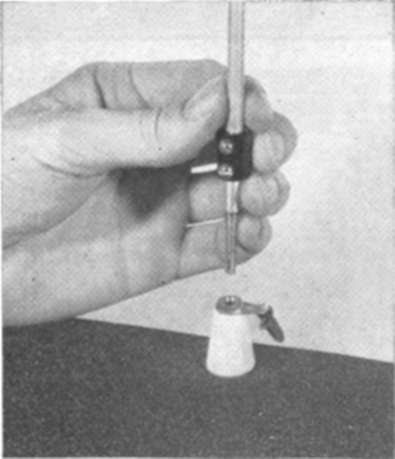
The antenna rod is set in a ceramic insulator atop the cabinet. Right, a key turns on the set.
Continue to:


My Books

