


Keeping Your Bicycle Fit. What To Do Every 200 Miles. Clean Off Dirt
Description
This section is from the book "Boy's Fun Book Of Things To Make And Do", by Grosset & Dunlap Publishers. Also see: The Pocket Dangerous Book for Boys: Things to Do.
Keeping Your Bicycle Fit. What To Do Every 200 Miles. Clean Off Dirt
Check coaster-brake action Inspect chain for weak links Oil and check adjustment of: wheel bearings pedal bearings crank bearings steering-fork bearings chain
Examine wheels for loose spokes Check height of saddle and handle bars
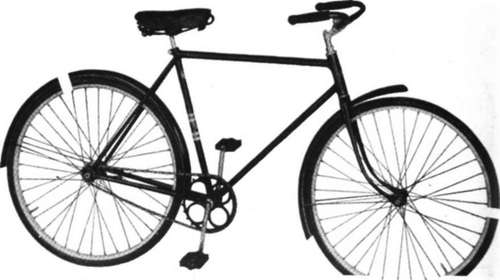
RECENT shortages of gasoline and rubber turned America once more to the bicycle for essential transportation as well as healthful fun. Thousands of men and boys have found cycling a pleasurable sport, a dependable means of travel, and a form of exercise neither too mild nor too strenuous -a revival of a youthful interest that bids fair to retain its adult popularity for many years.
Tremendous potential mileage is built into the modern bicycle; yours should render trouble-free service almost indefinitely if it is properly cared for and the few parts that wear out are replaced.
An adequate maintenance program must include regular cleaning, oiling, and adjustment every 200 miles or every month, whichever interval ends first. The pedal, wheel, crank, and head bearings should be given a few drops of light motor oil. If the coaster brake slips, run a few drops of kerosene into the oil cup in the rear hub and spin the wheel a few times by hand. Follow with a drop or two-no more-of light motor oil. Don't use thin sewing-machine oil.
Test the spokes when making your periodical inspection. Any loose ones should be tightened with a special wrench that fits the nipples in the rim. Take care, however, not to warp the wheels out of line. Rotate each, noting whether the rim runs true in the fork. Rims can be trued by tightening or loosening alternate spokes, but all spokes should be reasonably taut when you're through. It is often best to leave spoke adjustment to a bicycle repair man.
Inspect the chain, replacing weak or damaged links with "master" or snap-on links. A chain break on the road can throw the rider and damage the rear wheel assembly. With a stiff brush and kerosene, remove grit and dirt from the
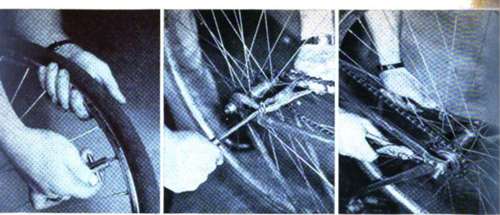
Rear Wheel
Tighten loose spokes with a special nipple wrench, then spin the wheel slowly to see that it runs true, tightening and loosening alternate spokes until all rim "wobble" is gone. To take off the wheel, remove the bolt securing the coaster-brake arm, then loosen the axle nuts and back off the tension screw, slide the wheel forward in the slotted fork, and take the chain off both sprockets.
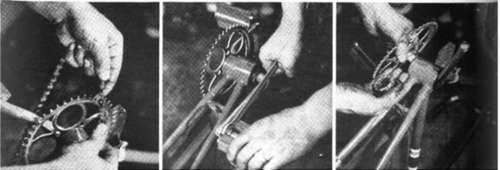
Driving Mechanism
Locate the master or snap-on link and hold it as at the left below. Bend it to compress the side nearest you. The cover plate can then be lifted off. Clean the chain, examine for faulty links, and lubricate it. Also inspect the sprocket teeth. Remove the crank by taking off the left pedal first, then the crank lock nut, keyed washer, and cone (all have left-handed threads). To maneuver the crank bend through the hanger, hold the ball retainer against its cone. Clean and grease.
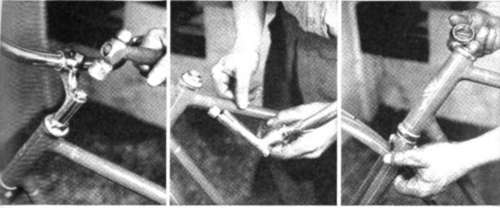
Steering Head
For periodical cleaning and greasing of the head bearings, unscrew the expansion bolt in the stem extension about w", tap it gently with a hammer to loosen the wedge nut, and then lift out the handle-bar assembly. The tapered wedge nut (center photo) has flanges which fit the expanding slot. Take off next the head lock nut, keyed washer, and cone, and slide the fork and stem down and out chain; then run oil along the sideplates of each link. When the links work freely, wipe off excess oil; too much will collect grit, which will eventually work into internal bearing surfaces.
An ideal method of lubrication is to work small amounts of oil into the inside link bearings and rub stick graphite on the sprocket teeth and chain rollers. Stick graphite alone will not suffice, as it cannot penetrate to the inside bearing surfaces. Oil alone, however, is quite satisfactory.
If the chain is very gritty or caked with mud, remove it and soak it in kerosene. Then dip it into an oil bath, working it back and forth until the oil has penetrated the rollers. Wipe off the excess.
Before replacing the chain, sight along the sprockets, to see whether they are in alignment. If sprocket teeth are badly worn, the sprockets should be replaced, particularly if a new chain is to be installed.
Replace the chain and adjust it by turning the long, square-headed screw that bears against the axle. With the top of the chain taut, the lower half should sag no more than Turn the crank slowly, feeling the chain to be sure there are no tight spots, for if it is slack in one position, tight in another, uneven wear is indicated and both chain and sprockets may have to be replaced. Sight again with the chain in place to make sure it tracks properly.
Bearing cones in the hubs, pedals, crank hanger, and head should be checked regularly for free running without binding or wobbling. Attention to bearings pays dividends in long service. The rear-wheel adjustment cone is always on the left side. If dust and grit have worked into a bearing, place it with its axle vertical, back off the cone, and pour in kerosene, revolving the part slowly until the dirt is washed out at the other end.
Front Wheel
To remove this wheel, simply loosen the axle nuts (or remove them if there is a mud guard) and lift it out of the slotted fork. Unscrew the cone with care, paying particular attention to the way the ball-bearing retaining rings face, for replacing them backwards will cause damage. To keep from dropping the balls, stand the wheel straight, withdraw the axle with one hand, and catch the retainer on the other side with the other. Some bikes have no retainer here, and require greater care
Continue to:


My Books

