


How Soap-Box Champions Build Their Racers
Description
This section is from the book "Boy's Fun Book Of Things To Make And Do", by Grosset & Dunlap Publishers. Also see: The Pocket Dangerous Book for Boys: Things to Do.
How Soap-Box Champions Build Their Racers
Important Hints on Building Frames, Wheels, Brakes Steering Gears and Bodies

Bob Ballard, one of the national and international champions.
A SOAP-BOX RACER must be safe and speedy. That these qualities can be obtained in a variety of ways is illustrated by the cars of champions who for several years past have gathered annually at Akron, Ohio, to compete for national and international honors. Attention to little details-to almost insignificant things that may affect running time only 1/10 of a second-spells the difference between victory and defeat.
Highly important are the wheels and axles. Perfect wheel balance is desirable.

Wheel brakes are not as easy to make as the drag type shown in the accompanying sketches, but one shown here is a good design, with a leather-faced shoe for each rear wheel.
This can be attained either by selecting the most evenly running wheels from a large assortment, or by changing the weight distribution by some method such as drilling; holes.
Camber, or tilting the wheels so that the tread or distance between them is less at the bottom than at the top, is important. Best speeds usually result when front wheels are tilted in 1/4" from the perpendicular at the bottom, and rear wheels Weight of the driver and the forces that act when the car is coasting cause the wheels to straighten to a vertical position, where tire drag is the least.
Wheels should run true. The most popular wheels seem to be rubber-tired disks equipped with roller bearings. Lubricants used have a marked effect on the performance of such wheels. The manufacturer of a widely-used disk wheel recommends one of the three following lubricants: (1) SAE 10 automobile engine oil alone. (2) SAE 10 oil plus an equal volume of oil of the same viscosity containing colloidal graphite. (3) Castor oil alone.
A number of high-placing cars at a recent derby were lubricated with special non-friction oil. Such oil, very free-running and durable, is a type normally used for breaking in close-fitting parts of automobile and aviation engines.

Shown here it a typical steering gear with drum and pulleys. While a good design, rules for the national championship races some years do not permit chain or rope for steering, but only wire cable.
Before a recent final event, 12-year-old Bob Ballard, of White Plains, N. Y.( a national and international champion, removed the wheels of his racer, cleaned the bearings, and then lubricated them with a high-grade household machine oil of a standard make that is available in practically every hardware and ten-cent store in the country.
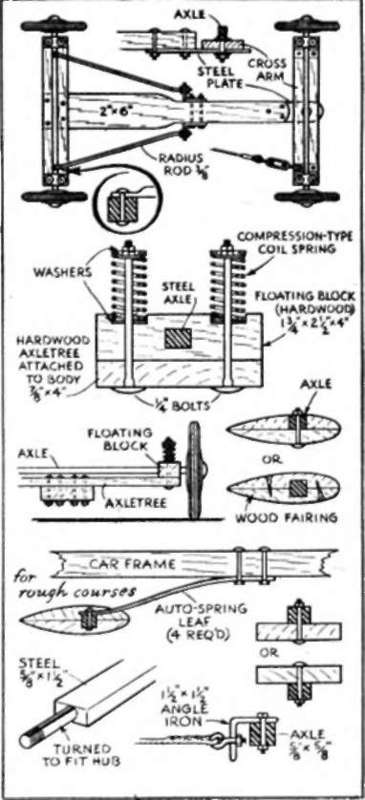
Axles generally are made of steel rods, pipes or bars which are either* self-supporting, fastened to axletrees, or unclosed in streamline fairing. Rigidity is important. An axle that springs or bends too much under the weight of the driver and the shocks of the course is, besides being unsafe, likely to slow down the car by allowing the wheels, to spread and produce drag. When the wheels are to be given a definite camber, this can be accomplished by bending the axles the required amount downward at the outer ends, or washers can be inserted between axle and axletree.

Axle design that uses coil-spring suspension.
From the standpoint of strength, an axle measuring about 1/2 by 11/2 inches in cross section is preferable to one only 1/2 inch square, or if round, having a diameter of 1/2 inch or so. Practically all of the championship contestants who used the smaller axles reinforced them with fairing or some other means. No matter what the shape, axles preferably should be of strong alloy steel rather than ordinary cold-rolled shafting or soft iron rod.
Easy, positive steering is essential to good performance. Most popular with soap-box drivers seems to be the drum-and-cable system. Basically it consists of a drum with square or circular cross section, fastened securely to a metal steering wheel shaft, and with a steel cable wound about it and attached to the ends of a pivoted front axle. Two 2-by-4's clamped around the shaft will make a suitable drum, and it is a simple matter to whittle or chop them to a cylindrical form.
One secret of easy steering is to use securely mounted, free-running and properly aligned pulleys. Designs involving as few pulleys as possible are the best. Keep the cable taut with the aid of a turnbuckle. Less steering effort is required to hold the car straight if coil springs (large screen-door springs will do) are attached between the axle ends and frame, and their tension adjusted to hold the axle automatically in the straight-ahead position.
The steering wheel should be of a size and shape that is easy to grasp. A common hazard is an exposed nut and shaft end. Pad the center of your steering wheel with a rubber disk or button or a smooth metal plate.
Brakes apparently receive much attention, although they occupy secondary positions in actual performance. Bob Ballard had just about the most effective brake in a recent year's collection. It was of the dragging-bar type and operated through a caster arrangement manipulated by a cable attached to a hinged footboard. A pressure of 25 pounds on the board would raise the rear wheels of the car clear of the ground. It has been calculated that, weight for weight, this racer had brakes three times as effective as those on present-day automobiles.
If wheel brakes are used, they should be applied against both rear wheels, but be operated by a single pedal or brake handle.
It is probable that no two frames of soapbox racers are exactly like. There are numerous and novel designs. One consists principally of a streamline base resembling in shape a section cut from an airplane wing, on which the body rests. This base is built up by fastening together several thicknesses of 3/4- or 7/8-inch boards of oak or other suitable wood. Glue, bolts, nails or screws can be used. Any necessary axle slots and holes are cut before the boards are fastened together.
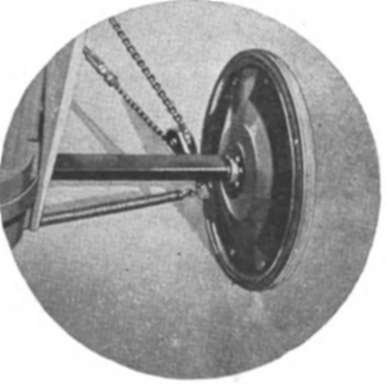
Steering system with pulleys attached to axle.
Axle Construction
Very flexible springs will permit the body to rock too much. Many soapbox courses are so smooth that highly elastic springs are of no advantage.
In coasting down the derby track at Akron, the soap-box cars attain a maximum speed of something like 38 miles per hour (average for course, about 28 m.p.h.). At this speed, the effect of wind is considerable, and streamlining becomes a useful feature.
It is perhaps significant that no car showing really good time in a recent race was equipped with a bulky windshield of celluloid or similar material.
A great many types of body construction can be used. One unusual body was made by spreading a plastic composed of sawdust and flour paste over a metal lath form. The mixture consisted of about one part flour and five parts sawdust. Surface irregularities were smoothed by applying gypsum

Cockpit of the car with the horse-shoe shaped frames. These are covered with wooden ribs and canvas.
Continue to:


My Books

