


Mensuration. Part 2
Description
This section is from the book "The Building Trades Pocketbook", by International Correspondence Schools. Also available from Amazon: Building Trades Pocketbook: a Handy Manual of reference on Building Construction.
Mensuration. Part 2
Circle
A m area, ╥ {pi) = 3.1416.
╥/4= .7854 p = perimeter or circumference.
p = ╥d = 3.1416 d.
p = 3 1/7 d (approximately).
p = 2╥r = 6.2832r.
d = P/╥ = p/3.1416 d = 7/22 p (approximately). d = l.l28√A r=p/2╥ = p/6.2832 r = .5642√A
A =╥d2 = .7854d2.
A = ╥r2 = 3.1416 r2.

Side of square of area equal to circle = .8862 d. Diameter of circle of area equal to a given square = 1.128 X side.

Ring
Area = .7854(D2 -d2).
Sector
If radius r and rise h are known, chord c

If chord c and rise h are known,
radius r =(c2 + 4h2)/8h
Approximately, r = c2/8h.
Subchord e =

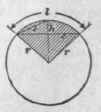
If h is not more than .4 c, length of arc l= (8e-c)/3, nearly. If l and r are known,
Angle E* = 57.296(l/r),
= 57.3(l/r), nearly.
Area = 1/2 lr.
If r and angle E* are known.
length l=Er/57.296=Er/57.3, nearly.
= .0175 Er. Area = .0087r2E.
Segment
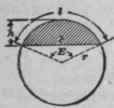
Area of segment = area of sector - area of triangle.
Height of triangle = r - h. If I, r, c, and h are known,
Area = 1/2 lr - 1/2 c(r- h). If c, h, r, and E are known, find I as shown under Sector; the area may then be found by the preceding formula.
Ellipse

Area = .7854 Dd.

*If the angle E contains minutes and seconds, these must be expressed in decimals of a degree. Divide the minut-60, and the seconds (if any) by 3,600, and add the sum of the decimals to the degrees; thus. 30°45'36"= 30° + 45/60 + 36/3600 =30.76°. If E is given in degrees and decimals, it may be reduced to minutes and seconds thus, .76°= .76° X 60' = 45.6'; .6' X 60" = 36"; hence, 30.76° = 30° 45' 36".
† The perimeter of an ellipse cannot be exactly determined, and this formula is merely an approximation giving fairly close results.
Helix
d = diameter of helix;
I = length of 1 turn of helix; t = pitch, or rise in 1 turn; n = number of turns;
╥2= 9.8696.
I =  t =
t = 
Total length = nl = 

Continue to:


My Books

